
Phillip II, the Habsburg King of Spain, …
Years: 1588 - 1599
May
Phillip II, the Habsburg King of Spain, sends a great Armada in 1588 to crush the English rebellion against Papal Authority, but the mission fails to conquer Englands: the English secure the Church of England with their defeat of the Spanish Armada in the Battle of Gravelines.
Francis Walsingham’s network of spies in the European capitals provides him with advance knowledge of the impending attack of the Spanish Armada.
The English victory marks the beginning of British naval superiority.
Spain continues her two-front war with England and the United Provinces.
Elizabeth I, Queen of England from 1558 to 1603, apparently inherited her red tresses from her father, Henry VII, as her mother, Anne Boleyn, seems to have been a brunette.
Also called The Virgin Queen, or Good Queen Bess, she reigns during the period, often (and justly) called the Elizabethan Age, when the small island kingdom asserts itself vigorously as a major European power in politics, commerce, and the arts.
Known for ordering the execution of her royal cousin Mary, Queen of Scots, as well as a few former favorites like Sir Walter Raleigh and the rebellious Earl of Essex, Elizabeth never marries.
Shrewd, courageous, and a master of self-display, she transforms herself into a powerful and enduring image of female authority, regal magnificence, and national pride.
Given her seventy-year life span, she has undoubtedly enhanced her natural color with dye in her later years, but that has long been the prerogative of any natural redhead.
The period after the defeat of the Spanish Armada in 1588 brings new difficulties for Elizabeth that are to last the fifteen years until the end of her reign.
The conflicts with Spain and in Ireland drag on, the tax burden grows heavier, and the economy is hit by poor harvests and the cost of war.
Prices rise and the standard of living falls.
During this time, repression of Catholics intensifies, and Elizabeth in 1591 authorizes commissions to interrogate and monitor Catholic householders.
To maintain the illusion of peace and prosperity, she increasingly relies on internal spies and propaganda.
Mounting criticism in her last years reflects a decline in the public's affection for her.
One of the causes for this "second reign" of Elizabeth, as it is now frequently called, is the different character in the 1590s of Elizabeth's governing body, the privy council.
A new generation is in power.
With the exception of Lord Burghley, the most important politicians had died around 1590: The Earl of Leicester in 1588, Sir Francis Walsingham in 1590, Sir Christopher Hatton in 1591.
Factional strife in the government, which had not existed in a noteworthy form before the 1590s, now becomes its hallmark.
A bitter rivalry between the Earl of Essex and Robert Cecil, son of Lord Burghley, and their respective adherents, for the most powerful positions in the state marred politics.
The queen's personal authority is lessening, as is shown in the affair of Dr. Lopez, her trusted physician.
When he is wrongly accused by the Earl of Essex of treason out of personal pique, she cannot prevent his execution, although she had been angry about his arrest and seems not to have believed in his guilt.
This same period of economic and political uncertainty, however, produces an unsurpassed literary flowering in England.
The first signs of a new literary movement had appeared at the end of the second decade of Elizabeth's reign, with John Lyly's Euphues and Edmund Spenser's The Shepheardes Calender in 1578.
Some of the great names of English literature enter their maturity during the 1590s, including William Shakespeare and Christopher Marlowe.
The English theater during this period and into the Jacobean era that is to follow reaches its highest peaks.
The notion of a great Elizabethan age depends largely on the builders, dramatists, poets, and musicians who were active during Elizabeth's reign.
They owe little directly to the queen, who was never a major patron of the arts.
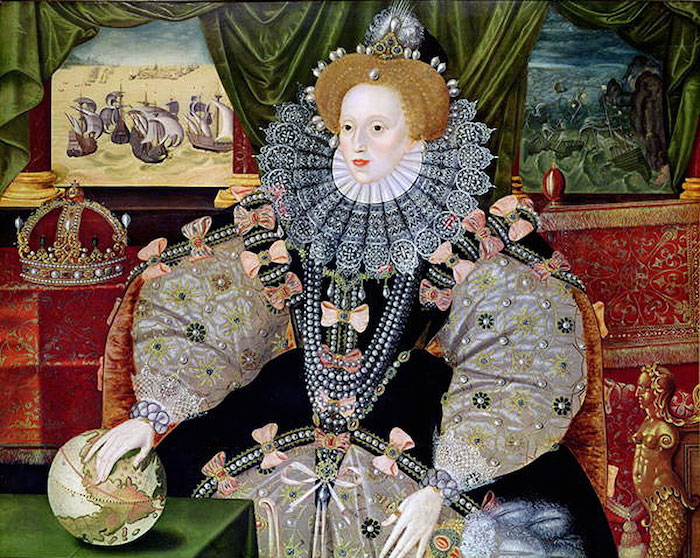
Anonymous. Formerly attributed to George Gower: Portrait of Elizabeth to commemorate the defeat of the Spanish Armada (1588), depicted in the background. Elizabeth's hand rests on the globe, symbolizing her international power.
Locations
People
- Christopher Marlowe
- Elizabeth I
- Philip II of Spain
- Robert Cecil
- Robert Devereux
- Walter Raleigh
- William Shakespeare
Groups
- Red-haired people
- Christians, Roman Catholic
- England, (Tudor) Kingdom of
- Protestantism
- Ireland, (English) Kingdom of
- Spain, Habsburg Kingdom of
Topics
- Protestant Reformation
- Counter-Reformation (also Catholic Reformation or Catholic Revival)
- Baroque Literature
- Baroque music
- “Renaissance, English”
- Elizabethan Period
- Eighty Years War (Netherlands, or Dutch, War of Independence)
- Anglo-Spanish War of 1585-1604
- Spanish Armada, Defeat of the
Commodoties
Subjects
- Commerce
- Writing
- Watercraft
- Performing Arts
- Labor and Service
- Fashion
- Conflict
- Faith
- Government
- Technology
- Movements
Regions
Subregions
Years: 1588 - 1599
May
Anonymous. Formerly attributed to George Gower: Portrait of Elizabeth to commemorate the defeat of the Spanish Armada (1588), depicted in the background. Elizabeth's hand rests on the globe, symbolizing her international power.
Locations
People
- Christopher Marlowe
- Elizabeth I
- Philip II of Spain
- Robert Cecil
- Robert Devereux
- Walter Raleigh
- William Shakespeare
Groups
- Red-haired people
- Christians, Roman Catholic
- England, (Tudor) Kingdom of
- Protestantism
- Ireland, (English) Kingdom of
- Spain, Habsburg Kingdom of
Topics
- Protestant Reformation
- Counter-Reformation (also Catholic Reformation or Catholic Revival)
- Baroque Literature
- Baroque music
- “Renaissance, English”
- Elizabethan Period
- Eighty Years War (Netherlands, or Dutch, War of Independence)
- Anglo-Spanish War of 1585-1604
- Spanish Armada, Defeat of the
Commodoties
Subjects
- Commerce
- Writing
- Watercraft
- Performing Arts
- Labor and Service
- Fashion
- Conflict
- Faith
- Government
- Technology
- Movements
Regions
Subregions