Philipp Jakob Spener, a leading figure in …
Years: 1691 - 1691
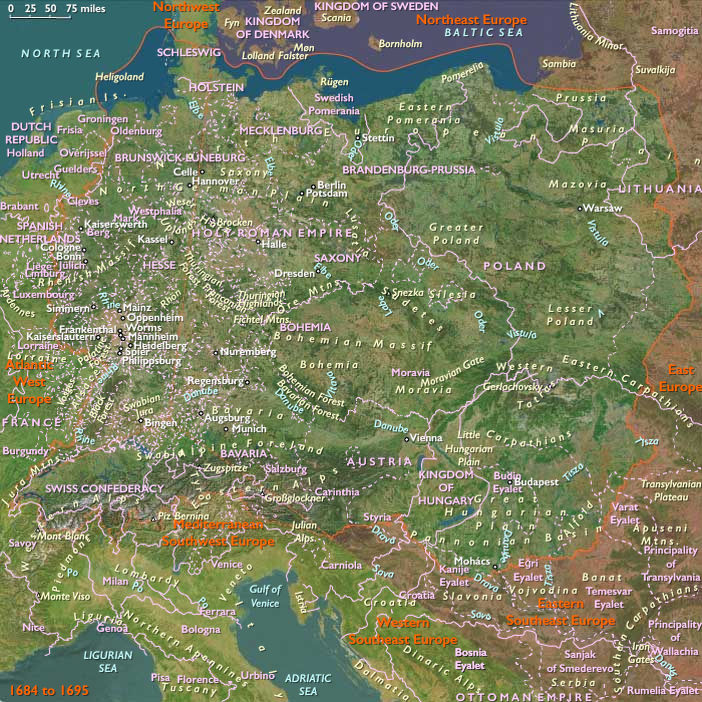
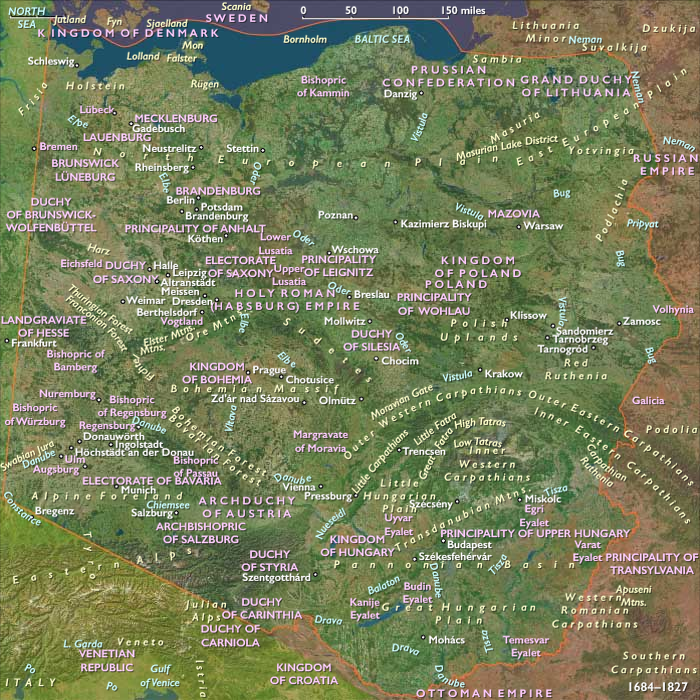
Philipp Jakob Spener, a leading figure in German Pietism, a movement of spiritual renewal among Protestants that stresses personal improvement and upright conduct as the most important manifestations of Christian faith, in 1686 had been made first court chaplain at Dresden, the most valued position in the German Lutheran Church, but his views soon aroused opposition.
Attacks upon Pietism, which is a reaction to the doctrinal preoccupation of contemporary Lutheranism, come from the orthodox Lutherans at the University of Leipzig and from the Saxon court, whose elector, John George III, had been rebuked by Spener for drunkenness.
Spener consequently moves in 1691 to ...
Locations
People
Groups
Subjects
Regions
Subregions
Related Events
Filter results
Showing 10 events out of 29247 total
Austria, having become deeply involved in the War of the Grand Alliance with France, does not press against the Turks, and thus an unfixed border ensues for more than five years.
The aim of King John III Sobieski of the Polish-Lithuanian Commonwealth has been to liberate Moldavia and Wallachia (present-day Romania) from Ottoman rule and to expand the Commomwealth's influence to the shores of the Black Sea, but his advances into Moldavia, undertaken between 1684 and 1691, have been mostly failures, and during the last one he had even been in danger of being captured.
Despite his previous victories, he is thus not able to achieve his objective.
...Berlin to become provost of St. Nicholas' Church.
Here he gains from the Brandenburg-Prussian court the support that enables him to carry out numerous reforms.
The trials of the thirty-six conversos have lasted three years and the cohesion of the group has been weakened by a strict regime of isolation, which has prevented any joint action, together with a perception of religious defeat due to the impossibility of escape.
The four autos-da-fé of 1691 are the bloodiest in the history of the Inquisition on Majorca.
The Inquisition condemns seventy-three people, of whom forty-five are turned over to the civil authorities to be burnt, five burnt in effigy; three already deceased have their bones burned, thirty-seven are effectively punished.
Most of the convicted had elected to affirm their Christian faith and thus are punished with a relatively “mild” execution—decapitated before being burned at the stake but three—Rafel Valls and the brothers Rafel Benet and Caterina Tarongí—refuse to deny their Jewish faith and are burned alive.
Thirty thousand people attend.
With the trials of 1691 come the end of the Crypto-Jewry of Majorca, the effect of the escape of the leaders, the devastation of the mass burnings, and the generalized fear having made it impossible to sustain the ancestral faith.
It is after these events, we can begin to actually speak of the Xuetes, or Chuetas (“lard” in the local language).
To publicly humiliate the condemned Jews, the Sanbenitos are hung out with the names of the condemned persons in the monastery of San Domingo, which effectively stigmatizes these families and relegates them to a lower class within society.
These families are ostracized to the point that they only can marry within their own group, a situation that is to continue until modern times.
The fifteen surnames of the Chuetas are Aguiló, Bonín, Cortès, Forteza, Fuster, Martí, Miró, Picó, Pinya, Pomar, Segura, Tarongí, Valentí, Valleriola and Valls.
At the end of the eighteenth century, the Chuetas will finally be liberated from nearly all legal sanctions, but they doubtless continued to suffer social isolation and discrimination, maintaining an intermarriage rate of only about five percent.
The sentences dictated by the Inquisition included other penalties that were to be maintained for at least two generations: those in the household of the condemned, as well as their children and grandchildren, could not hold public offices, be ordained as priests, marry persons other than Xuetes, carry jewelry or ride a horse.
These last two penalties do not appear to have been carried out, although the others are to continue in effect by the force of custom, beyond the two generations stipulated.

Michel Rolle, who had been elected in 1685 to join the Académie Royale des Sciences, is an early critic of calculus, arguing that it is inaccurate and based upon unsound reasoning.
The French mathematician is best known for developing Rolle's theorem in 1691, which essentially states that a smooth function, which attains equal values at two points, must have a stationary point somewhere between them. (A version of the theorem was first stated by the Indian astronomer Bhaskara in the twelfth century.)
Rolle also invents the notation to denote the nth root of x, which is to remain the standardized form.
Joseph Parrocel was born in Brignoles, into an artistic family that produced fourteen painters over six generations.
His grandfather Georges Parrocel (1540 to about 1614) (no surviving works) and his father Barthélemy Parrocel (1595–1660) were both painters.
One badly restored painting of Bathélemy survives in the church of Saint-Sauveur in Brignoles, France.
His brothers Jean Barthélemy Parrocel (1631–1653) (no surviving works) and Louis Parrocel (1634–1694) also became painters.
Joseph was only thirteen years old when his father died in 1660.
His elder brother Louis, who was already established as a painter in the Languedoc, had taken him under his care and given him a training as painter.
Three years later, he had run away from his brother's house to Marseilles, where his talent as a painter had soon become noticed and he obtained a commission for a number of paintings with scenes of the life of Saint Anthony of Padua for the church Saint-Martin.
He only executed two of them; it is also possible that he painted them during his second stay in the Provence.
He left for Paris and stayed there for four years, perfecting his skills, and had then returned to Provence and continued his journey to Italy, where he stays for eight years.
In Rome, he became the pupil of Jacques Courtois, a famous painter of battle scenes who was also known as "le Bourguignon" or "il Borgognone".
He also studied the works of Salvator Rosa, an unorthodox proto-Romantic painter.
Parrocel worked with him in his workshop and was thoroughly influenced by him.
Parrocel then started a journey through Italy and finally arrived in Venice.
He was planning to settle in this town but had left Italy in disgust after eight brigands attempted to murder him on the Rialto Bridge.
Settling in Paris in 1675, he had earned himself a reputation.
Accepted as an elected member at the Académie Royale de Peinture et de Sculpture on February 29, 1676, he had become an academician on November 14, 1676 with his admission piece "Siege of Maastricht".
Michel Baron, the child of theatrical parents, had been orphaned at the age of 12 and joined the company of children known as the Petits Comédiens du Dauphin.
He had in 1670 joined the company of Molière, the master treating him like a son.
He later became a member of the company at the Hôtel de Bourgogne and subsequently of the newly formed Comédie-Française.
He has created many of the leading roles in Jean Racine's tragedies, besides those in two of his own comedies, L'Homme à bonnes fortunes (1686; “The Don Juan”) and La Coquette et la fausse prude (1687; “The Flirt and the False Prude”).
He retires in 1691 as the undisputed master of the French stage.
Nicholas Barbon, widely considered the founder of fire insurance, had studied medicine at the University of Leiden, received his M.D. at Utrecht in 1661, and became an honorary fellow of the College of Physicians in 1664.
The considerable part that he took in the rebuilding of London after the Great Fire of 1666 had apparently roused his interest in selling fire insurance, and about 1680 he set up an office in London for that purpose.
Barbon's writings on economics to some extent anticipate the conclusions of Adam Smith on the division of labor and the theory of currency as expounded by David Ricardo.
His works include Apology for the Builder; or, A Discourse Showing the Cause and Effects of the Increase of Building (1685) and A Discourse of Trade (1690).
Sir Josiah Child has made some important contributions to economics, especially Brief Observations Concerning Trade and the Interest of Money (1668) and A New Discourse of Trade (1668, 1690).
He views Dutch prosperity as deriving in part from a low-interest-rate policy and in part from a relatively liberal trade policy.
Because of this, he advocates a reduction in England's maximum rate of interest from six to four percent.
Child has a mercantilist preference for a large population and supports government relief for the poor and the unemployed.
He also advocates proprietary rights of trade between Great Britain and its colonies.
The son of a London merchant, Child had amassed a fortune as supplier of food to the navy; he also became a considerable stockholder in the East India Company.
His speeches and writings supporting the East India Company's claims to political power and its right to restrict any competition with its trade brought him to the notice of the other shareholders.
He became a director of the company in 1677 and was elected governor of the East India Company in 1681, serving in that post for most of the decade.
He was for a time virtually the sole decision maker for the company, directing policy as if it were his private business.
He was often openly accused of using the company to aggrandize his social, economic, and political position.
He received his baronetcy in 1678.
William Dampier and two shipmates had, by agreement, been marooned later in 1688 on one of the Nicobar Islands, where they had built a small craft and sailed it to Acheen (Aceh) in Sumatra.
After further adventures Dampier returns to England in 1691 via the Cape of Good Hope, penniless but in possession of his journals.