King Philip I …
Years: 1075 - 1075
King Philip I of France Incites Revolt in Brittany (1075)
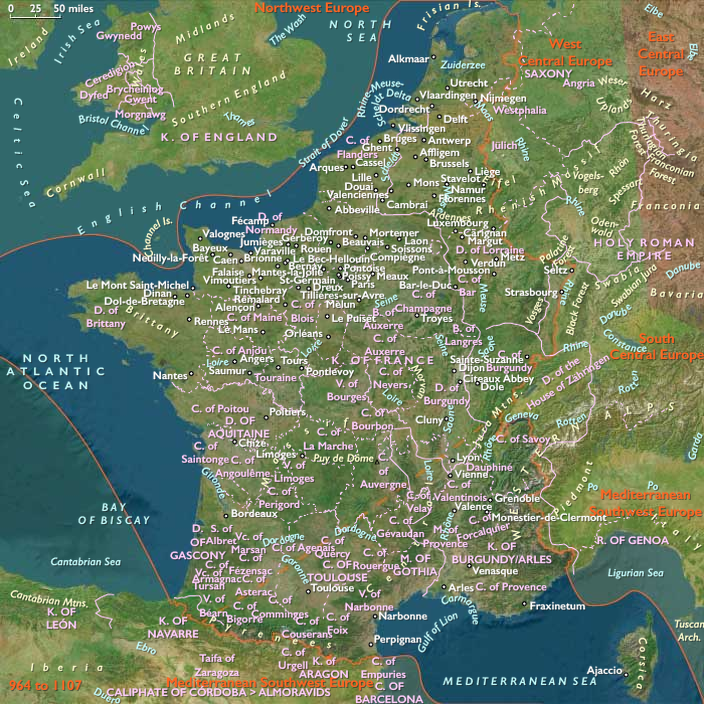
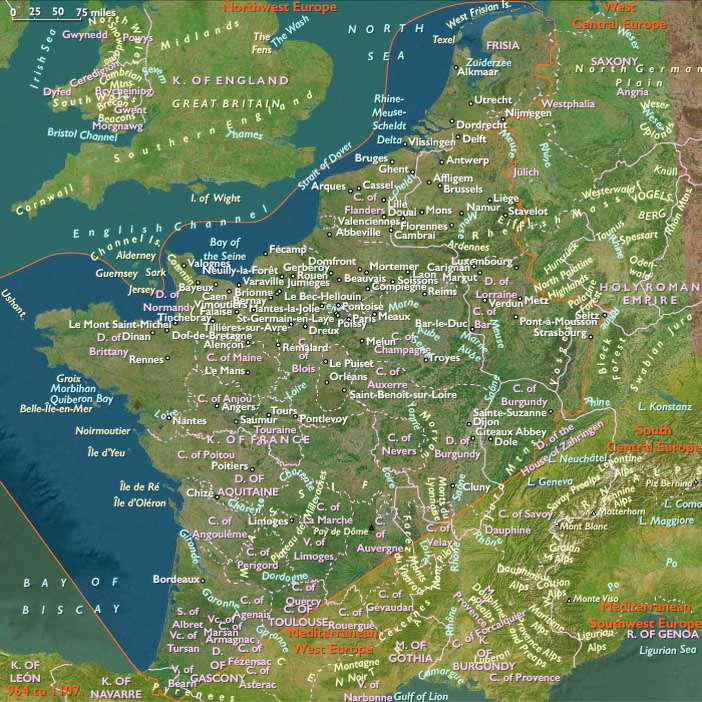
After his failure to install Edgar the Ætheling in Montreuil-sur-Mer (1074) as a figurehead against William I of England and Normandy, King Philip I of France redirected his focus to Brittany, aiming to destabilize Norman influence by encouraging rebellion in 1075.
Philip I’s Motivation for Supporting a Breton Revolt
- Philip had long sought to curb William’s growing dominance in northern France, as the Duke of Normandy was increasingly acting independently from the French crown.
- Brittany had historically resisted both Norman and Capetian control, making it an ideal battleground for Philip to challenge William’s expansion.
- Philip sought to harness Breton resistance, mirroring his earlier attempt to use Edgar the Ætheling as a tool against Norman power.
The Breton Revolt (1075)
- The rebellion was likely led by discontented Breton nobles who opposed Norman encroachment into Brittany over the past decades.
- Philip actively supported the rebels, aiming to prevent William from consolidating control over the duchy.
- The uprising posed a significant challenge to William, as he was already balancing his rule over both England and Normandy.
Consequences and William’s Response
- The Breton revolt forced William to intervene militarily, as he could not allow Brittany to become a base of anti-Norman resistance.
- Philip’s interference in Brittany signaled the beginning of a long-term Capetian strategy to contain Norman expansion on the continent.
- This rebellion contributed to the prolonged rivalry between the Capetians and the Norman-English kings, shaping medieval French history for centuries.
Philip’s support for the Breton rebels in 1075 was part of his broader effort to limit Norman influence in France, escalating the geopolitical struggle between the Capetian monarchy and the Norman dynasty.
Locations
People
Groups
- Breton people
- Maine, County of
- Flanders, County of
- Anjou, County of
- Alba (Scotland), Scots Kingdom of
- Brittanny, Duchy of
- French people (Latins)
- France, (Capetian) Kingdom of
- England, (Norman) Kingdom of
Topics
Commodoties
Subjects
Regions
Subregions
Related Events
Filter results
Showing 10 events out of 50689 total
Shen Kuo gains further reputation at court once he is dispatched as an envoy to the Khitan Liao Dynasty in the summer of 1075.
The Khitans have made several aggressive negotiations of pushing their borders south, while manipulating several incompetent Chinese ambassadors who concede to the Liao Kingdom's demands.
In a brilliant display of diplomacy, Shen Kuo comes to the camp of the Khitan monarch at Mt. Yongan (near modern Pingquan, Hebei), armed with copies of previously archived diplomatic negotiations between the Song and Liao dynasties.
Shen Kuo refutes Emperor Daozong's bluffs point for point, while the Song reestablish their rightful border line.
Shen, with regard to the Lý Dynasty of Dại Viet (in modern northern Vietnam), demonstrates in his Dream Pool Essays that he is familiar with the key players (on the Vietnamese side) in the prelude to the Sino-Vietnamese War of 1075–1077.
With his reputable achievements, Shen becomes a trusted member of Wang Anshi's elite circle of eighteen unofficial core political loyalists to the New Policies Group.
Wang Anshi, in his New Policies sponsored by Shenzong, has enhanced central authority over Song's frontier administrations, increased militia activity, increased troop levels and war horses sent to the frontiers (including the border areas with Dai Viet), and actively seeks loyal supporters in border regions who can heighten the pace of extraction of local resources for the state's disposal.
Officials at court debate the merits or faults of Wang's policies, yet criticism of his reforms even appears in Dai Viet, where the high officer Ly Thuong Kiet publicly announces that Wang's policies are deliberate efforts to seize and control their border frontiers.
Tensions between Song and Lý are at a critical point, and in these conditions any sign of hostility has the potential to ignite a war.
Wang Anshi tells the Song emperor that Dai Viet is being destroyed by Champa, with less than ten thousand soldiers surviving, hence it will be a good occasion to annex Dai Viet.
The Quang Nguyen chieftain Lưu Ky launches an unexpected attack against Yongzhou in 1075, which is repelled by the Song's Vietnamese officer Nung Trí Hoi in charge of Guihua.
Shenzong now seeks to cement an alliance with the "Five Clans" of northern Guangnan by issuing an edict which will standardize their once irregular tribute missions to visit Kaifeng every five years.
Shenzong has officials sent from the capital to supervise militiamen in naval training exercises.
Shenzong then orders that all merchants are to cease trade with the subjects of Dai Viet, a further indication of heightened hostility that prompts the Ly court under Ly Nhan Tông to prepare for war.
Upon hearing the news, the Ly ruler sends Ly Thuong Kiet and Nung Ton Dan with more than one hundred thousand troops to China to carry out a preemptive attack against the Song Dynasty troops.
In the autumn of 1075, Nung Tong Đan advances into Song territory in Guangxi while a naval fleet commanded by Ly Thuong Kiet captures Qinzhou and Lianzhou prefectures.
Ly Thuong Kiet calms the apprehensions of the local Chinese populace, claiming that he is simply apprehending a rebel who had taken refuge in China and that the local Song authorities had refused to cooperate in detaining him.

Trondheim’s Nidaros Cathedral, built from Norwegian blue soapstone and white marble, is built in 1075; it houses the tomb of the sainted Norwegian king Olaf II.
Ibn Butlan, who dies in Baghdad in 1075, is the author of the Taqwim al-Sihhah (The Maintenance of Health).
The work treats matters of hygiene, dietetics, and exercise.
It emphasizes the benefits of regular attention to the personal physical and mental well-being.
One of his Greek sources is Dioscorides.
The continued popularity and publication of this medieval text of Middle Eastern origin into the sixteenth century is thought to demonstrate the influence that Arabic culture had on early modern Europe.
The Jalali calendar, a sidereal calendar used in Persia, is reformed in 1075 under instructions from Nizam al-Mulk Throughout Malik's reign, new institutions of learning will be systematically established throughout the Seljuq lands, in such cities as Herat, Baghdad, Mosul, Basra, Nishapur, and Isfahan, the famous Nizamiyyah schools, which are named after him.
In many respects, these schools will turn out to be the predecessors and models of universities that will be established in Europe.
Suleiman ibn Qutalmish, a distant cousin of Malik-Shah, who rules as a chieftain in western Anatolia, captures Nicaea and …
…Nicomedia in about 1075, threatening Constantinople.
George II, following the 1073 devastation of Kartli (central Georgia) by the Seljuqs, had in the following year successfully repelled an invasion commanded a Turkish general left by the sultan in charge of the Caucasus.
The king had also secured the formal return of Upper Tao/Tayk (Theme of Iberia), a frontier region which had been a bone of contention between Georgia and the Empire early in the eleventh century, by the imperial governor, Gregory Pakourianos, who had begun to evacuate the region shortly after the 1071 disaster inflicted by the Seljuqs on the Byzantine army at Manzikert.
On this occasion, George had been bestowed with the imperial title of Caesaros, granted the fortress of Kars and put in charge of the Imperial Eastern limits.
This does not help to stem the Seljuq advance, however.
Alp Arslan’s son, Malik Shah, succeeds him as Great Seljuq sultan.
With the support of his father's vizier, Nizam al-Mulk, he continues his predecessor's policy of supporting Sunnite Islam against Egypt's Shiite Fatimid dynasty.
Nizam al-Mulk is the true manager of the Seljuq empire, extending Seljuq rule from the borders of Anatolia in the west to Transoxiana in the east, where the Seljuqs push back a Kara-Khanid attack on Khorasan and establish a shaky truce with the Ghaznavids, who continue to oppose the Seljuqs.
Years: 1075 - 1075
Locations
People
Groups
- Breton people
- Maine, County of
- Flanders, County of
- Anjou, County of
- Alba (Scotland), Scots Kingdom of
- Brittanny, Duchy of
- French people (Latins)
- France, (Capetian) Kingdom of
- England, (Norman) Kingdom of