Philip of Taranto, having been named vicar-general …
Years: 1299 - 1299
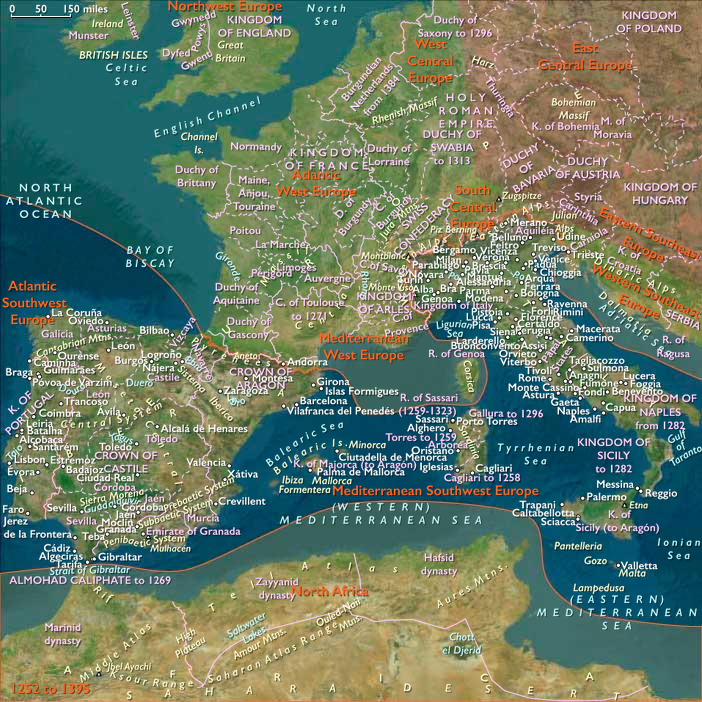
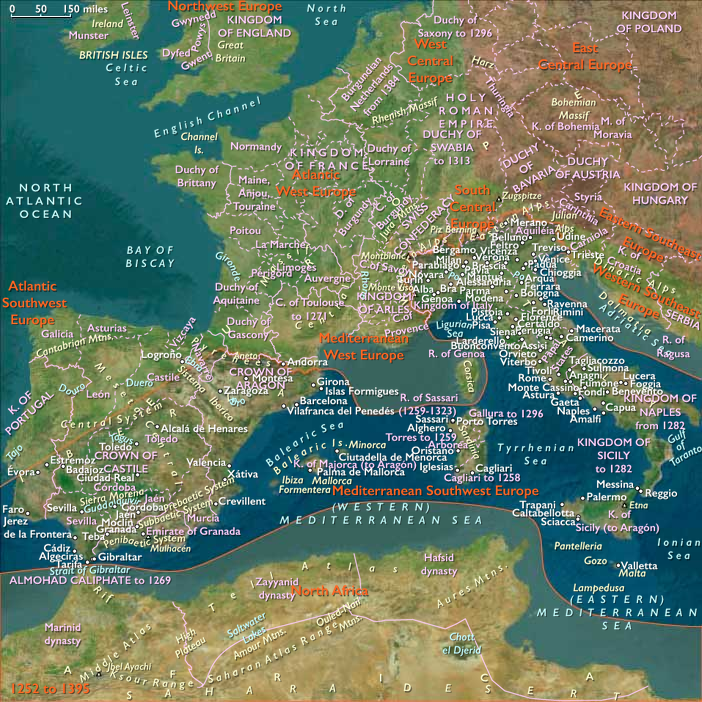
Philip of Taranto, having been named vicar-general of the Kingdom of Sicily by his father, Charles II of Naples, on July 12, 1294, had taken over preparations for a general invasion of the island.
Landing in November 1299 with about fifty galleys and numerous militia and noblemen, he besieges Trapani.
Frederick loses no time in assembling the able-bodied citizenry and his own troops at Castrogiovanni and marching to relieve Trapani.
The armies meet on the plain of Falconaria, between Marsala and Trapani.
Frederick’s forces triumph, and Philip is captured.
Locations
People
Groups
Topics
Commodoties
Subjects
Regions
Subregions
Related Events
Filter results
Showing 10 events out of 45162 total
John of Montecorvino, working mainly alone, has made numerous converts to Christianity and has translated the New Testament into Uighur.
In 1299, he builds a church at Khanbaliq.
Marco Polo, in his “Travels,” describes a Chinese junk, praising its system of bulkheads.
In use since before the ninth century, when these crafts were carrying merchants to Indonesia and India, junks lack three components—the keel as well as the stemposts and sternposts (upright beams at the bow and the stern)—that are basic to other types of ships.
Strong and seaworthy, the junk (the term is probably derived from the Chinese Chuan, "boat," via Malay djong) has a hull that is partitioned off by solid plank walls, or bulkheads, running both lengthwise and crosswise, dividing the junk into watertight compartments and giving it structural rigidity.
A deep, heavy rudder, mounted so that it can be raised and lowered, compensates for the lack of a keel.
Masts, numbering from one to five, carry the sails, which are constructed of narrow, horizontal sheets of linen or of matting panels.
Each panel has its own sheet, or line, thus helping to distribute the wind's force, and each sail can be rapidly spread or closed.
A lively tradition of realistic portraiture has emerged in painting during Japan’s Kamakura period, paralleling the trend toward greater realism and humanism in sculpture.
The biographies of famous evangelist priests become a popular subject of scroll painting, as seen in En'i’s Song Chinese-influenced Biography of Ippen Shonin, executed in 1299.
New developments in narrative hand scrolls include a focus on the vigorous depiction of military history and on the vivid and occasionally bizarre portrayal of Buddhist hell scenes.
The new form of painting called “nise-e” ("likeness paintings") that emerges during the Kamakura period fully expresses the personalities of great generals such as Minamoto no Yoritomo (1147-1199), members of the aristocracy, and even the emperor.
A truce had been forced on Armenia in 1281, following the defeat of the Mongols and the Armenians under Möngke Temur by the Mamluks at the Second Battle of Homs.
Further, following a powerful offensive push by Mamluk sultan Qalawun in 1285, the Armenians had had to sign a ten-year truce under harsh terms.
The Armenians were obligated to cede many fortresses to the Mamluks and were prohibited to rebuild their defensive fortifications.
Cilician Armenia was forced to trade with Egypt, thereby circumventing a trade embargo imposed by the pope.
Moreover, the Mamluks were to receive an annual tribute of one million dirhams from the Armenians.
The Mamluks, despite the above, continued to raid Cilician Armenia on numerous occasions.
It had been invaded in 1292 by Al-Ashraf Khalil, the Mamluk sultan of Egypt, who had conquered the remnants of the Kingdom of Jerusalem in Acre the year before.
Hromkla was also sacked, forcing the Catholicossate to move to Sis.
Hethum is forced to abandon Behesni, Marash, and Tel Hamdoun to the Turks.
In 1293, he had abdicated in favor of his brother T'oros III, and entered the monastery of Mamistra.
However, Thoros had recalled Hethum to the throne in 1295.
The two brought their sister Rita to Constantinople to marry Michael IX Palaiologos in 1296, but were imprisoned upon their return in Bardzrberd by their brother Sempad, who had usurped the throne in their absence.
In 1297, on a volitional journey to the court of Ghazan, Sempad had managed to receive recognition of his position as king from the Mongol ruler of Persia, which is necessary to legitimize his usurpation.
He had also received a bride from the Mongol khan in order to form a matrimonial alliance, perhaps a relative of the khan himself.
On Hethum's return, Sempad has Hethum blinded by cauterization and both brothers imprisoned at Partzerpert.
Thoros is murdered—strangled to death—on July 23, 1298 in Bardzrberd by Oshin, Marshal of Armenia, on Sempad's orders, but Constantine turns traitor again and helps Hethum overthrow Sempad, assuming the throne while Hethum heals.
Shortly after Hethum's resumption of the kingship in 1299, Constantine plots to restore Sempad again, and both are imprisoned for the rest of their lives.

Mercenaries have been streaming into Osman's realm from all over the Islamic world to fight against and plunder the weakening East Roman empire from 1281, when Osman became chief, or Bey, upon his father’s death.
In addition, the Turkic population of Osman's emirate are constantly reinforced by a flood of refugees, fleeing from the Mongols.
Of these, many are Ghazi warriors, or fighters for Islam, border fighters who believe they are fighting for the expansion or defense of Islam.
Under the strong and able leadership of Osman, these warriors had quickly proved a formidable force, and the foundations of the Empire were quickly laid.
With Sögüt as their base, Osman and his Ghazis have waged a slow and stubborn conflict against the imperial Greeks, who seek to defend their territories in the hinterland of the Asiatic shore opposite Constantinople.
Osman declares the independence of his own small principality from the Seljuq Sultanate of Rüm in 1299.
Ghazan Khan and an army of sixty thousand Ilkhanate troops and forty thousand Georgians and Armenians in 1299, nearly twenty years after the last Ilkhanate defeat in Syria at the Second Battle of Homs, cross the Euphrates river (the Mamluk-Ilkhanid border) and seize Aleppo.
The Ilkhanate army then proceeds southwards until they are only a few miles north of Homs in a battle line that is almost ten miles wide.
The Sultan of Egypt, who is in Syria at this time, marches an army of twenty thousand to thirty thousand Mamluks (more, according to other sources) northwards from Damascus until he meets the Ilkhanate forces two to three Arab farsakhs (six to nine miles) northeast of Homs at Wadi al-Khazandar on the 22nd of December 1299 at five o'clock in the morning.
The sun has already risen.
The battle starts with the Mamluk infantry charging the Ilkhanates, then the Ilkhanate heavy cavalry charges at the Mamluks while Ilkhanate archers stand behind their horses and pepper the Mamluks with arrows.
It seems that early on in the battle, the two forces ended up in hand-to-hand combat.
The Mamluks were thought to be superior to the Ilkhanates in close quarters fighting as the Mongols' general tactics in battle were based on the use of mounted archers.
Eventually, the Ilkhanate troops break through the Mamluk right flank in the afternoon of the battle.
It is unknown whether this was rumor or a true fact as the Mamluk army begins to rout upon hearing about the Ilkhanate breakthrough.
Messages between sections of the army can take hours to reach the other side of the battlefield.
The Ilkhanates are ultimately left in complete control of the battlefield and the remaining Mamluk army is routed and forced into retreat.
Mamluk sources state that only two hundred Mamluk soldiers were killed while Ilkhanate casualties numbered five thousand to ten thousand.
These figures are considered suspicious, given that the right flank of the Mamluks had collapsed yet only two hundred soldiers died during the entire battle.
The Mamluk army flees southwards towards Damascus.
However, en route they are constantly harassed by twelve thousand Maronite and Druze bowmen who want independence for their homeland.
The Ilkhanate troops follow them as far as Gaza.
The Ilkhanates continue their march until they reach Damascus.
The city is soon sacked and its citadel besieged.
Alauddin Khilji sends his generals to conquer Gujarat on February 24, 1299.
Against advice, the sultan attacks the Mongols of the Chagati Khanate.
The advance guard of the Khilji army defeats the Mongols and pursues them as they withdraw.
However, the Mongol general Qutlugh Khwaja tricks the Khijli commander into a position where he is surrounded and killed by the Mongols.
In face of Alauddin's continued offensives, however, the Mongols have to retreat north.
The Mongols, after taking some time to rally, attack at the worst time possible for Alauddin Khilji—when he is occupied with besieging Chittor.
A Mongol army of twelve thousand, now traveling light, moves to Delhi in a swift attack; many governors cannot send their troops to Delhi in time.
Alauddin Khilji is forced to retreat to Siri for about two months.
The Mongols attack and pillage not only the surrounding areas, but Delhi itself.
Alauddin Khilji continues to hold the fortress at Siri; the Mongols withdraw the siege after a few months and leave the area.
Barani, a contemporary historian at that time, attributes this "marvel" to the prayers of the Sufi mystic Shaikh Nizamuddin Auliya.
The colossal Surya temple at Konarak in Orissa, the most immense and ambitious of northern Indian Hindu temple complexes, takes the form of the giant horse-drawn sacred chariot associated with Surya the sun god, to whom the temple is dedicated.
Believed to have been begun by king Narasimhadeva I of the Eastern Ganga Dynasty in about 1240, the temple is never completed; by the end of the thirteenth century, the Muslim conquest has put an end to Hindu art in northern India.
Michael VIII had frequently harassed Epirus after restoring the empire in Constantinople in 1261, and in 1265 had forced Nikephoros, the son of Michael II Komnenos Doukas, to marry his niece Anna Palaiologina Kantakouzene.
Michael considered Epirus a vassal state, although Michael II and Nikephoros continued to ally with the Princes of Achaea and the Dukes of Athens.
Corcyra and much of Epirus had been taken in 1267 by Charles of Anjou, and Michael II had died in 1267/68.
Michael VIII had not attempted to annex Epirus directly, and had allowed Nikephoros I to succeed his father and deal with Charles, who had captured Dyrrhachium in 1271.
Nikephoros had allied with Charles against Michael VIII in 1279, agreeing to become Charles' vassal.
With Charles' defeat soon after, Nikephoros lost Albania to the Empire.
Under Andronikos II Palaiologos, son of Michael VIII, Nikephoros had renewed the alliance with Constantinople.
Nikephoros, however, had been persuaded to ally with Charles II of Naples in 1292, although Charles had been defeated by Andronikos's fleet.
Nikephoros has married his daughter to Charles's son Philip I of Taranto and sold much of his territory to him.
After Nikephoros's death in about 1297, Constantinople’s influence grows under his widow Anna, Andronikos's cousin, who rules as regent for her young son Thomas I Komnenos Doukas.
Florentine poet Guido Cavalcanti, a respected intellectual and poet of the “dolce stil nuovo,” is a friend of and influence on Dante.
He gains great renown for his doctrinal ode on love, “Donna me prega.” The approximately fifty poems ascribed to Cavalcanti are fascinating in their beauty, drama, and pathos.
Active in Florentine politics as a leader of the White Guelph faction in Florence, he is exiled because of the hostility between the White and Black factions.
Stricken with malaria, he soon returns in late 1299 to Florence, where he will die at fifty on August 29 of the following year.
The Frescobaldi family, beginning from an early economic base in the Italian community of cloth merchants in Bruges, had expanded their banking interests to their home city of Florence in the thirteenth century.
Their power base in the city's affairs lies in their participation in the small network that controls the great cloth-working Arti: the Arte della Lana, the Arte di Calimala, the guild of cloth finishers and merchants in foreign cloth, and the Cambio, or money exchange.