
Philip of Flanders now declares his neutrality …
Years: 1175 - 1175
Philip of Flanders now declares his neutrality towards Henry, in return for which the King agrees to provide him with regular financial support.
Henry now appears to his contemporaries to be stronger than ever, and he is courted as an ally by many European leaders and asked to arbitrate over international disputes in Spain and Germany.
He is nonetheless busy resolving some of the weaknesses that he believes had exacerbated the revolt.
Henry sets about extending royal justice in England to reassert his authority and spends time in Normandy shoring up support among the barons.
he King also makes use of the growing Becket cult to increase his own prestige, using the power of the saint to explain his victory in 1174, especially his success in capturing William.
Henry had undertaken a wave of castle-building during his visit in 1171 to protect his new territories—the Anglo-Normans have superior military technologies to the Irish, and castles give them a significant advantage.
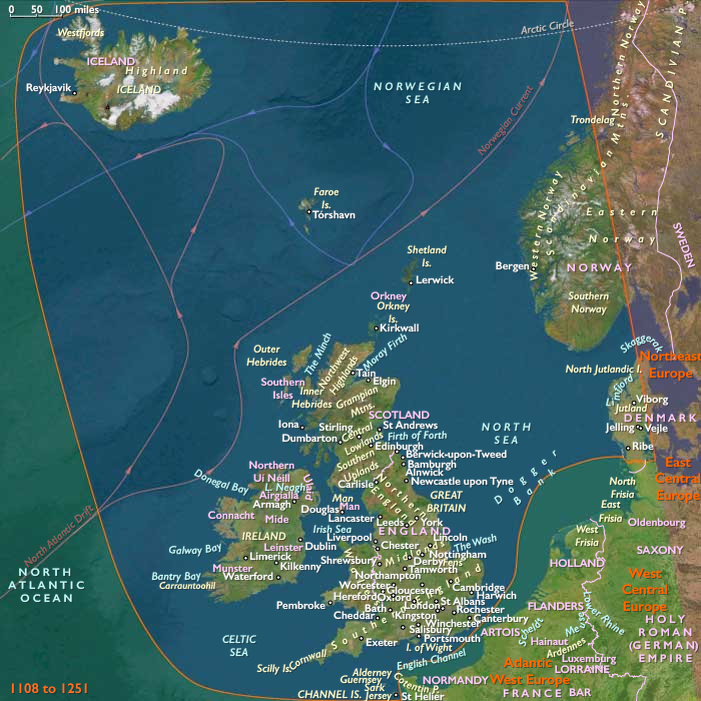
Henry hopes for a longer term political solution, however, similar to his approach in Wales and Scotland, and in 1175 he agrees to the Treaty of Windsor, under which Rory O'Connor is recognized as the high king of Ireland, giving homage to Henry and maintaining stability on the ground on his behalf.
This policy will proved unsuccessful, as O'Connor will be unable to exert sufficient influence and force in areas such as Munster.
Locations
People
Groups
- Irish people
- Scottish people
- Flanders, County of
- Alba (Scotland), Scots Kingdom of
- Normandy, Duchy of
- Normans
- France, (Capetian) Kingdom of
- Christians, Roman Catholic
- English people
- Anglo-Normans
- England, (Plantagenet, Angevin) Kingdom of
- Angevin Empire
- Ireland, (English) Lordship of
Topics
Commodoties
Subjects
Regions
Subregions
Related Events
Showing 10 events out of 48288 total
Years: 1175 - 1175
Locations
People
Groups
- Irish people
- Scottish people
- Flanders, County of
- Alba (Scotland), Scots Kingdom of
- Normandy, Duchy of
- Normans
- France, (Capetian) Kingdom of
- Christians, Roman Catholic
- English people
- Anglo-Normans
- England, (Plantagenet, Angevin) Kingdom of
- Angevin Empire
- Ireland, (English) Lordship of
Topics
Commodoties
Subjects
Regions
Subregions