
The Praguerie Revolt and its Suppression (1440) …
Years: 1440 - 1440
The Praguerie Revolt and its Suppression (1440)
In 1440, tensions arising from the centralizing policies and growing royal authority of King Charles VII erupted into open rebellion in an event known as the Praguerie. Named after a recent revolt in Prague, Bohemia—then closely linked to France through the House of Luxembourg—the Praguerie represented a coordinated aristocratic challenge to royal authority. The uprising was actively supported by Philip the Good, Duke of Burgundy, who, despite his reconciliation with Charles VII in the 1435 Treaty of Arras, reversed course in 1439 due to Charles's centralizing reforms, aligning himself once more against the French king.
Central to the rebellion was the ambitious Charles I, Duke of Bourbon, who sought to undermine royal control along with prominent nobles including Jean, Duke of Alençon, and mercenary captains such as Antoine de Chabannes. The rebels secured the symbolic leadership of the sixteen-year-old Dauphin Louis, proposing to replace his father as king and establish a regency controlled by the nobles.
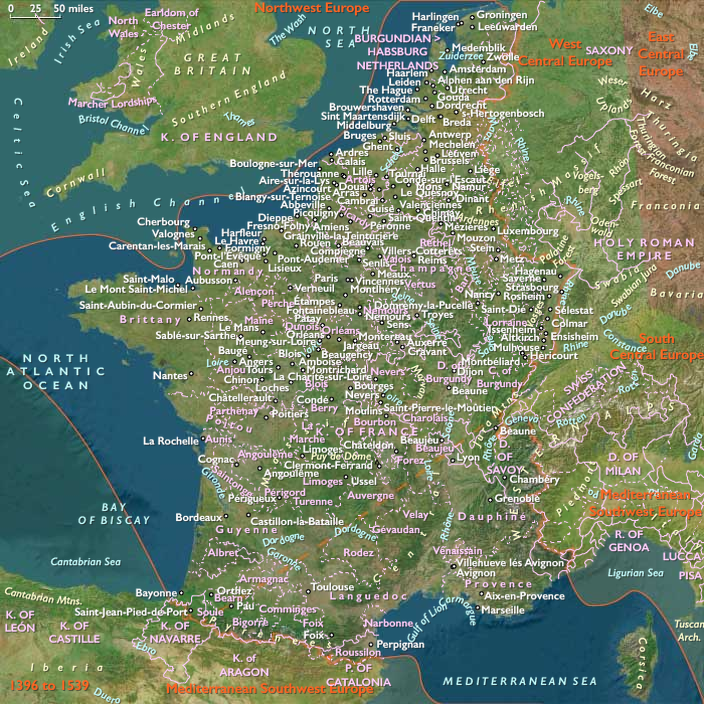
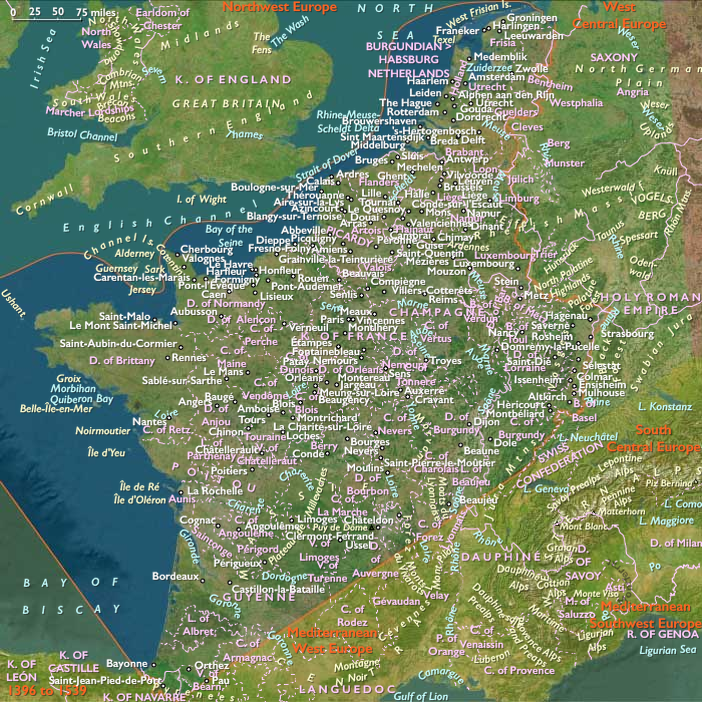
Responding swiftly, Arthur de Richemont, Constable of France, led royal troops into Poitou, historically a contested region associated with previous conflicts against royal minister Georges de la Trémoille. Within two months, Richemont decisively subdued much of the region, deploying the new royal artillery effectively to breach noble strongholds and quickly restoring order.
Efforts by the Dauphin and Alençon to incite broader uprisings in Auvergne failed, isolating the revolt. Although royal forces could not entirely prevent mercenary bands from pillaging parts of Poitou and ...
Locations
People
- Arthur III
- Charles I, Duke of Bourbon
- Charles VII of France
- Georges de la Trémoille
- Jean II
- Jean de Dunois
- Louis XI of France
- Philip the Good
Groups
Topics
Commodoties
Subjects
Regions
Subregions
Related Events
Showing 10 events out of 41826 total
Years: 1440 - 1440
Locations
People
- Arthur III
- Charles I, Duke of Bourbon
- Charles VII of France
- Georges de la Trémoille
- Jean II
- Jean de Dunois
- Louis XI of France
- Philip the Good
Groups
Topics
Commodoties
Subjects
Regions
Subregions