
Carteret also discovers a new archipelago inside …
Years: 1767 - 1767
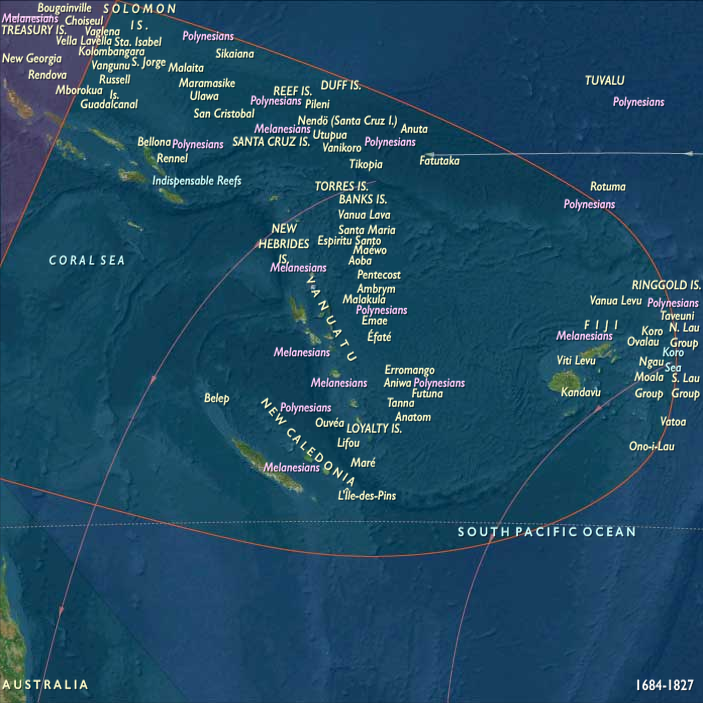
He also rediscovers the Solomon Islands first sighted by the Spaniard Álvaro de Mendaña in 1568, and the Juan Fernández Islands first discovered by Juan Fernández in 1574.
Locations
People
Groups
Topics
Subjects
Regions
Subregions
Related Events
Filter results
Showing 10 events out of 26141 total
Samuel Wallis was born near Camelford, Cornwall.
He had served under John Byron, and in 1766 was promoted to captain and was given the command of HMS Dolphin (1751) as part of an expedition led by Philip Carteret in the Swallow with an assignment to circumnavigate the globe.
The two ships are parted by a storm shortly after sailing through the Strait of Magellan, Wallis continuing to Tahiti, which he names "King George the Third's Island" in honor of the King (June 1767).
Wallis himself is ill and remains in his cabin: lieutenant Tobias Furneaux is the first to set foot, hoisting a pennant and turning a turf, taking possession in the name of His Majesty.
Dolphin stays in Matavai Bay in Tahiti for over a month.
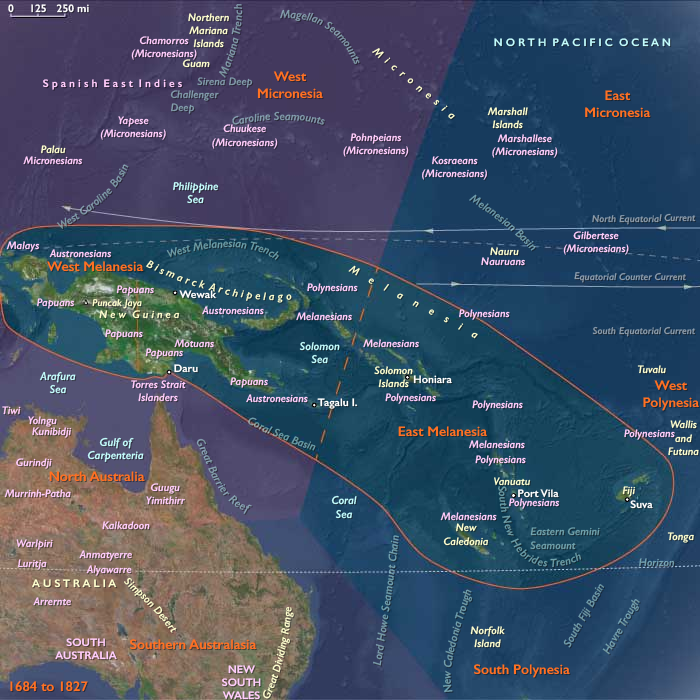
Wallis goes on to name or rename five more islands in the Society Islands and six atolls in the Tuamotu Islands, as well as confirming the locations of Rongerik and Rongelap in the Marshall Islands.
He renames the Polynesian island of Uvea as Wallis after himself, before reaching Tinian in the Mariana Islands.
He also sights Mehetia, a volcanic island in the Windward Islands, in the east of the Society Islands in French Polynesia.
This island is a very young active stratovolcano one hundred and ten kilometers (sixty-eight miles) east of the Taiarapu Peninsula of Tahiti.
It belongs to the Teahiti'a-Mehetia hotspot.
The vessels had been part of the first fleet carrying convicts to Australia.
They had sailed in a convoy under the command of post-captain Arthur Phillip, New South Wales' first Governor.
The two vessels encounter their first island in the Gilberts on June 17, 1788.
In a 1941 article in Life magazine, Samuel Eliot Morison will write that this island was probably Abemama, but might have been Aranuka.
Gilbert visits Tarawa on June 20, 1788.
He names it Matthew Island, after the owner of his ship, the Charlotte.
He names the lagoon Charlotte Bay.
Sketches he makes survive today.
Ayutthaya's art treasures, the libraries containing its literature, and the archives housing its historic records are almost totally destroyed, and the Burmese bring the Ayutthaya Kingdom to ruin.
Poniatowski attempts to push a radical reform during the Sejm in October of this year, restricting the disastrous liberum veto policy.
He is opposed by conservatives such as Michał Wielhorski, who are supported by the Prussian and Russian ambassadors, and who threaten war if the reform is passed.
The marshal of the confederation is Karol Stanisław "Panie Kochanku" Radziwiłł, another leader is the primate of Poland, Gabriel Podoski, but Russian ambassador Nicholas Repnin, who is also responsible for forming the Protestant and Orthodox confederations, is in fact the real leader.
On his insistence the confederates have to make peace with the pro-Russian Polish king, and send an envoy to the Russian tsarina, asking her to protect the freedoms of the Rzeczpospolita (Commonwealth).
He stirs the internal unrest in Poland in order to increase Russian control over the country.
Poniatowski's reforms, abandoned by the Familia, fail to pass at the Repnin Sejm, in which Repnin promises to guarantee the Golden Liberties of the Polish nobility, enshrined in the Cardinal Laws, with all the might of the Russian Empire.
After the 1767 Repnin Sejm, where Repnin de facto dictates the legislation (Cardinal Laws) the Polish parliament (Sejm), Russian control over Poland becomes much stronger.
It is designed by Ange-Jacques Gabriel by the order of Louis XV for his long-term mistress, Madame de Pompadour, and is constructed between 1762 and 1768.
Madame de Pompadour dies four years before its completion, and the Petit Trianon will subsequently be occupied by her successor, Madame du Barry.
The château of the Petit Trianon is a celebrated example of the transition from the Rococo style of the earlier part of the eighteenth century, to the more sober and refined Neoclassical style of the 1760s and onward.
Essentially an exercise on a cube, the Petit Trianon attracts interest by virtue of its four facades, each thoughtfully designed according to that part of the estate it would face.
The Corinthian order predominates, with two detached and two semi-detached pillars on the side of the formal French garden, and pilasters facing both the courtyard and the area once occupied by Louis XV's greenhouses.
Overlooking the former botanical garden of the king, the remaining facade is left bare.
The subtle use of steps compensates for the differences in level of the château's inclined location.
He focuses his investigation on the Pleiades cluster, and calculates that the likelihood of finding such a close grouping of stars is about one in half a million.
He concludes that the stars in these double or multiple star systems might be drawn to one another by gravitational pull, thus providing the first evidence for the existence of binary stars and star clusters.
His work on double stars influence Herschel’s research on the same topic.
Michell follows his work in seismology with work in astronomy, and after publishing his findings in 1767 he serves on an astronomical committee of the Royal Society.
Boone's first steps in Kentucky are near present-day Elkhorn City.
While on the Braddock expedition years earlier, Boone had heard about the fertile land and abundant game of Kentucky from fellow wagoner John Findley, who had visited Kentucky to trade with natives.
Boone and Findley had happened to meet again, and Findley had encouraged Boone with more tales of Kentucky.
At the same time, news had arrived about the Treaty of Fort Stanwix, in which the Iroquois had ceded their claim to Kentucky to the British.
This, as well as the unrest in North Carolina due to the Regulator Movement, likely prompts Boone to extend his exploration.
Tryon had seen the need for a centrally-located Government House while lieutenant governor.
After assuming office in 1765, William Tryon had worked with architect John Hawks to draw up plans for a government house similar to other British colonial structures of the time.
In December 1766, the North Carolina legislature had authorized £5,000 for the building of an "Edifice."
Tryon had told the legislature that the sum was not substantial enough for the plans he and Hawk had created; building it "in the plainest manner" would cost no less than £10,000 without including the outbuildings he envisioned.
Hawks agrees to supervise the construction for three years and goes to Philadelphia at Tryon's behest to hire workers; Tryon said native North Carolina workers will not know how to construct such a building.
Tryon is able to convince the legislature to increase taxes for the house.
This stirs resentment among some North Carolinians and helps prolong the War of the Regulation.
The new taxes are enacted on the belief that Americans only object to internal taxes and not to external taxes such as custom duties.
The Americans, however, argue against the constitutionality of the act because its purpose is to raise revenue and not regulate trade.
Colonists respond by organizing new boycotts of British goods.
These boycotts are less effective, however, as the Townshend goods are widely used.
