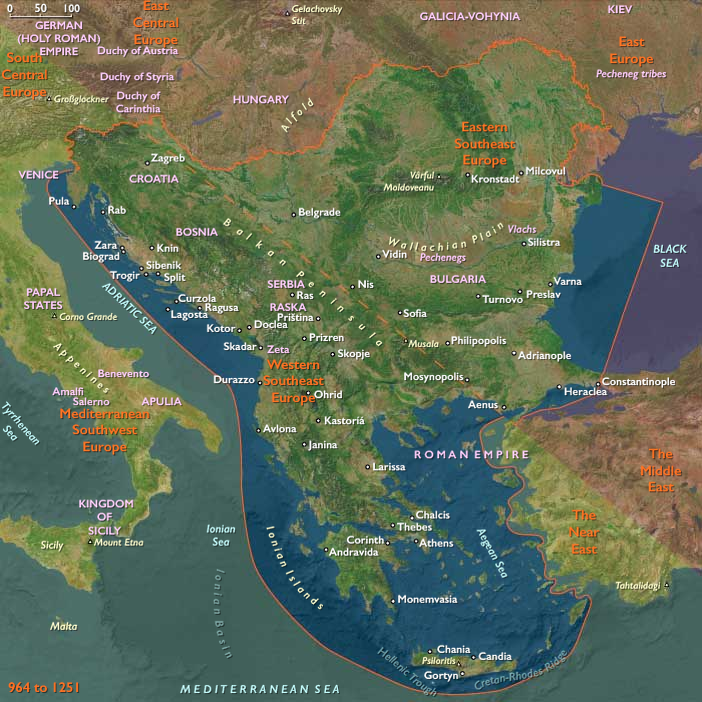
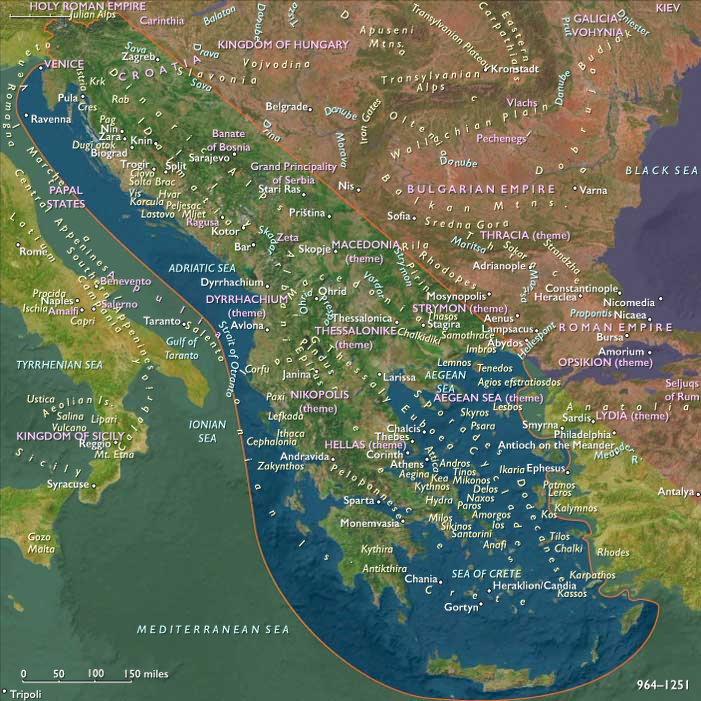
Petrila marches southwards and captures Ohrid and …
Years: 1072 - 1072
Petrila marches southwards and captures Ohrid and …
Locations
People
Groups
- Greeks, Medieval (Byzantines)
- Bulgarians (South Slavs)
- Serbs (South Slavs)
- Duklja, or Doclea
- Bulgaria, Theme of
- Roman Empire, Eastern: Doukid dynasty
Topics
Commodoties
Subjects
Regions
Subregions
Related Events
Filter results
Showing 10 events out of 50773 total
The Dvaravati period in Thailand’s history lasts from the sixth to the thirteenth centuries.
Dvaravati refers to both a culture and a disparate conglomerate of principalities.
The people of Dvaravati use the ancient Mon language, but whether they are ethnically Mon is unknown.
There is evidence that this kingdom may have had more than one ethnic group, including Malays and Khmer.
The term Dvaravati derives from coins which were inscribed in Sanskrit with śrī dvāravatī.
The Sanskrit word dvāravatī means "she with many gates" (from dvar, "door gate").
Little is known about the administration of the kingdom, or even whether it was technically a kingdom at all.
It may simply have been a loose gathering of principalities rather than a centralized state.
The main settlements appear to have been at Nakhon Pathom, …
...U Thong and Khu Bua west of the Chao Phraya.
The Dvaravati culture clearly influences other towns, like ...
…Lavo (modern-day Lopburi) or Si Thep, but these probably are not part of the kingdom.
Dvaravati itself is heavily influenced by Indian culture, and has played an important role in introducing Buddhism and particularly Buddhist art to the region.
The Kingdom is absorbed by the growing Lavo and Subharnaburi kingdoms.
Song dynasty Chancellor Wang Anshi, in implementing a series of reforms in 1069 upon his ascendance to office, promulgates a community-based law enforcement and civil order known as the Baojia system.
Wang attempts to diminish the importance of landholding and private wealth in favor of mutual-responsibility social groups that share similar values and can be easily controlled by the government.
Just as scholar-officials owe their social prestige to their government degrees, Wang wants to structure all of society as a mass of dependents loyal to the central government.
He uses various means, including the prohibition of landlords offering loans to tenants; this role is assumed by the government.
Wang establishes local militias that can aid the official standing army and lessen the constrained state budget expenses for the military.
He sets up low-cost loans for the benefit of rural farmers, whom he views as the backbone of the Song economy.
Since the land tax exacted from rural farmers fills the state treasury's coffers, Wang implements a reform to update the land-survey system so that more accurate assessments can be gathered.
Wang removes the mandatory poetry requirement in the civil service exams, on the grounds that many otherwise skilled and knowledgeable Confucian students are being denied entry into the administration.
Wang also establishes government monopolies for tea, salt, and wine production.
All of these programs receive heavy criticism from conservative ministerial peers, who believe his reforms damage local family wealth which provides the basis for the production of examination candidates, managers, merchants, landlords, and other essential members of society.
East Central Europe (1072–1083 CE): Hungarian Stability under Ladislaus I, Polish Royal Ambitions under Bolesław II, and Bohemian Alignment with the Holy Roman Empire
Between 1072 and 1083 CE, East Central Europe—encompassing modern-day Poland, Czechia, Slovakia, Hungary, and the eastern portions of Germany and Austria east of 10°E and north of the defined southeastern boundary—experienced significant developments in political consolidation, dynastic authority, and regional stability. In Hungary, King Ladislaus I restored political coherence after prolonged instability; Bolesław II "the Bold" continued to expand Poland’s territorial and royal ambitions; while Bohemia under Vratislaus II strengthened its strategic alignment with the Holy Roman Empire. These shifts significantly impacted regional power dynamics and set critical foundations for medieval governance and cultural identity.
Political and Military Developments
Hungarian Consolidation and Stability under Ladislaus I
-
Ladislaus I of Hungary (r. 1077–1095) decisively ended internal dynastic conflicts following the turbulent reigns of Solomon and Géza I. Ladislaus restored royal authority, strengthened military defenses, reorganized administration, and established law codes that firmly stabilized Hungary and enhanced royal prestige.
Polish Territorial and Royal Expansion under Bolesław II
-
Bolesław II "the Bold" of Poland continued territorial expansion into Ruthenia, significantly enlarging Poland’s sphere of influence. He successfully sought royal recognition, crowned as king in 1076, reinforcing Poland’s status as a significant European monarchy.
Bohemian Alignment and Autonomy under Vratislaus II
-
Duke Vratislaus II of Bohemia deepened Bohemia’s diplomatic alignment with the Holy Roman Empire, skillfully balancing imperial loyalty and local autonomy. His strategic diplomacy secured stability, and he later received royal recognition as the first King of Bohemia (in 1085, slightly beyond this era).
Imperial Influence and the Investiture Conflict
-
The Investiture Controversy (begun in 1075) profoundly impacted East Central Europe as Emperor Henry IV (r. 1056–1106) struggled with the papacy. Vratislaus II aligned closely with Henry, while Hungary and Poland navigated carefully between imperial and papal interests, impacting regional diplomacy and church-state relations.
Economic and Technological Developments
Economic Revival and Trade Expansion
-
Stability in Hungary under Ladislaus and Poland under Bolesław supported a vibrant revival of commerce. Regional trade networks expanded, notably along routes connecting the Baltic, Central Europe, and Byzantium, facilitating significant economic growth.
Urbanization and Fortifications
-
Key urban centers in Poland (Kraków, Gniezno), Hungary (Esztergom, Székesfehérvár), and Bohemia (Prague) further developed and fortified their infrastructure, bolstering administrative control, commerce, and defense capabilities.
Cultural and Artistic Developments
Hungarian Ecclesiastical and Cultural Flourishing under Ladislaus
-
Ladislaus I extensively patronized ecclesiastical institutions, monasteries, and churches, promoting cultural and religious revival. His reign saw the canonization of Stephen I (1083), enhancing Hungarian Christian identity and cultural prestige.
Polish Royal Patronage and Cultural Expansion
-
Bolesław II promoted cultural patronage, supporting ecclesiastical institutions, monasteries, and religious art. His coronation reinforced Poland’s royal and cultural identity, further integrating it into broader European Christian traditions.
Bohemian Cultural Development under Vratislaus II
-
Vratislaus II actively supported cultural growth, evident in cathedral expansions, monastic foundations, and manuscript production, significantly enriching Prague’s ecclesiastical and cultural life.
Settlement and Urban Development
Growth and Expansion of Polish Royal Centers
-
Kraków, Gniezno, and Poznań flourished under Bolesław II, expanding their urban structures and fortifications, becoming prominent administrative and economic centers.
Hungarian Urban and Administrative Development
-
Ladislaus I significantly developed Hungarian royal and ecclesiastical cities, notably Esztergom, Székesfehérvár, and Veszprém, consolidating Hungary’s administrative efficiency and urban prosperity.
Bohemian Urban Infrastructure
-
Under Vratislaus II, Prague and other Bohemian towns experienced ongoing urban growth, fortification, and enhanced administrative organization, strengthening Bohemia’s regional role and urban prosperity.
Social and Religious Developments
Consolidation of Christian Institutions
-
Christianity further deepened its dominant role in society across Hungary, Poland, and Bohemia. Ladislaus’s support of religious reform, Bolesław’s ecclesiastical patronage, and Vratislaus’s imperial-aligned religious policy significantly influenced regional religious institutions.
Strengthening Dynastic Authority
-
Dynastic and aristocratic structures became increasingly defined, reinforcing governance, social hierarchies, and royal authority. Ladislaus I in Hungary, Bolesław II in Poland, and Vratislaus II in Bohemia strengthened dynastic legitimacy and political cohesion.
Long-Term Consequences and Historical Significance
The era 1072–1083 CE proved transformative for East Central Europe. Hungarian stability under Ladislaus I, Poland’s royal expansion under Bolesław II, and Bohemia’s strengthened autonomy under Vratislaus II reshaped regional political alliances, cultural identities, and societal structures. These developments laid crucial foundations for enduring medieval kingdoms, significantly influencing East Central Europe’s historical trajectory for centuries to come.
The struggle between the Salian dynasty ruling the Holy Roman Empire and the rebel Saxons during the reign of King Henry IV of Germany reaches its climax in the period from summer 1073 until the end of 1075, in a rebellion that involves several clashes of arms.
The ensuing civil war from 1077 and 1088 is led by a group of opportunistic German princes who elect as their figurehead the duke of Swabia and anti-king Rudolf of Rheinfeld, a two-way brother-in-law of the young Henry IV, Holy Roman Emperor (Henry had been crowned at the age of six and assumed his offices at sixteen).
The investiture controversy, the most significant conflict between Church and state in medieval Europe, begins as a power struggle between Pope Gregory VII and Henry IV.
An early result is the trek of Henry from Speyer to the fortress at Canossa in Emilia Romagna to obtain the revocation of the excommunication imposed on him by the Pope.
The Emperor is in January 1077 forced to humiliate himself on his knees waiting for three days and three nights, before the entrance gate of the castle, while a blizzard rages.
The East Roman Empire must redraw its borders at the Bosporus after the disastrous Battle of Manzikert.
The Empire, its eastern boundary now synonymous with the Ionian coast of Classical Greece, has lost almost the whole of Asia Minor to the Seljuq Sultanate.
Alp Arslan's victories have changed the balance in near Asia completely in favor of the Seljuq Turks and Sunni Muslims.
The victory at Manzikert in 1071 signals the beginning of Turkish ascendancy in Anatolia, although the Eastern Roman Empire will continue for nearly four more centuries, and the Crusades will contest the issue for some time.
Most historians, including Edward Gibbon, date the defeat at Manzikert as the beginning of the end of the Eastern Roman Empire.
Certainly the entry of Turkic farmers following their horsemen ends the themes in Anatolia that had furnished the Empire with men and treasure.
Many in the East Roman Empire do not see this Seljuq victory as a total disaster, and when the Turks begin occupying the countryside in Anatolia, they begin to garrison the imperial cities as well, not as foreign conquerors but as mercenaries requested by various Greek factions—one Emperor, in 1078, even gives the defense of the city of Nicaea to the invading Turks.
The decline of the embattled Empire is not yet irretrievable.
The shrinking of its boundaries has reduced the empire from its status as a dominating world power to that of a small Greek state fighting for survival.
That survival now depends on the new political, commercial, and ecclesiastical forces in the West, for it can no longer draw on its former military and economic resources in Anatolia.
With the rise of Alexios I Komnenos to power in 1081, imperial stability is restored by an ensured succession in the Komnenos family, who will rule for more than one hundred years, from 1081 to 1185.
Eastern Southeast Europe (1072–1083 CE): Byzantine Crisis and Shifting Power Dynamics
Settlement and Migration Patterns
Changing Borders and Demographic Stability
Between 1072 and 1083 CE, Eastern Southeast Europe experienced significant political and territorial upheaval, although demographic patterns within existing territories largely remained stable.
Political and Military Developments
Aftermath of the Battle of Manzikert
The devastating defeat of the Byzantine Empire at the Battle of Manzikert in 1071 forced it to drastically redraw its borders at the Bosporus. The Empire lost nearly all of Asia Minor to the Seljuq Turks under Sultan Alp Arslan, significantly altering regional power dynamics and shifting its eastern boundary back toward the Ionian coast of Classical Greece.
Seljuq Turkish Ascendancy
The Battle of Manzikert marked the beginning of Turkish dominance in Anatolia. Despite the continuation of the Byzantine Empire for nearly four centuries afterward, the region’s balance of power decisively shifted toward Seljuq Turks and Sunni Muslims. Turkic migration into Anatolia fundamentally undermined the traditional Byzantine theme system, depriving the Empire of critical military manpower and economic resources.
Byzantine Response and Internal Challenges
In the wake of defeat, internal Byzantine factions sometimes invited Seljuq mercenaries into their cities for protection, paradoxically facilitating further Turkish penetration into imperial territories. In 1078, even the key city of Nicaea was entrusted to Seljuq forces, reflecting deep internal divisions.
Rise of the Komnenian Dynasty
Despite severe territorial and political setbacks, the ascension of Alexios I Komnenos in 1081 marked a turning point. Alexios initiated emergency reforms, including requisitioning Church funds, to stabilize the Empire. His rule initiated a century-long Komnenian dynasty (1081–1185), restoring a measure of stability and continuity to Byzantine governance.
Norman Expansion and Conflict
Meanwhile, the Normans, fresh from their conquest of southern Italy, posed another significant threat. Under the formidable leadership of Robert Guiscard and his son Bohemund, Norman forces successfully captured Dyrrhachium and Corfu, and laid siege to Larissa in Thessaly. Alexios I initially suffered several defeats before eventually repelling the Normans.
Diplomatic Maneuvers
To relieve pressure from the Normans, Alexios strategically bribed German King Henry IV with a substantial sum to attack Norman holdings in Italy, diverting their attention away from Byzantine territories. Additionally, Alexios secured the alliance of Henry, Count of Monte Sant'Angelo, who recognized Alexios' authority, marking the last significant instance of Byzantine political influence on peninsular Italy.
Economic and Technological Developments
Economic Pressures and Military Strain
The extensive military conflicts and territorial losses significantly strained the Byzantine economy. Resources previously drawn from prosperous Anatolian themes were lost, greatly reducing economic stability and fiscal capacity.
Defensive Infrastructure
Byzantine military strategy during this period emphasized fortification improvements along reduced territorial boundaries, especially in areas vulnerable to Norman incursions and further Turkish advances.
Cultural and Artistic Developments
Cultural Resilience Amid Crisis
Despite severe territorial and political crises, Byzantine cultural and intellectual life endured, supported by continued patronage from imperial and ecclesiastical authorities.
Social and Religious Developments
Orthodox Christianity’s Central Role
Orthodox Christianity remained dominant, providing spiritual cohesion and social stability amidst turmoil. Ecclesiastical institutions retained significant influence and continued supporting cultural continuity.
Ongoing Presence of Religious Movements
Alternative religious movements such as Bogomilism continued their presence, particularly in rural areas, reflecting ongoing religious and social diversity.
Long-Term Consequences and Historical Significance
The period from 1072 to 1083 CE represented a critical juncture marked by severe Byzantine territorial losses, internal political crises, and external military threats. The rise of Alexios I Komnenos and his reforms, along with shifting geopolitical dynamics involving Turkish and Norman expansions, significantly influenced the future trajectory of Eastern Southeast Europe and the broader Mediterranean region.

The venturesome Normans, following their successful conquest of southern Italy, see no reason to stop; the crumbling East Roman Empire appears ripe for conquest.
When Alexios I Komnenos ascends to the throne of Constantinople, his early emergency reforms, such as requisitioning Church money—a previously unthinkable move—prove too little to stop the Normans.
Led by the formidable Robert Guiscard and his son Bohemund, the Normans take Dyrrhachium and Corfu, and lay siege to Larissa in Thessaly.
Alexios suffers several defeats before being able to strike back with success.
He enhances this by bribing the German king Henry IV with three hundred and sixty thousand gold pieces to attack the Normans in Italy, which forces the Normans in 1083 and 1084 to concentrate on their defenses at home.
He also secures the alliance of Henry, Count of Monte Sant'Angelo, who controls the Gargano Peninsula and dates his charters by Alexios' reign.
Henry's allegiance is to be the last example of East Roman political control on peninsular Italy.
Years: 1072 - 1072
Locations
People
Groups
- Greeks, Medieval (Byzantines)
- Bulgarians (South Slavs)
- Serbs (South Slavs)
- Duklja, or Doclea
- Bulgaria, Theme of
- Roman Empire, Eastern: Doukid dynasty