
Peter the Hermit, according to Anna Komnena, …
Years: 1096 - 1096
August
Peter the Hermit, according to Anna Komnena, had attempted to go on a pilgrimage to Jerusalem before 1096, but had been prevented by the Seljuqs from reaching his goal and was reportedly mistreated.
However, doubts remain that he ever made such a journey.
Sources differ as to whether he was present at Pope Urban II's famous Council of Clermont in 1095; but it is certain that he was one of the preachers of the crusade in France afterward, and his own experience may have helped to give fire to the Crusading cause.
He soon leapt into fame as an emotional revivalist; and the vast majority of sources and historians agree that thousands of peasants eagerly took the cross at his bidding.
This part of the crusade is also the crusade of the "paupers", a term which in the Middle Ages indicated a status as impoverished or mendicant wards of the Church.
Peter has organized and guided the paupers as a spiritually purified and holy group of pilgrims who would be protected by the Heavenly Host.
Peter had had difficulty in Germany, controlling his men, who in spring 1096 had gone on rampages killing Jews.
Leading the first of the five sections of the People's Crusade to the destination of their pilgrimage, the Church of the Holy Sepulcher, he had started (with forty thousand men and women) from Cologne in April, 1096, and arrived (with thirty thousand men and women) at Constantinople at the end of July.
The Eastern Roman Emperor Alexios I Komnenos is less than pleased with their arrival, for along with the head of the Eastern Orthodox Church, Patriarch Nicholas III of Constantinople, he is now required to provide for the care and sustenance of the vast host of paupers for the remainder of their journey.
Most of the paupers had failed to make their way out of Roman Catholic jurisdiction.
The majority were incapable of being provided for by the various lordships and dioceses along the way and either starved, returned home or were put into servitude.
Peter the Hermit had joined the only other section of the People’s Crusade that had succeeded in reaching Constantinople, that of the French Walter Sans Avoir, into a single group, encamping the still numerous pilgrims around Constantinople while he negotiated the shipping of the People's Crusade to the Holy Land.
The Emperor meanwhile had failed to provide for the pilgrims adequately and the camp had made itself a growing nuisance, as the increasingly hungry paupers turn to pilfering the imperial stores.
Alexios, worried at the growing disorder and fearful of his standing before the coming armed Crusader armies, had quickly concluded negotiations and ships them across the Bosporus to the Asiatic shore in the beginning of August, with promises of guards and passage through the Turkish lines.
He has warned the People's Crusade to await the arrival of the main body of crusaders, which is still on the way, but in spite of his warnings, the paupers enter Turkish territory, joined by number of bands of Italian crusaders who had arrived at the same time.
The army of the People's Crusade lands in Asia Minor on August 6, 1096, and camps at Helenopolis (Civetot/Civetote) to the northwest of Nicaea, capital of the Seljuq Sultanate of Rûm.
The young Sultan, Kilij Arslan I, is in the middle of a military campaign to the east, fighting the Danishmend emirate.
Locations
People
- Adhemar of Le Puy
- Alexios I Komnenos
- Anna Komnene
- Baldwin I of Jerusalem
- Bohemond I of Antioch
- Constantine I
- Danishmend Gazi
- Eustace III
- Fakhr al-Mulk Radwan
- Godfrey of Bouillon
- Guglielmo Embriaco
- Iftikhar al-Dawla
- Kerbogha
- Kilij Arslan I
- Manuel Boutoumites
- Peter the Hermit
- Pope Urban II
- Raymond IV
- Robert Curthose
- Robert II, Count of Flanders
- Stephen
- Tancred
- Tatikios
- Walter Sans Avoir
- Yaghi-Siyan
Groups
- Arab people
- Persian people
- Armenian people
- Jews
- Kurdish people
- Lombards (West Germanic tribe)
- Germans
- Christians, Armenian Apostolic Orthodox
- Christians, Maronite
- Christians, Miaphysite (Oriental Orthodox)
- Coptic Orthodox Church of Alexandria
- Greeks, Medieval (Byzantines)
- Islam
- Egypt in the Middle Ages
- Muslims, Sunni
- Muslims, Shi'a
- Syrian people
- Papal States (Republic of St. Peter)
- Toulouse, County of
- Flanders, County of
- Abbasid Caliphate (Baghdad)
- Normandy, Duchy of
- Normans
- German, or Ottonian (Roman) Empire
- Turkmen people
- Cyprus, East Roman (Byzantine)
- Fatimid Caliphate
- French people (Latins)
- France, (Capetian) Kingdom of
- 'Uqaylid Dynasty of Mosul
- Hungary, Kingdom of
- Genoa, (Most Serene) Republic of
- Druze, or Druse, the
- Bulgaria, Theme of
- Lorraine (Lothier), Lower, (second) Duchy of
- Seljuq Empire (Isfahan)
- Christians, Roman Catholic
- Christians, Eastern Orthodox
- England, (Norman) Kingdom of
- Danishmends
- Rum, Sultanate of
- Apulia, Norman Duchy of
- Aleppo, Seljuq Emirate of
- Armenia, Baronry of Little, or Lesser
- Roman Empire, Eastern: Komnenos dynasty, restored
Topics
Commodoties
Subjects
Regions
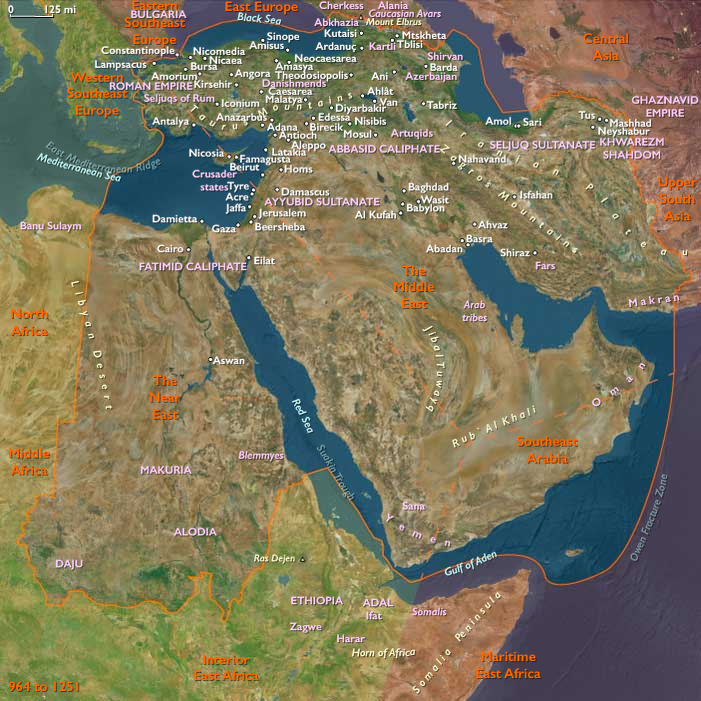
Subregions
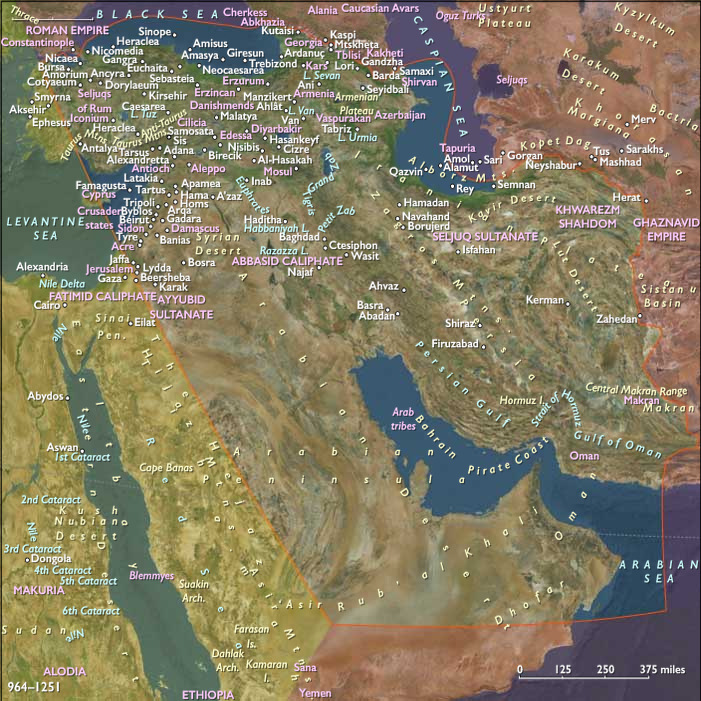
Related Events
Showing 10 events out of 17 total
Years: 1096 - 1096
August
Locations
People
- Adhemar of Le Puy
- Alexios I Komnenos
- Anna Komnene
- Baldwin I of Jerusalem
- Bohemond I of Antioch
- Constantine I
- Danishmend Gazi
- Eustace III
- Fakhr al-Mulk Radwan
- Godfrey of Bouillon
- Guglielmo Embriaco
- Iftikhar al-Dawla
- Kerbogha
- Kilij Arslan I
- Manuel Boutoumites
- Peter the Hermit
- Pope Urban II
- Raymond IV
- Robert Curthose
- Robert II, Count of Flanders
- Stephen
- Tancred
- Tatikios
- Walter Sans Avoir
- Yaghi-Siyan
Groups
- Arab people
- Persian people
- Armenian people
- Jews
- Kurdish people
- Lombards (West Germanic tribe)
- Germans
- Christians, Armenian Apostolic Orthodox
- Christians, Maronite
- Christians, Miaphysite (Oriental Orthodox)
- Coptic Orthodox Church of Alexandria
- Greeks, Medieval (Byzantines)
- Islam
- Egypt in the Middle Ages
- Muslims, Sunni
- Muslims, Shi'a
- Syrian people
- Papal States (Republic of St. Peter)
- Toulouse, County of
- Flanders, County of
- Abbasid Caliphate (Baghdad)
- Normandy, Duchy of
- Normans
- German, or Ottonian (Roman) Empire
- Turkmen people
- Cyprus, East Roman (Byzantine)
- Fatimid Caliphate
- French people (Latins)
- France, (Capetian) Kingdom of
- 'Uqaylid Dynasty of Mosul
- Hungary, Kingdom of
- Genoa, (Most Serene) Republic of
- Druze, or Druse, the
- Bulgaria, Theme of
- Lorraine (Lothier), Lower, (second) Duchy of
- Seljuq Empire (Isfahan)
- Christians, Roman Catholic
- Christians, Eastern Orthodox
- England, (Norman) Kingdom of
- Danishmends
- Rum, Sultanate of
- Apulia, Norman Duchy of
- Aleppo, Seljuq Emirate of
- Armenia, Baronry of Little, or Lesser
- Roman Empire, Eastern: Komnenos dynasty, restored
Topics
Commodoties
Subjects
Regions
Subregions