
Peter Paul Rubens's Calvinist parents had fled …
Years: 1603 - 1603
Peter Paul Rubens's Calvinist parents had fled Antwerp for Cologne in 1568, after increased religious turmoil and persecution of Protestants during the rule of the Spanish Netherlands by the Duke of Alba.
Jan Rubens had become the legal advisor (and lover) to Anna of Saxony, the second wife of William I of Orange, and settled at her court in Siegen in 1570.
Following Jan Rubens' imprisonment for the affair, Peter Paul Rubens was born in 1577.
The family had returned to Cologne the next year.
In 1589, two years after his father's death, Rubens had moved with his mother to Antwerp, where he had been raised as a Catholic.
Religion would figure prominently in much of his work and Rubens will later become one of the leading voices of the Catholic Counter-Reformation style of painting.
In Antwerp, Rubens had received a humanist education, studying Latin and classical literature, beginning at fourteen his artistic apprenticeship with Tobias Verhaeght.
Subsequently, he studied under two of the city's leading painters of the time, the late Mannerist artists Adam van Noort and Otto van Veen.
Much of his earliest training involved copying earlier artists' works, such as woodcuts by Hans Holbein the Younger and Marcantonio Raimondi's engravings after Raphael.
Completing his education in 1598, he entered the Guild of St. Luke as an independent master.
Rubens had traveled in 1600 to Italy, stopping first in Venice, where he saw paintings by Titian, Veronese, and Tintoretto, before settling in Mantua at the court of Duke Vincenzo I of Gonzaga.
The coloring and compositions of Veronese and Tintoretto had had an immediate effect on Rubens's painting, and his later, mature style will be profoundly influenced by Titian.
With financial support from the Duke, Rubens had traveled in 1601 to Rome by way of Florence, where he studied classical Greek and Roman art and copied works of the Italian masters; the Hellenistic sculpture Laocoön and his Sons is especially influential on him, as is the art of Michelangelo, Raphael and Leonardo da Vinci.
Influenced also by the recent, highly naturalistic paintings by Caravaggio, he later makes a copy of that artist's Entombment of Christ, recommends that his patron, the Duke of Mantua, purchase The Death of the Virgin, and will be instrumental in the acquisition of The Madonna of the Rosary for the Dominican church in Antwerp.
During this first stay in Rome, Rubens had completed his first altarpiece commission, St. Helena with the True Cross, for the Roman church of Santa Croce in Gerusalemme.
He travels to Spain in 1603 on a diplomatic mission; delivering gifts from the Gonzagas to the court of Philip III, he is able to study the Philip II's extensive collections of Raphael and Titian.
He also paints an equestrian portrait of the Duke of Lerma during his stay (Prado, Madrid) that demonstrates the influence of works like Titian's Charles V at Mühlberg (1548; Prado, Madrid).
This journey marks the first of Rubens's many combinations of art and diplomacy.
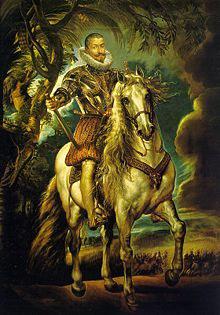
Equestrian Portrait of the Duke of Lerma, 1603, Museo del Prado, Madrid. Painted during Rubens's first trip to Spain in 1603.
Locations
People
Groups
Topics
- Protestant Reformation
- Counter-Reformation (also Catholic Reformation or Catholic Revival)
- Portraits, Baroque
- Western Art: 1600 to 1612
Subjects
Regions
Subregions
Related Events
Showing 10 events out of 33830 total
Years: 1603 - 1603
Equestrian Portrait of the Duke of Lerma, 1603, Museo del Prado, Madrid. Painted during Rubens's first trip to Spain in 1603.
Locations
People
Groups
Topics
- Protestant Reformation
- Counter-Reformation (also Catholic Reformation or Catholic Revival)
- Portraits, Baroque
- Western Art: 1600 to 1612
Subjects
Regions
Subregions