
Peter Paul Rubens’ first version of the …
Years: 1612 - 1612
Peter Paul Rubens’ first version of the Massacre of the Innocents, painted by the artist around 1611–12, is widely regarded as a demonstration of the artist's learnings from his time spent in Italy between 1600 and 1608, where he had observed first-hand the works of Italian Baroque painters like Caravaggio.
These influences are seen in this painting through the sheer drama and emotive dynamism of the scene, as well as the rich color.
There is also evidence of the use of chiaroscuro.
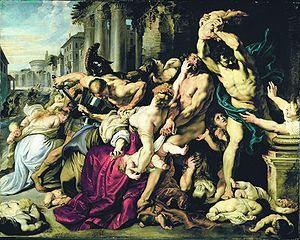
Peter Paul Rubens: Massacre of the Innocents (ca. 1611-1612)
Locations
People
Groups
Topics
Subjects
Regions
Subregions
Related Events
Filter results
Showing 10 events out of 33331 total
The Dutch begin to explore the region of southwestern Oceania in the early seventeenth century.
Like Hideyoshi, Ieyasu encourages foreign trade but also is suspicious of outsiders.
He wants to make Edo a major port, but once he learns that the Europeans favor ports in Kyushu and that China has rejected his plans for official trade, he moves to control existing trade and allows only certain ports to handle specific kinds of commodities.
A code of laws is established to regulate the daimyo houses.
The code encompasses private conduct, marriage, dress, and types of weapons and numbers of troops allowed; requires alternate-year residence at Edo; prohibits the construction of ocean-going ships; proscribes Christianity; and stipulates that bakufu regulations are the national law.
Although the daimyo are not taxed per se, they are regularly levied for contributions for military and logistical support and such public works projects as castles, roads, bridges, and palaces.
The various regulations and levies not only strengthened the Tokugawa but depletes the wealth of the daimyo, thus weakening their threat to the central administration.
The han, once military-centered domains, become mere local administrative units.
The daimyo does have full administrative control over their territory and complex systems of retainers, bureaucrats, and commoners.
Loyalty is exacted from religious foundations, already greatly weakened by Nobunaga and Hideyoshi, through a variety of control mechanisms.
The Tokugawa not only consolidate their control over a reunified Japan, they also have unprecedented power over the emperor, the court, all daimyo, and the religious orders.
The emperor is held up as the ultimate source of political sanction for the shogun, who ostensibly is the vassal of the imperial family.
The Tokugawa helps the imperial family recapture its old glory by rebuilding its palaces and granting it new lands.
To ensure a close tie between the imperial clan and the Tokugawa family, Ieyasu's granddaughter is made an imperial consort in 1619.
Saris is the chief factor of the EIC's trading post in Java, and with the assistance of William Adams, a British sailor who had arrived in Japan in 1600, is able to gain permission from the ruler to establish a commercial house in Hirado on the Japanese island of Kyushu.
However, unable to obtain Japanese raw silk for import to China and with their trading area reduced to Hirado and Nagasaki from 1616 onward, in 1623 the company closes their factory
The Growing Demand for Mercury in Science and Technology (17th Century Onward)
With scientific and technological advancements beginning in the 17th century, mercury became increasingly important for use in thermometers, barometers, and later electrical and chemical applications. The demand for this versatile metal continued to grow as instrumentation and industrial processes evolved.
Early Scientific Uses of Mercury
-
Thermometers and Barometers (17th–18th Century)
- Mercury thermometers were pioneered by Daniel Gabriel Fahrenheit (1714), who used mercury instead of alcohol, as it remained liquid over a wider temperature range.
- Evangelista Torricelli (1643) created the first mercury barometer, using the metal’s high density to measure atmospheric pressure.
-
Chemical and Industrial Uses (18th–19th Century)
- Mercury was used in gold and silver extraction (amalgamation process), especially in Spanish colonial mines in South America.
- In medicine, it was used in remedies such as mercurial ointments and quicksilver pills, despite its toxic effects.
-
Electrical and Industrial Applications (19th–20th Century)
- Mercury arc rectifiers were developed in the early 20th century to convert AC to DC electricity.
- Chlor-alkali processes used mercury to produce chlorine and sodium hydroxide, important for chemical manufacturing.
- Mercury-vapor lamps and switches became widely used in lighting and electrical circuits.
Impact of Rising Mercury Demand
- Increased mining activity, especially in Almadén (Spain), Idria (Slovenia), and Huancavelica (Peru), led to environmental and health concerns.
- By the 20th century, mercury’s toxicity became well-documented, leading to declining industrial use and stricter regulations.
Conclusion: Mercury’s Role in Scientific and Industrial Progress
From the 17th century onward, mercury played a crucial role in scientific instrumentation, industrial applications, and electrical technology. Though its use declined due to health risks, it remains an essential element in historical advancements in physics, chemistry, and engineering.
East Europe (1612–1623 CE): Restoration of Stability and the Romanov Ascendancy
Political and Military Developments
End of the Time of Troubles
From 1612 to 1623 CE, Muscovy emerged from the chaotic "Time of Troubles," marked by the expulsion of foreign forces and restoration efforts by national militia led by Dmitry Pozharsky and Kuzma Minin. The political crisis gradually subsided, paving the way for renewed stability.
Ascension of the Romanov Dynasty
In 1613, the Zemsky Sobor (Assembly of the Land) elected Michael Romanov as tsar, establishing the Romanov dynasty. This event marked a significant turning point, ushering in an era of political stabilization, administrative reforms, and central authority reinforcement.
Territorial Management and Security
Muscovy strengthened its military defenses and administrative controls over regions destabilized during previous conflicts. Security measures were enhanced, and diplomatic relations with neighboring states, especially Poland-Lithuania and Sweden, were cautiously managed to avoid further conflicts.
Economic and Technological Developments
Economic Recovery and Trade Revival
Economic conditions improved significantly as stability returned. Trade routes reopened, and commerce revitalized urban economies, notably in Moscow and other significant trade hubs. Efforts were made to rehabilitate agricultural productivity and infrastructure.
Military and Infrastructure Innovations
Technological advancements, particularly in military fortifications and infrastructure, continued to enhance regional security and territorial control. Military tactics and siege capabilities were refined to prevent future instability.
Cultural and Artistic Developments
Cultural Revival and Patronage
Cultural activities regained momentum, benefiting from renewed royal and aristocratic patronage. Architectural projects flourished, and religious and secular arts experienced a resurgence, contributing to Muscovy’s renewed cultural vitality.
Intellectual and Literary Productivity
Intellectual activities, including chronicling and scholarly documentation, flourished during this recovery period. These endeavors recorded and analyzed political and social developments, reinforcing historical identity and cultural continuity.
Settlement Patterns and Urban Development
Urban Regeneration and Expansion
Cities, particularly Moscow, underwent significant regeneration and expansion, supported by strategic urban planning and improved infrastructure. Population growth resumed, and administrative effectiveness improved.
Strengthening Urban Fortifications
Efforts continued to strengthen and expand urban fortifications, providing robust security and stability essential for urban recovery and growth.
Social and Religious Developments
Restoring Social Cohesion
Societal cohesion steadily improved as political stability returned. Integration of diverse ethnic groups continued, facilitating administrative effectiveness and social harmony.
Orthodox Church’s Role in Rebuilding
The Orthodox Church played a critical role in rebuilding efforts, guiding moral recovery, supporting educational initiatives, and strengthening community structures, significantly aiding societal stability and cultural restoration.
Long-Term Consequences and Historical Significance
The era from 1612 to 1623 CE represented a significant recovery period for Muscovy, marked by the establishment of the Romanov dynasty and renewed political and social stability. These developments laid essential foundations for future territorial expansion, administrative reforms, and cultural flourishing in Russia.
Northeast Europe (1612–1623 CE): Military Confrontations, Territorial Realignments, and Cultural Flourishing
Between 1612 and 1623 CE, Northeast Europe experienced intensified military confrontations, strategic territorial realignments, and continued cultural and intellectual vibrancy. This period, marked by significant regional conflicts such as the Kalmar War, reshaped political boundaries and further defined the roles of major powers like Sweden, Denmark–Norway, Poland–Lithuania, and Muscovy.
The Kalmar War and Swedish-Danish Rivalry
The Kalmar War (1611–1613) between Sweden under King Gustavus Adolphus and Denmark–Norway under King Christian IV significantly heightened regional tensions. Though brief, the conflict centered on control of Baltic trade routes and territorial dominance. The resulting Treaty of Knäred (1613) forced Sweden into substantial monetary concessions, temporarily enhancing Danish–Norwegian influence but leaving underlying rivalries unresolved.
Swedish Reforms and Expansion under Gustavus Adolphus
Following the Kalmar War, King Gustavus Adolphus (r. 1611–1632) undertook major military and administrative reforms, significantly strengthening Sweden’s capabilities. He modernized the army, enhanced central governance, and promoted aggressive territorial expansion in Livonia and Ingria, fortifying strategic cities like Reval (Tallinn) and Narva. These reforms laid foundations for Sweden’s rise as a major European power.
Polish–Lithuanian Commonwealth’s Continued Influence
Under King Sigismund III Vasa, the Polish–Lithuanian Commonwealth solidified its administrative presence in Livonia and maintained diplomatic influence throughout the region. Persistent tensions with Sweden, particularly regarding Sigismund’s claims to the Swedish throne, sustained political rivalries, influencing diplomatic negotiations and military strategies.
Muscovy’s Stabilization and Reforms
Muscovy, emerging from the tumultuous "Time of Troubles" with the establishment of the Romanov dynasty under Tsar Michael I (r. 1613–1645), stabilized internally through administrative reforms and diplomatic realignments. Though cautious, Muscovy gradually reasserted influence, preparing strategically for renewed territorial and diplomatic engagements in the Baltic region.
Economic Stability and Political Neutrality in Prussia
The secularized Duchy of Prussia, under Duke Albert Frederick, maintained political neutrality, economic stability, and robust governance. Königsberg continued as a key economic hub, sustaining regional prosperity despite surrounding geopolitical tensions and conflicts.
Continued Economic Prosperity in Major Urban Centers
Urban centers such as Reval (Tallinn), Riga, Königsberg, and Visby maintained robust economic growth, driven by maritime commerce, strong merchant networks, and stable urban governance. These cities remained economic anchors, buffering the region against disruptions caused by military conflicts and political rivalries.
Cultural and Intellectual Flourishing
Protestantism, especially Lutheranism, further stimulated cultural and educational growth, expanding universities, scholarly institutions, and literacy rates across Northeast Europe. Religious education fostered intellectual innovation and cultural production, significantly shaping societal structures and identities.
Advancements in Science and Scholarship
Scientific and intellectual activities continued to thrive, inspired by earlier scholars like Tycho Brahe. Northeast Europe advanced as a key center of astronomical research and scientific inquiry, contributing significantly to early modern Europe's intellectual heritage.
Diplomatic Realignments and Strategic Alliances
Diplomatic negotiations intensified significantly during this period, characterized by shifting alliances, territorial claims, and cautious strategic maneuvering. The complex diplomatic interplay among Sweden, Denmark–Norway, Poland–Lithuania, Muscovy, and Prussia reflected persistent regional uncertainty and efforts toward stability.
Legacy of the Era
The era from 1612 to 1623 CE profoundly impacted Northeast Europe through significant military confrontations, territorial realignments, and continued cultural and intellectual vibrancy. These developments significantly shaped the region’s political landscape, economic resilience, and cultural identities, laying critical groundwork for subsequent historical trajectories.
East Central Europe (1612–1623 CE): Bohemian Revolt, Thirty Years' War Outbreak, and Intensifying Religious Conflict
Between 1612 and 1623 CE, East Central Europe—encompassing modern-day Poland, Czechia, Slovakia, Hungary, and the eastern territories of Germany and Austria—became the epicenter of profound turmoil marked by the outbreak of the Thirty Years' War, intense religious polarization, and widespread political instability. Triggered by the Bohemian Revolt against Habsburg rule, the period dramatically reshaped the region’s political landscape, escalating from regional dissent into a destructive pan-European conflict.
Political and Military Developments
Matthias’s Ascension and Imperial Crisis
-
Following Emperor Rudolf II’s death in 1612, his brother Matthias (1612–1619) inherited an empire already fraught with internal divisions. Matthias struggled to assert centralized authority over increasingly defiant Protestant nobles in Bohemia, Moravia, and Austria, who demanded religious liberties and political autonomy.
Bohemian Revolt and Defenestration of Prague (1618)
-
In 1618, Protestant nobles in Bohemia violently rejected Habsburg Catholic governance in the Defenestration of Prague, throwing imperial officials from Prague Castle’s windows. This dramatic rebellion marked the official outbreak of the Thirty Years' War.
-
Bohemian nobles elected the Calvinist Elector Palatine, Frederick V, as their new king in 1619, directly challenging Habsburg authority and escalating the conflict regionally.
Ferdinand II and Habsburg Counteroffensive
-
Ferdinand II (1619–1637) succeeded Matthias as Holy Roman Emperor and king of Bohemia and Hungary. Deeply committed to Catholicism, Ferdinand refused compromise, launching an aggressive military campaign to reclaim Bohemia and punish rebels.
-
At the pivotal Battle of White Mountain (1620) near Prague, Ferdinand’s imperial forces decisively crushed the Protestant alliance, forcing Frederick V to flee and ending Protestant rule in Bohemia.
Expanding Conflict into Germany
-
The Bohemian conflict rapidly escalated into broader German territories, drawing numerous Protestant and Catholic states into direct military confrontation. The Palatinate, Saxony, Brandenburg, and Bavaria soon became heavily involved, significantly widening the war’s geographic and political scope.
Economic and Technological Developments
Devastating Economic Impact of War
-
The outbreak and intensification of the Thirty Years' War severely disrupted regional economies. Agricultural productivity collapsed, trade routes fractured, and widespread destruction crippled urban centers, notably Prague and its surrounding regions following the Battle of White Mountain.
-
Despite wartime destruction, military-related industries—especially armaments, metallurgy, and fortification-building—briefly thrived, driven by growing demand for weaponry and defensive infrastructure.
Cultural and Artistic Developments
Cultural Disruption and Artistic Decline
-
While artistic and cultural activities initially continued in Prague under early Habsburg rule, the Battle of White Mountain (1620) severely disrupted cultural patronage and intellectual life. Many Protestant intellectuals, artists, and craftsmen fled Bohemia, significantly impacting Prague’s renowned Renaissance cultural heritage.
Catholic Cultural Resurgence
-
Habsburg victory bolstered Catholic cultural resurgence across East Central Europe, prominently promoting Baroque artistic expression as a statement of Catholic triumph. Ecclesiastical patronage significantly expanded, supporting elaborate church construction and religious artworks designed to reaffirm Catholic authority.
Settlement and Urban Development
Widespread Urban Destruction
-
Numerous towns, cities, and villages across Bohemia, Moravia, and eastern Germany suffered severe damage during the war’s early years. Prague, previously prosperous and culturally dynamic, experienced significant depopulation, economic decline, and physical destruction, requiring decades of recovery.
-
Frontier fortifications and defensive constructions expanded significantly across strategic border regions, reflecting heightened military tensions and regional instability.
Social and Religious Developments
Deepening Religious Polarization and Catholic Restoration
-
The Bohemian Revolt intensified religious polarization throughout East Central Europe. After the Battle of White Mountain, Ferdinand II imposed harsh re-Catholicization policies across Bohemia and Moravia, forcibly suppressing Protestantism and driving large-scale emigration.
-
Protestant communities across Germany, Poland, and Hungary increasingly faced restrictions and persecution, further polarizing society and setting the stage for decades of religious conflict.
Aristocratic Repression and Social Upheaval
-
Ferdinand’s crackdown severely diminished noble autonomy in Bohemia, Moravia, and Austria, confiscating lands and redistributing properties to loyal Catholic aristocrats. This reshaped regional aristocratic structures, deepening social divisions and displacing traditional elites.
Long-Term Consequences and Historical Significance
The era 1612 to 1623 CE profoundly transformed East Central Europe, marking the explosive outbreak of the Thirty Years' War, dramatically reshaping political alliances, religious identities, and social structures. The decisive Catholic victory at White Mountain profoundly impacted Bohemian and regional histories, imposing Catholic dominance, widespread cultural repression, and economic devastation. The resultant political and religious polarization irrevocably shaped the trajectory of Central European history, setting a volatile foundation for decades of continued warfare and social upheaval across the continent.
The word hajduk, which had entered the Polish language from Hungarian in the late sixteenth century, was initially a colloquial term for a style of foot soldier, Hungarian or Turco-Balkan in inspiration, that has formed the backbone of the Polish infantry arm from the 1570s.
Unusually for this period, Polish-Lithuanian hajduks wear uniforms, typically of grey-blue woolen cloth, with red collar and cuffs.
Their principal weapon is a small caliber matchlock firearm, known as an arquebus.
For close combat they also carry a heavy variety of saber, capable of hacking off the heads of enemy pikes and polearms.
Contrary to popular opinion, the small axe they often wear tucked in their belt (not to be confused with the huge half-moon shaped berdysz axe, which is seldom carried by hajduks) is not a combat weapon but a tool for cutting wood.
Years: 1612 - 1612
Peter Paul Rubens: Massacre of the Innocents (ca. 1611-1612)
Locations
People
Groups
Topics
Subjects
Regions
Subregions