Peter goes to Sardinia in 1354 and …
Years: 1354 - 1354
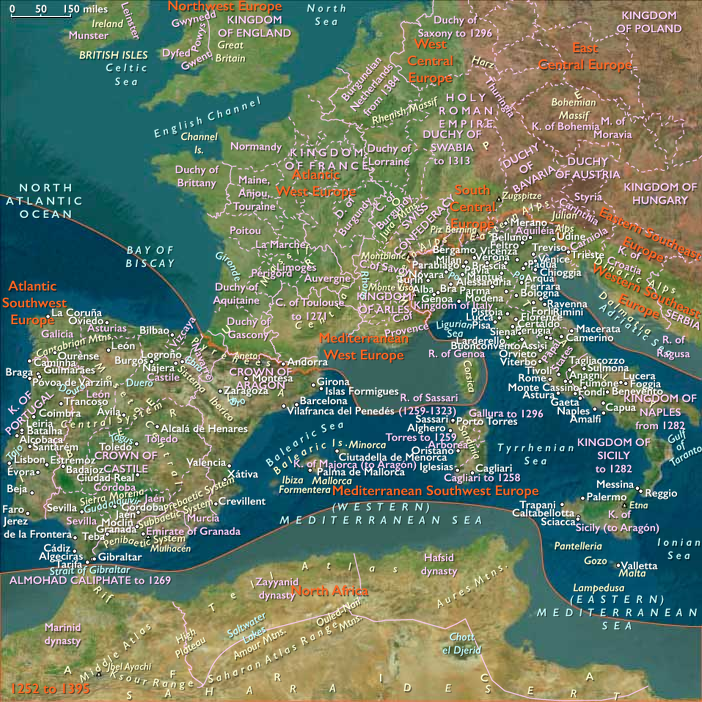
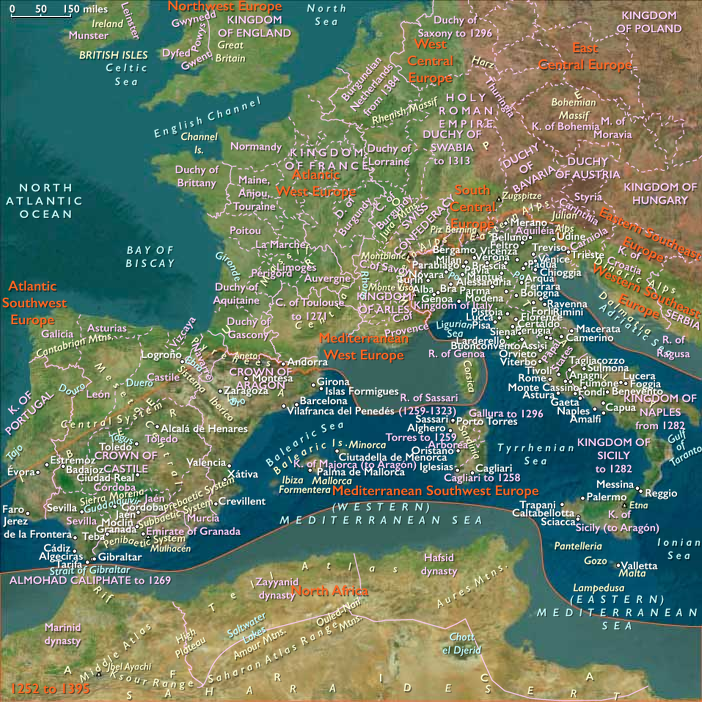
Peter goes to Sardinia in 1354 and succeeds in suppressing most of the rebels, but opposition to Aragonese governance persists.
Locations
People
Groups
- Genoa, (Most Serene) Republic of
- Arborea, Giudicato of
- Aragón, Kingdom of
- Venice, (Most Serene) Republic of
- Aragon, Crown of
- Catalonia, Principality of
- Sardinia, Kingdom of
Topics
Commodoties
Subjects
Regions
Subregions
Related Events
Filter results
Showing 10 events out of 44142 total
The final years of the Yuan dynasty are marked by struggle, famine, and bitterness among the populace.
Kublai Khan's successors had in time lost all influence on other Mongol lands across Asia, while the Mongols beyond the Middle Kingdom see them as too Chinese.
They have gradually lost influence in China as well.
The reigns of the later Yuan emperors have been short and marked by intrigues and rivalries.
Uninterested in administration, they are separated from both the army and the populace, and China is torn by dissension and unrest.
Outlaws ravage the country without interference from the weakening Yuan armies.
People in the countryside from the late 1340s onward have suffered from frequent natural disasters such as droughts, floods and the resulting famines, and the government's lack of effective policy has led to a loss of popular support.
The Red Turban Rebellion, which started in 1351, has grown into a nationwide uprising.
When Toghtogha in 1354 leads a large army to crush the Red Turban rebels, Toghun Temür suddenly dismisses him for fear of betrayal.
This results in Toghun Temür's restoration of power on the one hand and a rapid weakening of the central government on the other.
He has no choice but to rely on local warlords' military power, and will gradually lose his interest in politics and cease to intervene in political struggles.
Empress Gi, whose son Ayurshiridara had been designated Crown Prince in 1353, has begun a campaign to force the emperor to pass the imperial throne to her son, using her Korean eunuch Bak Bulhwa as her agent..
Her intentions become known to the emperor, however, and he grows apart from her.

Orhan, as John VI's ally, had in 1346 married Theodora, John's daughter, and had acquired the right to conduct raids in the Balkans.
Ottoman raiding parties had begun to move regularly through Gallipoli into Thrace.
Huge quantities of captured booty strengthen Ottoman power and attract thousands from the uprooted Turkmen masses of Anatolia into Ottoman service.
Orhan’s campaigns provide the Ottomans with an intimate knowledge of the area.
John Kantakouzenos has never been popular as an emperor, and feeling against him comes to a head when some of his Ottoman mercenaries, under Orhan's son Süleyman, take the occasion of the destruction of Gallipoli by earthquake to occupy and fortify the city in March 1354.
They refuse to leave, despite the protests of Kantakouzenos and others.
It is the Ottomans' first permanent establishment in Europe, at the key point of the crossing from Asia.
From Gallipoli, Süleyman’s bands move up the Maritsa River into southeastern Europe, raiding as far as Adrianople.
The island of Lesbos had passed to the Latin Empire after the Fourth Crusade (1202–1204) but had been reconquered sometime after 1224 by the Empire of Nicaea.
It is granted in 1354 as a fief to the Genoese Francesco I Gattilusio, whose family will rule Lesbos until it is conquered in 1462 by the Ottoman Turks.
Louis invades Serbia, forcing Stephen Dušan to withdraw from the region along the river Sava.
Under duress, Stephen Dušan initiates negotiations with the Holy See of the acknowledgment of the popes' primacy.
Dušan's law code is the most lasting monument to his rule.
For the purposes of Dušan's Code, a wealth of charters have been published, and some great foreign works of law have been translated to Serbian; however, the third section of the Code is new and distinctively Serbian, albeit with Greek influence and attention to a long legal tradition in Serbia.
Dušan explains the purpose of his Code in one of in his charters; he intimates that its aims are spiritual and that the code will help his people to save themselves for the afterlife.
The Code had been proclaimed on May 21, 1349, in Skopje, and contained one hundred and fifty-five clauses, while in 1353 or 1354 sixty-six further clauses are added at Serres.
The authors of the code are not known, but they are probably members of the court who specialize in law.
Dušan's Code proclaims on subjects both secular and ecclesiastic, the more so because Serbia has recently achieved full ecclesiastic autonomy as an independent Orthodox Church under a Patriarchate.
The first thirty-eight clauses relate to the church and they deal with issues that the Medieval Serbian Church faces, while the next twenty-five clauses relate to the nobility.
Civil law is largely excluded, since it was covered in earlier documents, namely Saint Sava's Nomokamon and in Corpus Juris Civilis.
Dušan's Code originally deals with criminal law, with heavy emphasis on the concept of lawfulness, which is mostly taken directly from imperial Greek law.
Following Stephen Dusan’s death at forty-seven on December 20, 1354, his son and successor ascends the Serbian throne as Stephen Uros V, under whom the Serbian empire will rapidly collapse.
The Nemanje dynasty has given Serbia masterpieces of religious art combining Western, imperial Greek, and local styles.
The Nemanjic state under Dushan's reign has reached its greatest extent, incorporating Thessaly, Epirus, Macedonia, all of modern Albania and Montenegro, a substantial part of eastern Bosnia, and modern Serbia as far north as the Danube.
Dushan has very nearly realized his ambition to found a new Serbo-Greek empire.
During the course of his entire reign, Dushan has remained on the defensive in the north, although he has succeeded in preventing Hungary from extending its boundaries south of the fortresses on the Save and Danube rivers.
He is the only man who might be able to prevent the rapid expansion of the Turks into the Balkans, but he dies on December 20, 1354, at forty-seven.
The defeat of the Genoese by Peter and his Venetian and Catalan allies near Alghero off the Sardinian coast allows Venice to blockade Genoa, which then concludes an alliance with Milan and resumes the offensive.
Peter goes to Sardinia in 1354 and succeeds in suppressing most of the rebels, but opposition to Aragonese governance persists.
Venice, losing to Genoa in the 1354 naval Battle of Sapienza near southern Greece, is forced to conclude a peace by which both cities pledge not to encroach on each other’s territory and commercial routes.
Cola di Rienzo, following imprisonment in Prague and Avignon, reenters Rome in August 1354 as an envoy of Pope Innocent VI, having collected a few mercenary troops on the way.
He is received with great rejoicings and quickly regains his former position of power.
After vainly besieging the fortress of Palestrina, he returns to Rome, where he treacherously seizes the soldier of fortune, Giovanni Moriale, who is put to death, and where, by other cruel and arbitrary deeds, he soon loses the favor of the people.
Their passions are quickly aroused and a tumult breaks out on October 8.
Cola attempts to address them, but the building in which he stands is set on fire, and while trying to escape in disguise he is murdered by the mob on October 8.
Milan’s ruler, the sixty-four-year-old Archbishop Giovanni Visconti, had been thwarted by the Florentines in his 1351 grab for their territory.
He prepares to renew his attack but dies on October 5, 1354 before launching it.
Lombardy is divided among his nephews: thirty-one-year-old Bernabo Visconti is given Milan; …
Years: 1354 - 1354
Locations
People
Groups
- Genoa, (Most Serene) Republic of
- Arborea, Giudicato of
- Aragón, Kingdom of
- Venice, (Most Serene) Republic of
- Aragon, Crown of
- Catalonia, Principality of
- Sardinia, Kingdom of