
Peter Damian, born in Ravenna, Italy, around …
Years: 1045 - 1045
Peter Damian, born in Ravenna, Italy, around 1007 and orphaned early, had spent his youth in hardship and privation, but showed such signs of remarkable intellectual gifts that his brother, Damianus, archpriest at Ravenna, took him to be educated.
Adding his brother's name to his own, Peter had made such rapid progress in his studies of theology and canon law, first at Ravenna, then at Faenza, finally at Parma, that when about twenty-five years old he was already a famous teacher at Parma and Ravenna.
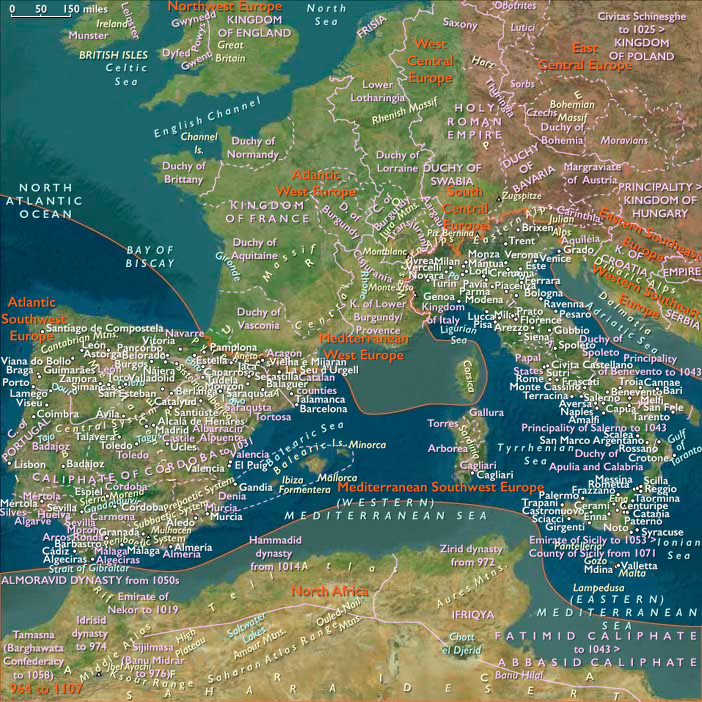
About 1035, however, he had deserted his secular calling and, avoiding the compromised luxury of Cluniac monasteries, entered the isolated hermitage of Fonte Avellana, near Gubbio.
Both as novice and as monk, his fervor was remarkable but had led him to such extremes of self-mortification in penance that his health was affected.
On his recovery, he had been appointed to lecture to his fellow monks, then, at the request of Guy of Pomposa (Guido d'Arezzo) and other heads of neighboring monasteries, for two or three years he had lectured to their brethren also, and (about 1042) wrote the life of St. Romuald for the monks of Pietrapertosa.
Soon after his return to Fonte Avellana he had been appointed economus (manager or housekeeper) of the house by the prior, who had designated him as his successor.
In 1043 he had become prior of Fonte Avellana, and will remaine so until his death in February 1072.
A zealot for monastic and clerical reform, he has introduced a more-severe discipline, including the practice of flagellation ("the disciplina"), into the house, which, under his rule, has quickly attained celebrity, and become a model for other foundations, even the great abbey of Monte Cassino: subject-hermitages will be founded at San Severino, Gamogna, Acerreta, Murciana, San Salvatore, Sitria and Ocri.
There is much opposition outside his own circle to such extreme forms of penitence, but Peter's persistent advocacy ensures its acceptance, to such an extent that he is eventually obliged to moderate the imprudent zeal of some of his own hermits.
Another innovation is that of the daily siesta, to make up for the fatigue of the night office.
During his tenure of the priorate, a cloister is built, silver chalices and a silver processional cross are purchased, and many books are added to the library, a collection which he cares about very much.
Although living in the seclusion of the cloister, Peter Damian closely watches the fortunes of the Church, and like his friend Hildebrand, the future Pope Gregory VII, he strives for reforms in a deplorable time.
When Benedict IX resigns the pontificate into the hands of the archpriest John Gratian (Gregory VI) in 1045, Peter hails the change with joy and writes to the new pope, urging him to deal with the scandals of the church in Italy, singling out the wicked bishops of Pesaro, of Città di Castello and of Fano.
Locations
People
Groups
- Germans
- Christianity, Chalcedonian
- Papal States (Republic of St. Peter)
- Italy, Kingdom of (Holy Roman Empire)
Subjects
Regions
Subregions
Years: 1045 - 1045
Locations
People
Groups
- Germans
- Christianity, Chalcedonian
- Papal States (Republic of St. Peter)
- Italy, Kingdom of (Holy Roman Empire)
Subjects
Regions
Subregions