
Mansur al-Hallaj, a Persian mystic, breaks his …
Years: 909 - 909
Mansur al-Hallaj, a Persian mystic, breaks his early ties with Sufism, the mystical school of Islam, and turns to public preaching, but comes under fire from the Sufis for revealing his secret experiences publicly.
When he utters the phrase “ana l'haqq” ("I Am the Truth"), a Sufi faction brings charges of blasphemy against him.
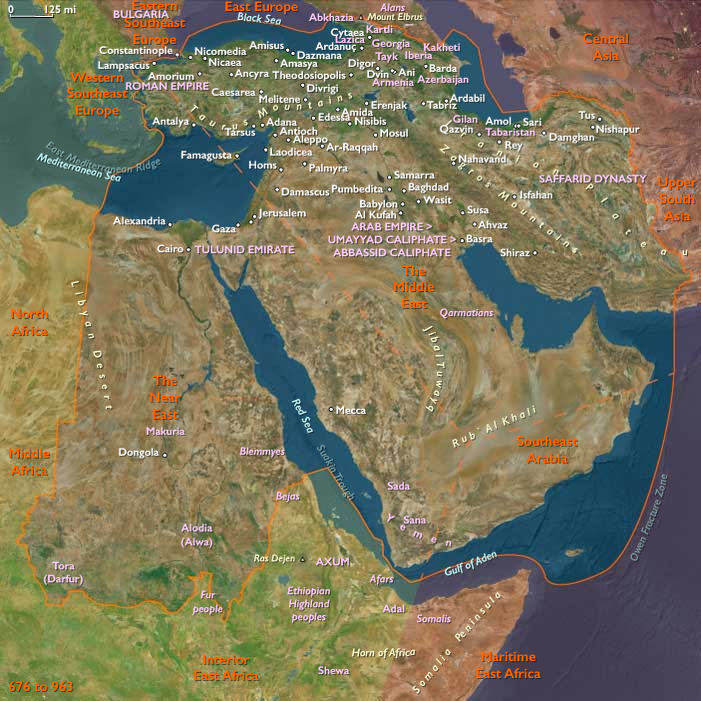
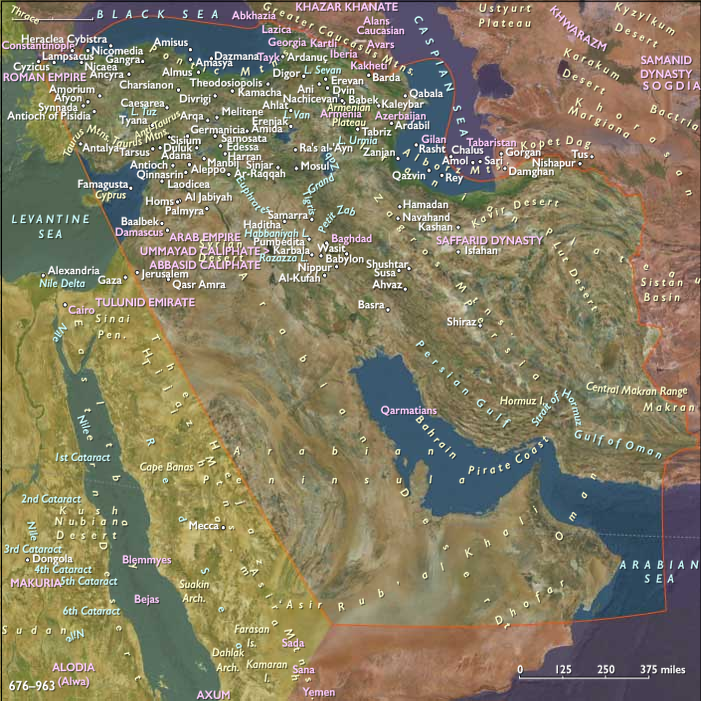
After a 908 pilgrimage to Mecca, al-Hallaj gathers a large band of disciples in Baghdad and preaches to them his versions of mysticism and asceticism.
Locations
People
Groups
Topics
Subjects
Regions
Subregions
Related Events
Filter results
Showing 10 events out of 53449 total
Wang Shenzhi establishes the Min Kingdom in today's Fujian Province, with Fuzhou (known at this time as Changle) as its capital, in 909.
When the major warlord Zhu Quanzhong the military governor of Xuanwu Circuit (headquartered in modern Kaifeng, Henan) forced Emperor Zhaozong's son and successor Emperor Ai to yield the throne to him, ending Tang and starting a new Later Liang Dynasty with him as its Emperor Taizu, Wang Shenzhi had recognized the new emperor, and had subsequently been given the greater chancellor title of Shizhong.
In 909, Emperor Taizu creates him the Prince of Min, and also gives him the chancellor title of Zhongshu Ling.
Also in 909, after Wang Shenzhi feels slighted by Zhang Zhiyuan, the emissary from Hongnong (the predecessor state to Wu, ruled at this time by Yang Wo the Prince of Hongnong, who does not recognize the Later Liang emperor), Wang decapitates Zhang and breaks off diplomatic relations with Hongnong.
Arnulf, soon after his ascension to the Bavarian dukedom, had faced constant raids from the Hungarians, who have laid waste to the lands of Bavaria, Saxony, and Thuringia.
In 909, the Magyars raid Alamannia.
On their return, however, Arnulf inflicts a reverse upon them on the Rott (river).
Yusuf ibn Abi'l Saj had come to power in Azerbaijan 901 by overthrowing his nephew, Devdad Ibn Muhammad.
He had razed the walls of Maragha and moved the capital of the Sajid dynasty to Ardabil.
Shortly afterwards, the Bagratid king of Armenia, Smbat I, had offered to become a direct vassal of the caliph al-Muktafi.
As this threatened the Sajids' interests in Armenia, Yusuf had demanded that Smbat appear before him.
When the Bagratid refused, Yusuf had invaded Armenia.
An agreement was eventually reached between the two sides in 903; Smbat received a crown from Yusuf, acknowledging him as his overlord.
Yusuf had never formalized his relations with the caliph, and they had became hostile toward each other.
In 908 a caliphal army had been sent against Yusuf, but al-Muktafi had died and his successor al-Muqtadir had made peace with the Sajid.
Al-Muqtadir's vizier Ibn al-Furat had been instrumental in the establishment of the peace; from this point forward, Yusuf will consider him to be his protector in Baghdad and often name him on his coinage.
The peace allows Yusuf to be invested with the governments of Azerbaijan and Armenia in 909 by the caliph.
Isma'ilis from Yemen have reached North Africa, where the Fatimid movement arises.
Before the Fatimids, there had been other rulers in North Africa and Egypt who had succeeded in making themselves virtually independent of the 'Abbasid caliphs in Baghdad; but they had been Muslims of the Sunni branch of Islam, willing to recognize the token suzerainty of the caliph as head of the Islamic community.
The Fatimids, however, as the heads of a rival religious movements—the Isma'ili sect of the Shi'i branch—are dedicated to the overthrow of the existing religious and political order in all Islam.
Unlike their predecessors, they refuse to offer even nominal recognition to the 'Abbasid caliphs, whom they reject as usurpers.
They themselves—as Isma'ili imams, descendants of the Prophet through his daughter Fatimah and his kinsman 'Ali—are, in the eyes of their followers, the rightful caliphs, both by descent and by divine choice the custodians of the true faith and the legitimate heads of the universal Islamic state and community.
Their purpose is not to establish another regional sovereignty but to supersede the 'Abbasids and to found a new caliphate in their place.
By 909, they are strong enough for their imam, who had been in hiding, to emerge and proclaim himself caliph, with the messianic title of al-Mahdi (the Rightly Guided One).
This marks the beginning of a new state and dynasty.
The decline of the Aghlabid dynasty of Ifriqiya had begun under Ibrahim II ibn Ahmad (875-902).
An attack by the Tulunids of Egypt had had to be repelled and a revolt of the Berbers put down with much loss of life.
In addition, in 893 there had begun among the Kutama Berbers the movement of the Shiite Fatimids to overthrow the Aghlabids.
Ubaydalla Said has captured the cities of Kairouan and …
…Raqqada and has taken an oath of allegiance from the people.
By 909, the Aghlabid Dynasty is overthrown and replaced with the Ismaili Shiite Fatimid dynasty, which claims descent from Fatima, daughter of the Prophet Muhammad, through Ismail, the older, disinherited son of the sixth Shiite imam, Jafar ibn Muhammad.
Al-Mahdi Billah proclaims himself as the Imam in 909.
Tiaret had grown up as a site under the domination of petty Berber tribal kingdoms; the first of these being the Rustamid dynasty between 761 and 909 when Tiaret serves as the capital of the area.
However, this capital may have been ten kilometers (six or seven miles) west of the present-day Tiaret.
It was first founded by Abd al-Rahman Rustamid, an Ibadi theologian from Greater Iran.
Tiaret was said to be relatively freethinking and democratic, being a center for scholarship that permits a wide range of sects and movements, notably the Mu'tazila.
There are many Jews living in the area until at least the tenth century, including the scholar and doctor Judah ibn Kuraish, who becomes the doctor to the Emir of Fes.
Tiaret occupies a strategic mountain pass at 3,552 feet (1,083 meters), and is thus a key to dominating the central Maghreb.
Later, from the start of the eighth century, it has served the key northern terminus of the West African branch of the slave trade.
As such, it offers a lucrative income from taxes on the trade, and is a desirable prize.
The Rustamids had fought the Kairouan-based Aghlabids of Ifriqiya in 812, but have otherwise reached a modus vivendi; this had displeased Ibādī tribes on the Aghlabid border, who have launched a few rebellions.
After Abdu l-Wahhāb, the Rustamids had grown militarily weak; they are easily conquered by the Berber Kutama tribesmen, allied to the Ismaili Fatimids, in 909, upon which many Ibāḍis—including the last Imām—flee their capital to the Sedrata tribe of Ouargla, whence they will ultimately emigrate to Mzab.
Significant parts of northeastern England, formerly Northumbria, are under the control of Danish Vikings after successful raids.
Danish attacks into central England had been resisted and effectively reduced by Alfred the Great, to the point where his son, King Edward of Wessex, can launch offensive attacks against the foreigners.
Edward is allied with the Mercians under his sister Æthelfleda, and their combined forces ware formidable.
The allies in 909 launch a five-week campaign against Lindsey and successfully capture the relics of Saint Oswald of Northumbria.
The Mayan site of Toniná in modern day Chiapas, Mexico, has been an aggressive state in the Late Classic, using warfare to develop a powerful kingdom.
For much of its history, Toniná has been engaged in sporadic warfare with Palenque, its greatest rival and one of the most important polities in the west of the Maya region, although Toniná had eventually become the dominant city in the west.
The last Long Count date is inscribed on a monument at Toniná, marking the end of the classic period.
All Maya "long count" calendar inscriptions fall between CE 292 and 909, roughly defining the period called Classic.
Subsequent Mayan civilization is known as Postclassic.
The caliphate, during the conflict with Yusuf, had encouraged King Smbat to oppose the Sajid.
Yusuf, after mending his relations with the caliph, had decided to retaliate, and has found a willing ally in the prince of Vaspurakan, Gagik Artsruni, who was engaged in a dispute with the Bagratid over the province of Nakhchivan.
Gagik became Yusuf's vassal and the Sajid had given him a crown.
Yusuf had taken Nakhchivan in 909, and, together with Gagik, had gained control of Siunikh.
He then pursued Smbat across the country, and after spending the winter in Dvin defeats in 910 an army under the command of Smbat's two sons, Ashot and Mushel to the north of Erevan.
Mushel is captured and poisoned.
