
...Perrot journeys to the junction of the …
Years: 1685 - 1685
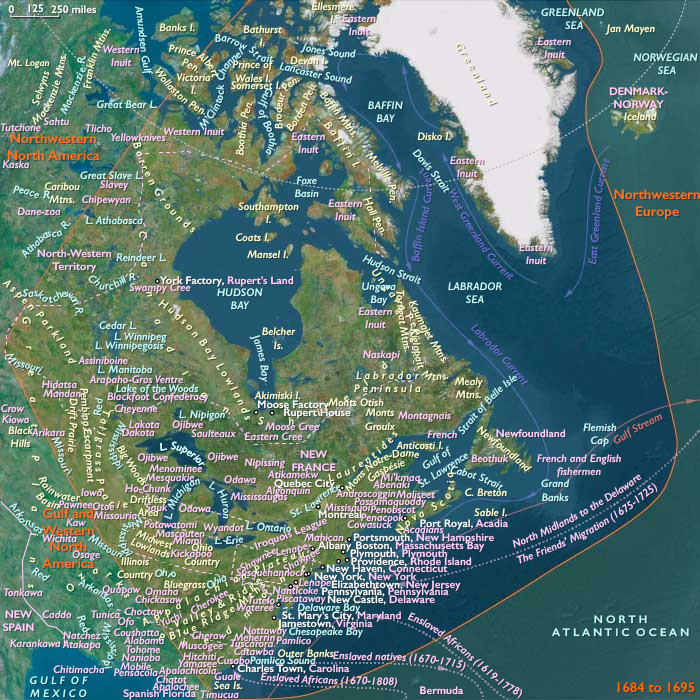
...Perrot journeys to the junction of the Wisconsin and Mississippi rivers, where he builds Ft. St. Nicolas near present-day Prairie du Chiene, considered to be Wisconsin’s second oldest European settlement (after Green Bay).
Locations
People
Groups
- Iroquois (Haudenosaunee, also known as the League of Peace and Power, Five Nations, or Six Nations)
- Meskwaki, or Fox tribe (Amerind tribe)
- Ojibwa, or Ojibwe, aka or Chippewa (Amerind tribe)
- New France (French Colony)
- France, (Bourbon) Kingdom of
Topics
- North American Fur Trade
- Colonization of the Americas, French
- Beaver Wars, or French and Iroquois Wars
Commodoties
Subjects
Regions

Subregions
Related Events
Filter results
Showing 10 events out of 29478 total
The Chinese porcelain industry at Jingdezhen has been reorganized under the Kangxi emperor, from 1661 the third Emperor of the Manchu Qing Dynasty and the second Qing emperor to rule over China proper.
The export trade is soon flourishing.
Famille rose (French: “rose family”), a group of Chinese porcelain wares characterized by decoration painted in opaque overglaze rose colors, chiefly shades of pink and carmine, are known to the Chinese as yang cai (“foreign colors”) because they are first introduced from Europe about 1685 during the reign of the Kangxi emperor, who will rule to 1722—the longest reign on the throne in China's history, sixty-one years.)
Famille rose enamel ware allows a greater range of color and tone than was previously possible, enabling the depiction of more complex images, including flowers, figures and insects.
Chinese export porcelain from the late seventeenth century includes blue and white and Famille verte wares (and occasionally Famille noire and jaune); Oriental blue and white porcelain is highly prized in Europe and America.
Wares include garnitures of vases, dishes, teawares, ewers, and other useful wares, figure models, animals and birds.
Francesco Morosini, who had first risen to prominence as Captain-General of the Venetian forces on Crete during the siege of Candia by the Ottoman Empire, had eventually been forced to surrender the city, and was accused of cowardice and treason on his return to Venice; however, he was acquitted after a brief trial.
Morosini takes command of a fleet against the Ottomans at the outbreak of the Morean War in 1685 and sacks Koroni, a seaport in in Messenia.
Italian woodcarver Andrea Brustolon had gone to Venice in 1677 for a year of training, moving to Rome in 1678.
Returning to Venice in 1680, he engaged in decorative carving for several churches and created his outstanding works, the furniture for the Venier di San Vio and Correr di San Simeone families; these walnut and ebony pieces are decorated with elaborately carved figures.
Known for his furniture in the flamboyant Venetian Baroque style, characterized by extravagant curves and lavish ornamentation, Brustolon returns to his birthplace, Belluno, in 1685 and devotes himself mainly to work for religious uses, usually in wood but occasionally in ivory.
A shipment of cocoa beans from Veracruz to Sevilla in 1585 is the first recorded shipment to Europe for commercial purposes.
Christopher Columbus had returned from the New World with some cocoa beans to show Ferdinand and Isabella of Spain but Spanish friars had introduced it to Europe more broadly.
It was still served as a beverage, but the Europeans had added sugar and milk to counteract the natural bitterness and removed the chili pepper, replacing it with another Mexican indigenous spice, vanilla.
These changes to the taste have made it a luxury item among the European nobility, and the drinking of chocolate in coffee houses has now become very fashionable.
The earliest surviving chocolate pot, made by the English silversmith George Garthorne, dates from 1685.
Similar in form and stylistic development to the coffeepot, the chocolate pot has a hinged or sliding finial covering an aperture through which is introduced a molionet, or stick for stirring and crushing the chocolate.
The first form of solid chocolate will not be invented until the end of the eighteenth century.
John Blow composes the earliest surviving English opera.
An organist and noted for his church music, Blow composes Venus and Adonis between 1680 and 1685 for performance at court and called by him A Masque for the Entertainment of the King.
French fur trader Nicolas Perrot had immigrated to New France (Canada) as a youth, and his services there under the Jesuits and Sulpicians enabled him to learn native languages and native cultures.
He had entered the fur trade about 1663, working in the Great Lakes region, and in 1668 he was among the first French traders who dealt with the Algonkin tribes around Green Bay.
Governor Frontenac had sent Perrot in 1670 as interpreter on an expedition that claimed the Upper Mississippi area for France in June 1671.
He returned to New France that autumn, married, and settled on an estate at Becancour.
For the next twelve years, he evidently worked his lands but also engaged in some fur trading, as he was awarded a license for that purpose in 1674.
In 1683 Governor Lefebvre de La Barre had authorized Perrot to undertake a Great Lakes trading expedition, and the next year, the governor directed him to obtain the support of western tribes in his campaign against the Iroquois.
After negotiating peace between the Ojibwa and Fox tribes in 1685, he is made commandant of the Green Bay region, and, with his commission, ...
René-Robert Cavelier, Sieur de La Salle, had on July 24, 1684, sailed again from France and returned to America with four ships and three hundred colonists in order to establish a French colony on the Gulf of Mexico, at the mouth of the Mississippi River.
One ship was lost to pirates in the West Indies and a second sank in the inlets of Matagorda Bay, where a third ran aground.
La Salle establishes Fort Saint Louis at the head of Lavaca Bay near present-day Inez, Texas.
The creation of the fort and small settlement in 1685 establishes royal France's claim to possession of the region that is now Texas.
La Salle leads a group eastward on foot on three occasions to try to locate the Mississippi.
The Earl of Rochester, appointed Lord Lieutenant of Ireland, has not taken up this position; he is still President of the Council when James II becomes king in February 1685, and he is at once appointed to the important office of Lord Treasurer.
In spite of their family relationship and their long friendship, however, James and his Treasurer do not agree.
The king wishes to surround himself with Roman Catholic advisers; the Earl, on the other hand, looks with alarm on his master's leanings to that form of faith.
The four ships of the La Salle expedition carry almost three hundred people, including soldiers, artisans and craftsmen, six missionaries, eight merchants, and over a dozen women and children.
France and Spain had ceased hostilities shortly after their departure, and Louis is no longer interested in sending La Salle further assistance.
Details of the voyage are kept secret so that Spain will be unaware of its purpose, and La Salle's naval commander, the Sieur de Beaujeu, resents the fact that La Salle had not informed him of their destination until the party was well underway.
The discord between the two had intensified when they reached Santo Domingo and quarreled over where to anchor.
Beaujeu had sailed to another part of the island, allowing Spanish privateers to capture the St. François, which had been fully loaded with supplies, provisions, and tools for the colony.
During the 58-day voyage, two people had died of illness and one woman had given birth to a child.
The voyage to Santo Domingo had lasted longer than expected, and provisions had run low, especially after the loss of the St. François.
La Salle has little money with which to replenish supplies, and finally two of the merchants aboard the expedition sell some of their trade goods to the islanders, and lend their profits to La Salle.
To fill the gaps left after several men deserted, La Salle recruits a few islanders to join the expedition.
In late November 1684, when La Salle had fully recovered from a severe illness, the three remaining ships had continued their search for the Mississippi River delta.
Before they left Santo Domingo, local sailors had warned that strong Gulf currents flowed east and would tug the ships toward the Florida straits unless they corrected for it.
On December 18, the ships reach the Gulf of Mexico and enter waters that Spain claims as its territory.
None of the members of the expedition have ever been in the Gulf of Mexico or know how to navigate it.
Due to a combination of inaccurate maps, La Salle's previous miscalculation of the latitude of the mouth of the Mississippi River, and overcorrection for the currents, the expedition fails to find the Mississippi.
Instead, they land at Matagorda Bay in early 1685, 400 miles (644 km) west of the Mississippi.
The French colonists set foot on land on February 20 for the first time since leaving Santo Domingo three months previously.
They set up a temporary camp near the location of the present-day Matagorda lighthouse.
The chronicler of the expedition, Henri Joutel, described his first view of Texas: "The country did not seem very favorable to me. It was flat and sandy but did nevertheless produce grass. There were several salt pools. We hardly saw any wild fowl except some cranes and Canadian geese which were not expecting us."
Against Beaujeu's advice, La Salle orders La Belle and L’Aimable "to negotiate the narrow and shallow pass" to bring the supplies closer to the campsite.
To lighten L'Aimable's load, its eight cannons and a small portion of its cargo are removed.
After La Belle successfully negotiates the pass, La Salle sends her pilot to L'Aimable to assist with the navigation, but L'Aimable's captain refuses the help.
As L’Aimable sets sail, a band of Karankawa approach and carry off some of the settlers.
La Salle leads a small group of soldiers to rescue them, leaving no one to direct the L’Aimable.
When he returns, he finds the L’Aimable grounded on a sandbar.
Upon hearing that the captain had ordered the ship to sail forward after it had struck a sandbar, La Salle becomes convinced that the captain had deliberately grounded the ship.
Years: 1685 - 1685
Locations
People
Groups
- Iroquois (Haudenosaunee, also known as the League of Peace and Power, Five Nations, or Six Nations)
- Meskwaki, or Fox tribe (Amerind tribe)
- Ojibwa, or Ojibwe, aka or Chippewa (Amerind tribe)
- New France (French Colony)
- France, (Bourbon) Kingdom of
Topics
- North American Fur Trade
- Colonization of the Americas, French
- Beaver Wars, or French and Iroquois Wars
