
Perkin Warbeck, who, claiming to be Richard …
Years: 1493 - 1493
Perkin Warbeck, who, claiming to be Richard of Shrewsbury, Duke of York, had first claimed the English throne at the court of Burgundy in 1490, had explained his (i.e., Richard of Shrewsbury's) mysterious disappearance, by claiming that his brother Edward V had been murdered, but he had been spared by his brother's (unidentified) killers because of his age and "innocence".
He had been made to swear an oath, however, not to reveal his true identity for "a certain number of years".
He had lived from 1483 to 1490 on the continent of Europe under the protection of Yorkist loyalists, but when his main guardian, Sir Edward Brampton, returned to England, he was left free.
He then declared his true identity.
Warbeck had landed in Ireland in 1491 in the hope of gaining support for his claim as Lambert Simnel had four years previously.
However, little support was found and he was forced to return to the European mainland.
Here his fortunes have improved.
He was first received by Charles VIII of France, but in 1492 was expelled under the terms of the Treaty of Etaples, by which Charles had agreed not to shelter rebels against Henry VII.
He has been publicly recognized as Richard of Shrewsbury by Margaret of York, the widow of Charles the Bold, the sister of Edward IV and thus the aunt of the Princes in the Tower.
Whether Margaret truly believes that the pretender is her nephew Richard, or whether she considers him a fraud but supported him anyway, is unknown, but she tutors him in the ways of the Yorkist court.
Henry complains to Philip of Habsburg, Duke of Burgundy, about the harboring of the pretender, and, since he is ignored, imposed a trade embargo on Burgundy, cutting off important Burgundian trade-links with England.
The pretender is also welcomed by various other monarchs and is known in international diplomacy as the Duke of York.
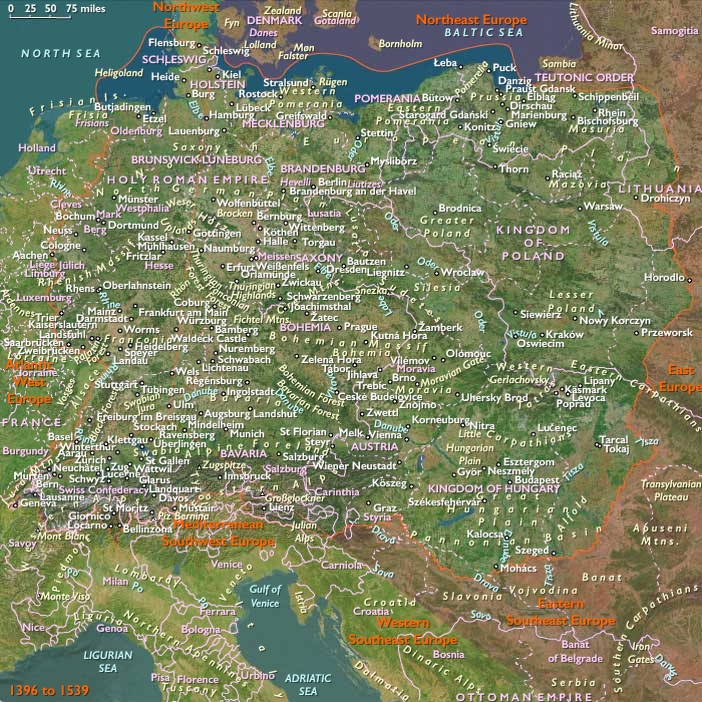
At the invitation of Duke Philip's father, King Maximilian I, in 1493 he attends the funeral of the Emperor Frederick III and is recognized as King Richard IV of England.
The pretender also promises that if he dies before becoming king, his claim will fall to Maximilian.
Frederick’s grave, built by Nikolaus Gerhaert von Leyden, in St. Stephen's Cathedral, Vienna, is one of the most important works of sculptural art of the late Middle Ages. (His amputated leg is buried with him.)
The heavily adorned tomb will not be completed until 1513, two decades after Frederick's death; it survives today in its original condition.
Locations
People
- Frederick III
- Henry VII of England
- James IV of Scotland
- Margaret of York
- Maximilian I of
- Perkin Warbeck
- Philip I of Castile
Groups
- Christians, Roman Catholic
- Austria, Archduchy of
- Ireland, (English) Lordship of
- France, (Valois) Kingdom of
- Scotland, Kingdom of
- Holy Roman Empire
- England, (Tudor) Kingdom of
Topics
Subjects
Regions
Subregions
Years: 1493 - 1493
Locations
People
- Frederick III
- Henry VII of England
- James IV of Scotland
- Margaret of York
- Maximilian I of
- Perkin Warbeck
- Philip I of Castile
Groups
- Christians, Roman Catholic
- Austria, Archduchy of
- Ireland, (English) Lordship of
- France, (Valois) Kingdom of
- Scotland, Kingdom of
- Holy Roman Empire
- England, (Tudor) Kingdom of
Topics
Subjects
Regions
Subregions