
People from Melanesia and Micronesia migrate toward …
Years: 1053BCE - 910BCE
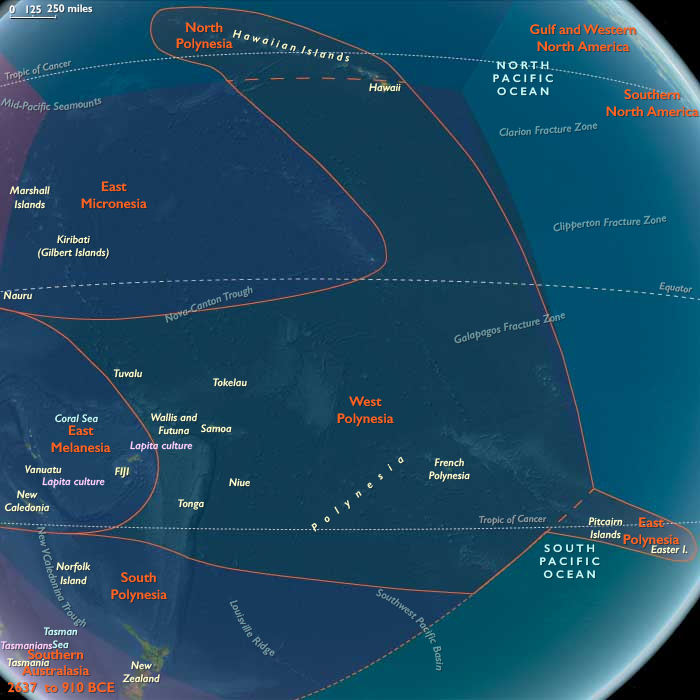
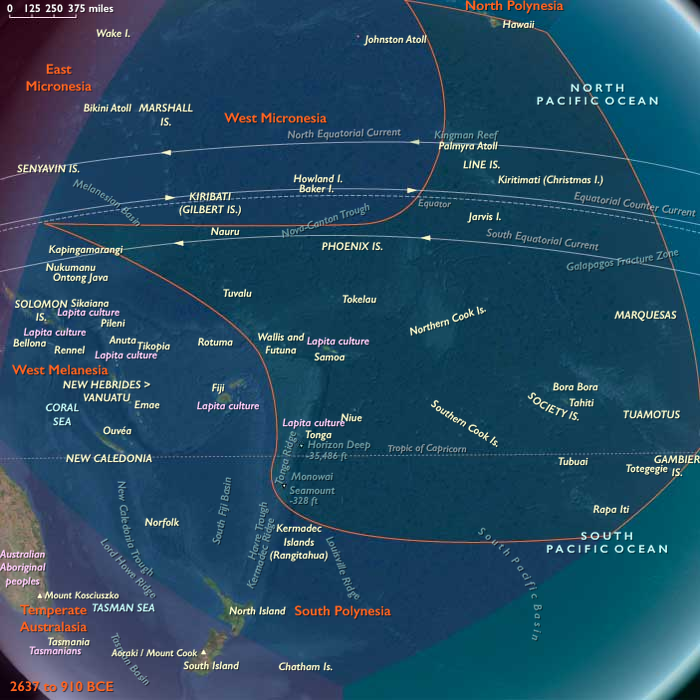
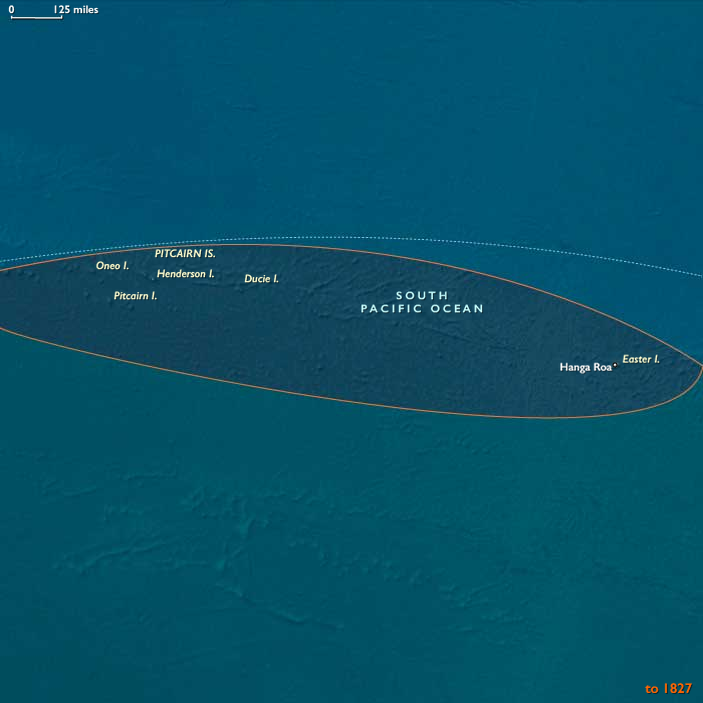
People from Melanesia and Micronesia migrate toward the Polynesian triangle, a region of the Pacific Ocean with three island groups at its corners: Hawaii, Easter Island (Rapa Nui), and New Zealand.
It is often used as a simple way to define Polynesia.
At the center is Tahiti with Samoa to the west.
The Polynesian people, by ancestry, are considered to be a subset of the sea-migrating Austronesian people and the tracing of Polynesian languages places their prehistoric origins in the Malay Archipelago.
There are three theories regarding the spread of humans across the Pacific to Polynesia.
These are outlined well by Kayser et al. (2000) and are as follows:
• Express Train model: A recent (circa three thousand years ago) expansion out of Southeast Asia, predominantly Taiwan, via Melanesia but with little genetic admixture between those migrating and the existing native population, reaching western Polynesian islands around two thousand years ago.
The majority of current genetic, linguistic, and archaeological data supports this theory.
• Entangled Bank model: Supposes a long history of cultural and genetic interactions among southeast Asians, Melanesians, and already-established Polynesians.
• Slow Boat model: Similar to the express-train model but with a longer hiatus in Melanesia along with admixture, both genetically, culturally and linguistically with the local population.
This is supported by the Y-chromosome data of Kayser et al. (2000), which shows that all three haplotypes of Polynesian Y chromosomes can be traced back to Melanesia.
Speakers of Austronesian languages spread throughout the islands of Southeast Asia between circa 3000 and 1000 BCE.
These people, according to linguistic and archaeological evidence, originated from aborigines in Taiwan as tribes whose natives were thought to have arrived through South China at the beginning of the eighth millennium to the edges of western Micronesia and on into Melanesia.
The archaeological record shows well-defined traces of this expansion, which allow the path it took to be followed and dated with a degree of certainty.
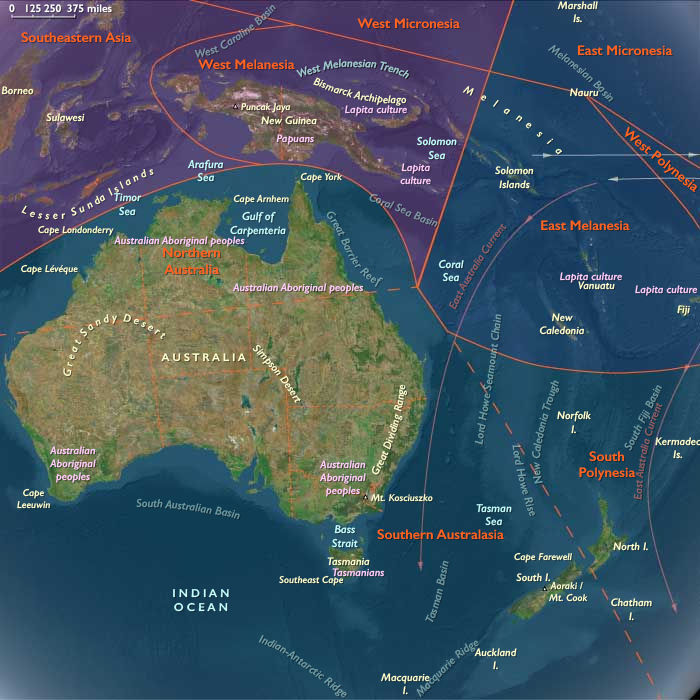
It is thought that roughly thirty-five hundred years ago, the Lapita culture appeared in the Bismarck Archipelago, northwest Melanesia.
This culture is argued to have either been developed there or, more likely, to have spread from China/Taiwan.
The most eastern site for Lapita archaeological remains recovered so far through archaeology in Samoa is at Mulifanua on Upolu.
The Mulifanua site, where four thousand two hundred and eighty-eight pottery shards have been found and studied, has a true age of circa three thousand years BP, based on carbon-14 dating.
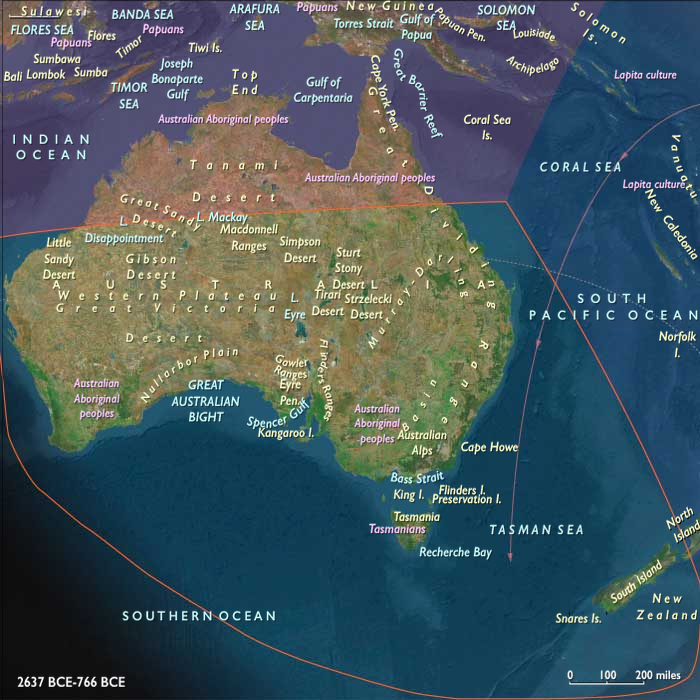
Within a mere three or four centuries between 1300 and 900 BCE, the Lapita culture spread six thousand kilometers further to the east from the Bismarck Archipelago, until it reached as far as Fiji, Tonga, and Samoa, which were populated around two thousand years ago.
In this region, the distinctive Polynesian culture will develop, sharing common traits in language, customs, and society.
Groups
Topics
Commodoties
Subjects
Regions
Subregions
Related Events
Showing 10 events out of 67026 total
Years: 1053BCE - 910BCE
Groups
Topics
Commodoties
Subjects
Regions
Subregions