
South America Minor (49,293–28,578 BCE) South …
Years: 49293BCE - 28578BCE
South America Minor (49,293–28,578 BCE)
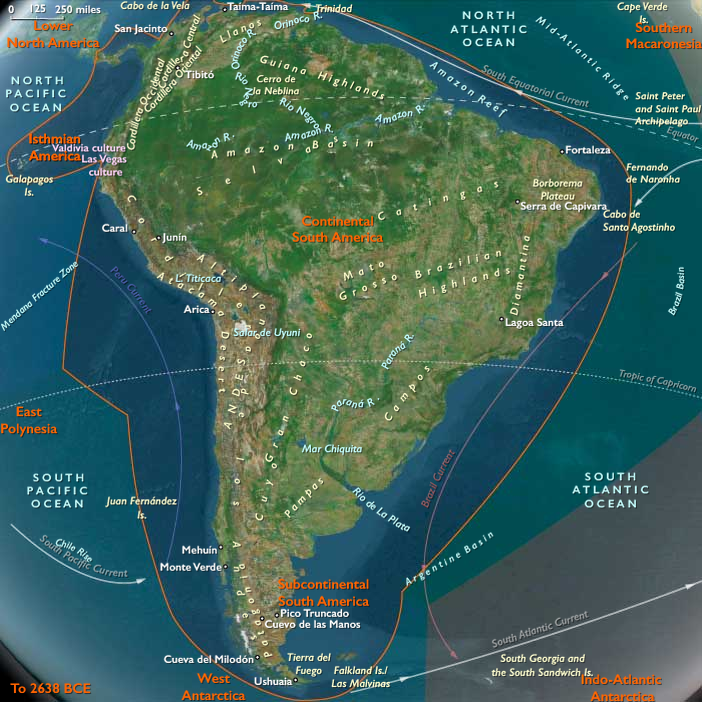
South America Minor includes southern Chile (incl. Central Valley), southern Argentina (Patagonia south of the Río Negro/Río Grande), Tierra del Fuego, Falkland/Malvinas, Juan Fernández.
Anchors: Patagonian steppe, Andean icefields, Strait of Magellan–Beagle Channel, Fuegian archipelago, Pacific fjords, Atlantic shelf banks.
Geographic & Environmental Context
-
Cordilleran ice sheets dominated the southern Andes; outlet glaciers sculpted fjords and moraines.
-
Patagonian steppe: cold, windy; periglacial dunes/loess.
-
Sea-level lowstand exposed broad Atlantic shelves and expanded Magellan–Beagle shorelines.
Climate & Environmental Shifts
-
LGM: strong westerlies, low temperatures, aridity inland; permafrost/seasonal frost common on steppe.
Subsistence & Settlement
-
Human occupation in this early window is unlikely; robust evidence appears much later (>14.5 ka at Monte Verde to the north).
-
Productive kelp highway ecologies existed (shellfish, pinnipeds, seabirds), but sustained use likely post-LGM.
Technology & Material Culture — N/A (pre-human).
Movement & Interaction Corridors — N/A (pre-human).
Cultural & Symbolic Expressions — N/A.
Environmental Adaptation & Resilience
-
Ecological scaffolding (kelp forests, shelf banks, guanaco steppe) set the later human adaptive palette.
Transition
-
Deglaciation and shelf flooding will open fjord/archipelago routes, enabling the well-documented Holocene maritime foragers of the southern cone.
Topics
Commodoties
Subjects
Regions
Subregions

Years: 49293BCE - 28578BCE
Topics
Commodoties
Subjects
Regions
Subregions