
South America Minor (1684–1827 CE): Indigenous Independence …
Years: 1684 - 1827
South America Minor (1684–1827 CE): Indigenous Independence and Imperial Peripheries
Geographic & Environmental Context
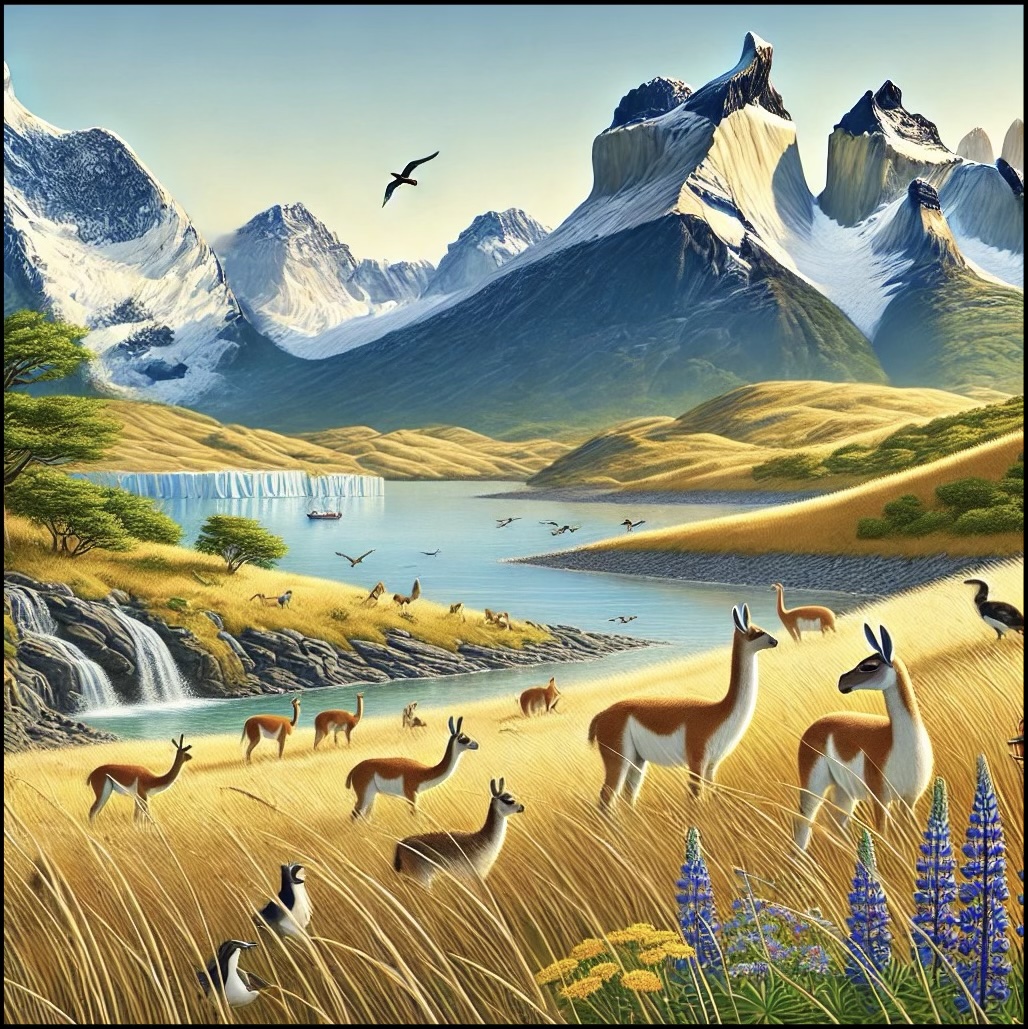
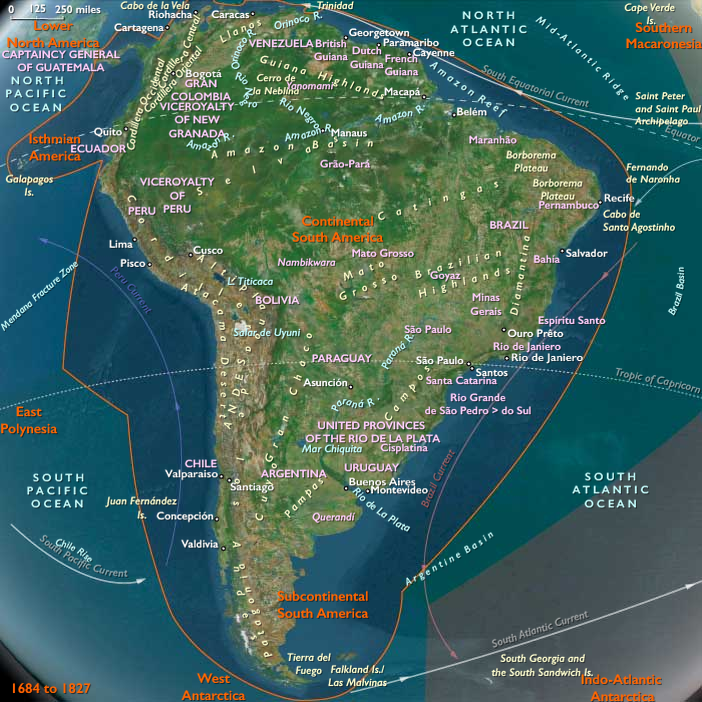
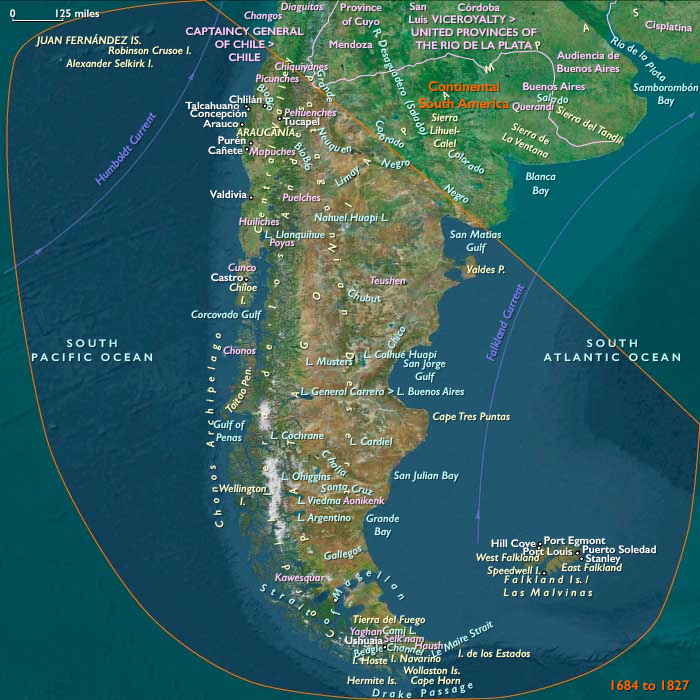
The subregion of South America Minor includes southern Chile (including the Central Valley), southern Argentina (Patagonia south of the Río Negro and Río Grande), Tierra del Fuego, the Falkland Islands (Islas Malvinas), and the Juan Fernández Islands. Anchors included the Bio-Bío frontier, the Araucanian Andes, the Patagonian steppe, the Strait of Magellan, and the offshore Falklands and Juan Fernández Islands. The region remained on the margins of empire, contested by Indigenous autonomy, sparse colonial settlements, and growing imperial interest in strategic waters.
Climate & Environmental Shifts
The later Little Ice Age deepened cold and stormy conditions in Patagonia and Tierra del Fuego. Snow cover lingered longer in the Araucanian Andes, affecting harvests. The Central Valley of Chile alternated between droughts and floods. Hurricanes did not reach this far south, but fierce subpolar storms lashed the Falklands and the Strait of Magellan, while the Juan Fernández Islands enjoyed milder maritime climates.
Subsistence & Settlement
-
Mapuche and Spanish Chile: The Mapuche preserved autonomy south of the Bio-Bío River. Farming of maize, beans, and potatoes continued alongside livestock captured from Spanish herds. Spaniards in Santiago and Concepción consolidated haciendas and wheat exports, but attempts to conquer Araucanía failed.
-
Patagonia: The Tehuelche adopted horses (by the 18th century) and expanded hunting, raiding, and mobility across the steppe. Their networks reached into Pampas trade circuits.
-
Tierra del Fuego: The Yaghan and Kawésqar sustained maritime hunting with canoes and harpoons. The Selk’nam continued guanaco hunting and ritual hain initiations, remaining inland and largely insulated from outsiders.
-
Falkland Islands: Visited by European sailors; France established Port Louis (1764), followed by Britain (1765) and Spain (1767). Settlements shifted but whaling and sealing stations increased by the late 18th century.
-
Juan Fernández Islands: Used as a provisioning stop by Spanish and foreign ships; goats and invasive species transformed the ecology. Castaway Alexander Selkirk’s marooning (1704–1709) later inspired Robinson Crusoe.
Technology & Material Culture
-
Mapuche developed cavalry warfare, lances, and iron tools through trade and capture.
-
Tehuelche combined bolas with horseback raiding.
-
Fuegian canoe peoples retained bark craft, harpoons, and bone tools adapted to icy seas.
-
Spanish towns in central Chile displayed adobe churches, plazas, and hacienda complexes.
-
European forts and harbors appeared intermittently in the Falklands and Juan Fernández.
Movement & Interaction Corridors
-
Bio-Bío frontier remained the line of conflict and exchange between Spaniards and Mapuche.
-
Horse trade and raiding circuits linked Patagonia, the Pampas, and Araucanía.
-
Canoe routes continued in Tierra del Fuego’s channels.
-
Falklands and Juan Fernández became integral to global shipping, whaling, and piracy routes, linking South America to the Atlantic and Pacific.
Cultural & Symbolic Expressions
-
Mapuche rituals honored ngen spirits, with ngillatun feasts reinforcing community bonds and collective resistance.
-
Tehuelche oral traditions incorporated the horse as a new symbol of power.
-
Selk’nam hain ceremonies dramatized mythic order and kinship.
-
Spanish Catholic festivals persisted in Santiago and Concepción, but Indigenous cosmologies thrived independently beyond colonial reach.
-
Sailors’ lore attached symbolic weight to the Falklands and Juan Fernández as remote, perilous, and storied isles.
Environmental Adaptation & Resilience
Mapuche and Tehuelche resilience lay in mobility, cavalry, and crop diversification. Fuegians adapted to Little Ice Age chill through layered furs, canoe heating fires, and cooperative hunting. Colonists rebuilt haciendas after floods and earthquakes. Islanders of Juan Fernández coped with introduced goats and rats, altering diets and landscapes.
Transition
By 1827 CE, South America Minor remained largely Indigenous: Mapuche and Tehuelche independence endured; Fuegian peoples thrived in maritime niches. Central Chile was firmly Spanish until independence revolutions of the 1810s–1820s, when patriots like Bernardo O’Higgins secured Chile’s independence. The Falklands and Juan Fernández had become contested imperial outposts. This was still a frontier world—part Indigenous stronghold, part maritime crossroads—poised to enter the age of republican nation-states and intensified global interest.
Peninsular South America (with civilization) ©2024-25 Electric Prism, Inc. All rights reserved.
People
Groups
Topics
Commodoties
Subjects
Regions
Subregions
Years: 1684 - 1827
Peninsular South America (with civilization) ©2024-25 Electric Prism, Inc. All rights reserved.
People
Groups
Topics
Commodoties
Subjects
Regions
Subregions