
The Origins of the Reconquista and the …
Years: 1108 - 1252
The Origins of the Reconquista and the Expansion of Christian Rule
Resistance to the Muslim invasion of the Iberian Peninsula in the 8th century was initially limited to small groups of Visigothic warriors who had taken refuge in the mountains of Asturias, part of the former Suebic Kingdom. This region was one of the least Romanized and least Christianized parts of Spain, making it a natural stronghold for resistance.
Pelayo and the Birth of the Reconquista
According to tradition, Pelayo (718–737), King of Oviedo, first rallied the local Asturians to defend themselves against Muslim incursions. His resistance eventually turned offensive, marking the beginning of the seven-hundred-year Reconquista, which would later become the defining theme of medieval Spanish history.
What began as a struggle for survival in Asturias would evolve into a religious crusade to expel the Muslims from Spain and ultimately transform into an imperial mission to reconstruct a united Christian monarchy.
The Expansion of the Kingdom of León
Pelayo’s successors, later known as the Kings of León, extended Christian control southward from Asturias, gradually:
- Capturing territory from the Muslims,
- Depopulating and fortifying borderlands as defensive measures, and
- Resettling these reclaimed lands, reinforcing their control over the expanding frontier.
As Christian forces advanced, the political center of the kingdom shifted southward, following the military frontier, solidifying the role of León as the new heart of Christian resistance and expansion in Iberia.
Locations
Groups
- Arab people
- Berber people (also called Amazigh people or Imazighen, "free men", singular Amazigh)
- Christianity, Chalcedonian
- Islam
- al-Andalus (Andalusia), Muslim-ruled
- Mozarabs
- Asturias, Kingdom of
- Asturias, Kingdom of
- León, Kingdom of
Topics
Subjects
Regions
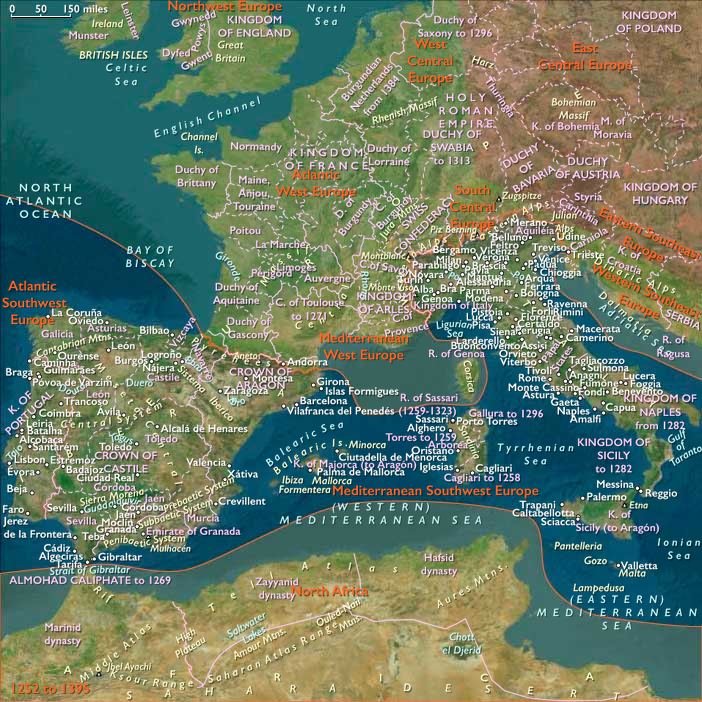
Subregions
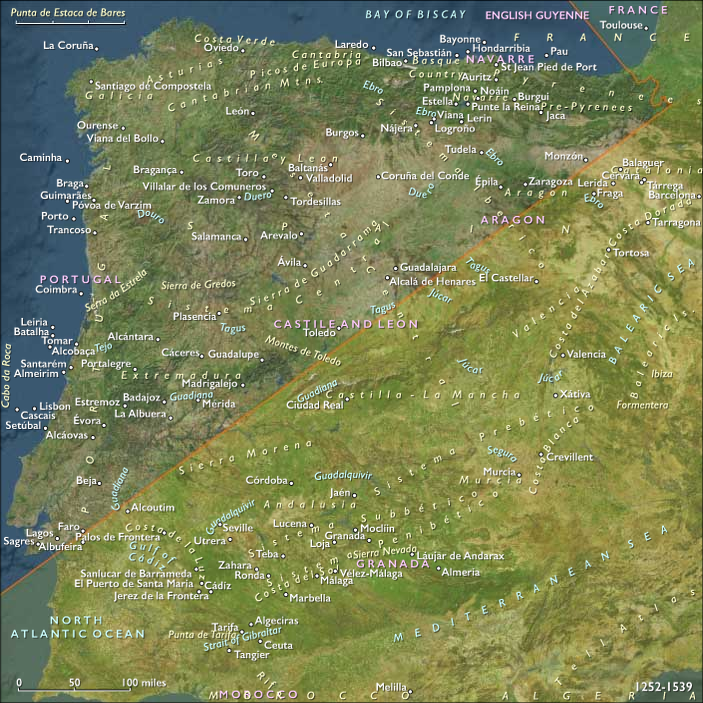
Years: 1108 - 1252
Locations
Groups
- Arab people
- Berber people (also called Amazigh people or Imazighen, "free men", singular Amazigh)
- Christianity, Chalcedonian
- Islam
- al-Andalus (Andalusia), Muslim-ruled
- Mozarabs
- Asturias, Kingdom of
- Asturias, Kingdom of
- León, Kingdom of
Topics
Subjects
Regions
Subregions