Paulinus, last of the missionaries sent to …
Years: 627 - 627
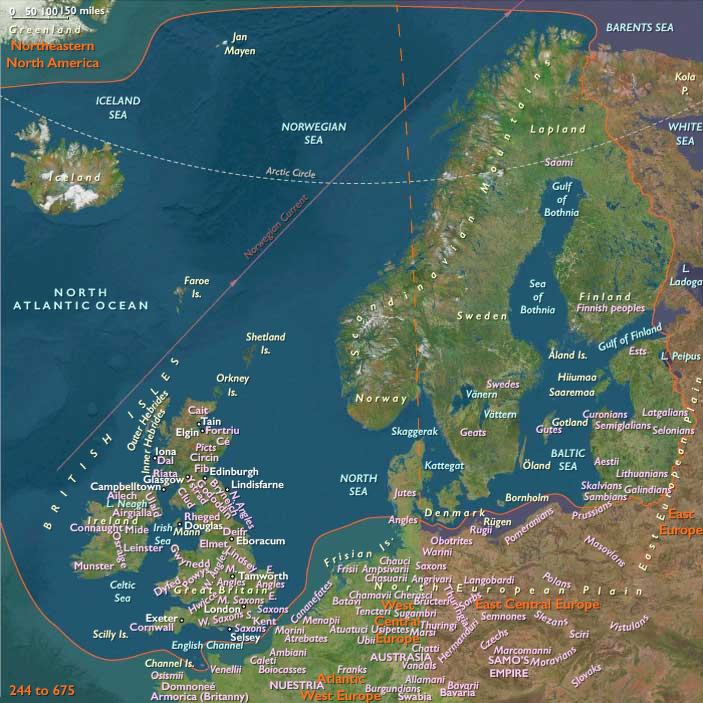
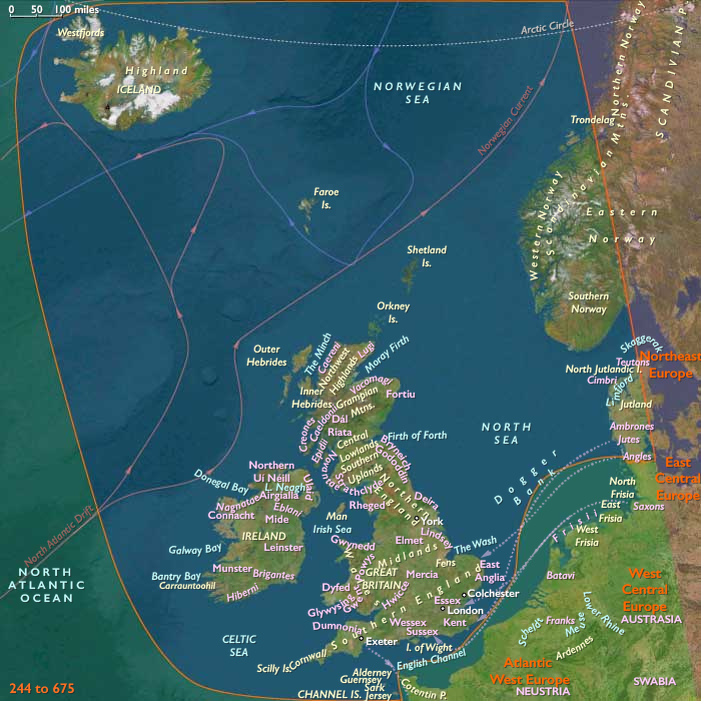
Paulinus, last of the missionaries sent to England by Pope Gregory I, builds a wooden church in the old Roman legionary headquarters in York and baptizes Edwin of Northumbria as the first Christian king in Northern England, triggering the initial phase of the conversion of the pagan north.
Locations
People
Groups
- Polytheism (“paganism”)
- Angles
- Anglo-Saxons
- Bernicia, Kingdom of
- Christianity, Chalcedonian
- Deira, Kingdom of
- Britain, Medieval
Topics
Subjects
Regions
Subregions
Related Events
Filter results
Showing 10 events out of 56849 total
Constantinople’s alliance with the Western Turkic Khaganate and the Khazars, a Turkic people from north of the Caucasus who aid East Roman emperor Heraclius in his campaign against the Persians, proves of material assistance in these years and of lasting import in Roman diplomacy.
Early in 627, the Göktürks and their Khazar allies approach the Caspian Gates at Derbent, a newly built stronghold that is the only gate to the fertile land of Aghvania (modern-day Azerbaijan).
The hordes of heavy cavalry led by Tong Yabghu storm Derbent, defeat the lightly armed militia, and swarm over Aghvania, plundering it thoroughly.
The fall and sack of Derbent is described in detail by the Armenian historian Movses Kagankatvatsi, thought to have been an eyewitness to the event.
The fall of the fortress, which had been considered impregnable, sparks panic all over the country.
Aghvanian forces withdraw to their capital, Partav, whence they make for the Caucasus Mountains.
The Göktürks and Khazars overtake them near the village of Kalankatuyk, where they are either slain or taken prisoner.
The conquerors impose upon Aghvania a heavy system of taxation, as reported by Movses.
Imperial forces in Asia Minor have regained control of much of Anatolia.
Heraclius has swept through southern Armenia with a fifty thousand-man expeditionary force, recapturing most of the imperial fortresses lost to the Persians ten and fifteen years earlier.
The army of Shahrbaraz, still in Anatolia, is now cut off completely.
The Persian general, hearing from the emperor’s agents (who show him letters) that Khosrau dissatisfied with his failure to capture Constantinople, is planning to have him executed, surrenders to Heraclius, refusing to join the imperial army against his ungrateful sovereign.
Heraclius now makes an alliance with Tong Yabghu Qaghan, ruler (khagan) of the Western Turkic Khaganate, for a joint invasion of the Persian Empire in the spring of 627.
He promises his daughter Eudoxia Epiphania, age fifteen, in marriage to Tong Yabghu and sends her under escort with wondrous gifts.
The Kingdom of Iberia, whose ruler, Stephen, had reversed his father’s pro-Roman politics to pro-Iranian and, through loyalty to his Sassanid suzerains, has succeeded in reuniting Iberia under his sway, is he next objective of the Turkic-Constantinopolitan offensive.
In the words of Movses Kagankatvatsi, the Khazars "encircled and besieged the famous and great sybaritic trade city of Tbilisi," whereupon they were joined by Emperor Heraclius with his mighty army.
Heraclius and Tong Yabghu (called Ziebel in the Roman sources) meet under the walls of Narikala.
The yabgu rides up to the emperor, kisses his shoulder and makes a bow.
In return, Heraclius hugs the barbarian ruler, calls him his son, and crowns him with his own diadem.
During the ensuing feast the Khazar leaders receive ample gifts in the shape of earrings and clothes, while the yabghu is promised the hand of the emperor's daughter, Eudoxia Epiphania.
The siege drags on without much progress, punctuated by frequent sallies on the part of the besieged; one of these claims the life of their king, who is taken captive in the fighting and flayed alive on the ordes of Heraclius.
After two months, the Khazars retreat to the steppe, promising to return by the autumn.
Tong Yabghu leaves young Böri Shad, either his son or nephew, in charge of the remaining forty thousand which are to assist Heraclius during the siege.
Before long these depart as well, leaving the Romans to continue the siege alone and prompting jeers from the besieged.
When the Georgians ironically refer to the Emperor as "the goat," hinting at his incestuous marriage, Heraclius recalls a passage from the Book of Daniel about the two-horned ram overthrown by the one-horned goat.
He interprets this as a good sign and strikes southward against Persia.
Heraclius again invades Persia to deal with the Persian second force and in December 627, after a rapid march across the Armenian highlands into the Tigris plain towards Dastagird, the Sassanian royal residence, meets the Persians near the ruins of Nineveh.
Here, astride his renowned war-horse, he kills three Persian generals in single combat, charges into enemy ranks at the head of his troops, kills the Persian commander, and scatters the Persian host.
Heraclius plunders the city palace of Dastagird and gains tremendous riches (also recovering three hundred captured imperial flags) He turns northeastward to Caucasian Albania to rest his army.
Khosrau flees to the mountains of Susiana to rally support for the defense of the Persian capital Ctesiphon.
His letters calling Shahrbaraz to his aid have been intercepted, and, although his resources are by now drastically reduced, he refuses peace terms.
The Chalukyas control territories on both coasts of India by 627, dominate the east Asian trade, and act as an effective barrier to expansion by the ambitious kingdoms of South India.
Muhammad confronts 'Abd Allah ibn Ubayy, who had joined in spreading slanders about Muhammad's wife Aishah, in spring 627.
'Abd Allah, it turns out, has little support in Yathrib, so becomes reconciled to Muhammad.
The expected confrontation with the Meccans occurs in April 627 when Abu Sufyan leads a great confederacy of ten thousand men against Yathrib's three thousand defenders.
On Muhammad's orders, the crops have already been harvested and a trench dug to defend the main part of the oasis from the Meccan cavalry.
The confederates besiege the Muslims for two weeks but fail in their attempts to cross the trench and run low on fodder for the horses.
Meanwhile, Muhammad's agents among the attackers foment potential dissensions.
After a night of wind and rain, the Meccans, recognizing their inability to dislodge Muhammad, abandon the siege and return to Mecca.
After the siege of Yathrib, one of the city's remaining Jewish clans, the Banu Qurayzah, is accused of plotting against Muhammad; when they surrender, his followers did a trench around the market, round up the clan's six-hundred-plus men and tie their hands behind them.
After spending the night in prayer, the Jews are led to the trench one by one and forced to kneel, then offered the opportunity to convert to Islam.
Upon their refusal, they are beheaded, their bodies piled in the trench.
Reportedly, only three or four agree to conversion.
The Muslims then sell into slavery all of the clan's women and children, except Rayhana bint Amr.
According to Ibn Ishaq, Muhammad took Rayhana as a maiden slave and offered her the status of becoming his wife if she accepted Islam, but she refused.
According to his account, even though Rayhana is said to have later converted to Islam, she died as a slave.
Ibn Sa'd writes and quotes Waqidi that she was manumitted but later married by Muhammad.
According to Al-Halabi, Muhammad married and appointed a dowry for her.
It is further narrated that, upon marriage, she refused to wear the hijab, causing a rift between her and Muhammad.
The couple later reconciled.
She died young, shortly after Muhammad's hajj and was buried in Jannat al-Baqi cemetery.
Ibn Hajar quotes a description of the house that Muhammad gave to Rayhana after their marriage from Muhammad Ibn al-Hassam's History of Medina.
In another version, Hafiz Ibn Minda writes that Muhammad set Rayhana free, and she went back to live with her own people.
This version is also supported as the most likely by nineteenth-century Muslim scholar, Shibli Nomani.
Not much is known about Rayhana; she will die a year before Muhammad.

An important but unidentified Anglo-Saxon ruler is buried on a heath about eight miles (thirteen kilometers) northeast of present Ipswich in Suffolk, England.
His “coffin” is a clinker-built vessel approximately seventy-nine feet (twenty-four meters) long and eight feet (two-and-a-half meters) in the beam.
Thirty-seven Merovingian gold coins, probably accumulated between the years 620 and 630, suggest the date of interment; the tomb (according to arguments advanced by several experts) may be that of Raedwald, king of the East Angles and high king of the Anglo-Saxons, who dies in about 627, succeeded by his son Eorpwald.
Grave-goods include a Swedish helmet and shield, a sword and spears, cauldrons and bowls of Coptic as well as Celtic craftsmanship, a huge silver dish with stampings on it of Emperor Anastasius I, two Byzantine silver baptismal spoons bearing the names Paulos and Saulos, and numerous other jewelry items. (Modern archaeologists refer to this find as the Sutton Hoo ship burial.)
The grave may, alternately, be that of Eorpwald, who is murdered and succeeded by Ricberht, a member of the East Anglian elite, who will reestablish paganism during his rule.
The Pyu complete their commercial center of Sri Ksetra in the dry zone of present northern Burma in 638.
Sri Ksetra or Thaye Khittaya (lit., "Field of Fortune" or "Field of Glory"), located eight kilometers southeast of Prome (Pyay) at present-day Hmawza village, is the last and southernmost Pyu capital.
The city, founded between the fifth and seventh centuries, likely overtook Halin as the premier Pyu city by the seventh or eighth century, and will retain that status until the Mranma arrive in the ninth century.
The city is home to at least two dynasties, and maybe three.
The first dynasty, called the Vikrama Dynasty, is believed to have launched the Pyu calendar, which will later become the Burmese calendar, on March 22, 638.
Phraya Kalavarnadit, the legendary first king of Lavo, is said to have established the city of Lavo around 450 CE as one of the Dvaravati city-states.
Kalavarnadit establishes a new era called the Chulasakaraj, which is the era used by the Siamese and the Burmese until the nineteenth century.
Isanavarman I of Chenla expands Khmer influence to the Chao Phraya valley through his campaigns around the seventh century.
Dvaravati cities that fall under Khmer hegemony become Lavo, while the Western cities are spared from Khmer hegemony and form the Kingdom of Supannabhum.
Lavo is the center from which Khmer authority rules over Dvaravatians.
The only native language found during early Lavo times is the Mon language.
However, there is debate whether Mon was the sole ethnicity of Lavo.
Nonetheless, it also should be noted that the area also home to a sizable Malays and Khmer people earlier during Dvaravati period.
Some historians point out that Lavo was composed of mixed Mon and Lawa people (a Palaungic people), with the Mons forming the ruling class.
It is also hypothesized that the migration of Tai people into Chao Phraya valley occurred during the time of the Lavo kingdom.
Years: 627 - 627
Locations
People
Groups
- Polytheism (“paganism”)
- Angles
- Anglo-Saxons
- Bernicia, Kingdom of
- Christianity, Chalcedonian
- Deira, Kingdom of
- Britain, Medieval