
Sir Theophilus Shepstone, the British Secretary for …
Years: 1877 - 1877
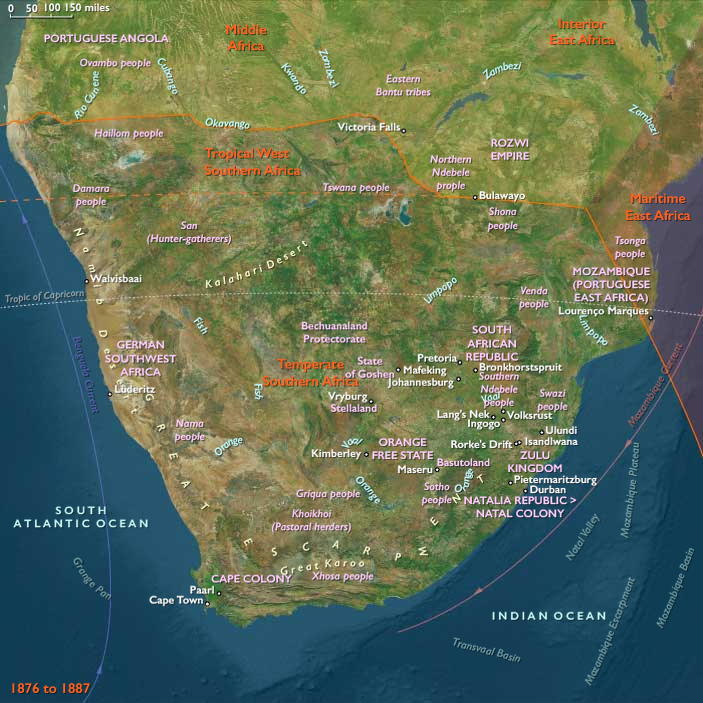
The annexation, partly spurred by the Boers' failure to subjugate the Pedi, is a convenient way of resolving the border dispute between the Boers and the Zulus.
This also saves the Transvaal from financial ruin, as its government has little money.
The Transvaal Boers object, but as long as the Zulu threat remains, they fear that if they take up arms to resist the British annexation actively, King Cetshwayo and the Zulus would take the opportunity to attack.
They also fear a war on two fronts, namely that the local tribes would seize the opportunity to rebel and the simmering unrest in the Transvaal would be re-ignited.he British annexation nevertheless results in resentment against the British occupation and a growing nationalism.
The Transvaal Boers led by Vice President Paul Kruger will hereafter elect to deal first with the perceived Zulu threat to the status quo, and local issues, before directly opposing the British annexation.
Kruger makes two visits to London for direct talks with the British government.
Kruger, whose family was of German descent, was born at Bulhoek, on his grandfather's farm, which was approximately fifteen kilometers west of the town of Steynsburg and one hundred kilometers to the north of Cradock in the Eastern Cape Province, and he had grown up on the farm Vaalbank.
He had received only three months of formal education but from life on the veld had become proficient in hunting and horse riding.
Kruger's father, Casper Kruger, had joined the trek party of Hendrik Potgieter when the Great Trek started in 1835.
The trekkers had crossed the Vaal River in 1838, and had at first stayed in the area that is known today as Potchefstroom.
The trekkers had taken advantage of the political vacuum left after the Zulu wars and their aftermath, and had easily overcome the indigenous peoples.
Kruger's father had later decided to settle in the district now known as Rustenburg.
At the age of sixteen, Kruger had been entitled to choose a farm for himself at the foot of the Magaliesberg, where he had settled in 1841.
The following year, he had married Anna Maria Etresia du Plessis (1826-1846), and they had gone together with Paul Kruger's father to live in the Eastern Transvaal.
After the family had returned to Rustenburg, Kruger's wife and infant died in January, 1846.
He then married his second wife, Gezina Susanna Fredrika Wilhelmina du Plessis (1831-1901) in 1847, with whom he will remain until her death in 1901.
The couple will have seven daughters and nine sons, some dying in infancy.
A deeply religious man, Kruger claims to have only read one book, the Bible.
He also claims to know most of it by heart.
He is a founding member of the Reformed Church in South Africa.
He had begun his military service as a field cornet in the commandos and eventually became Commandant-General of the Zuid Afrikaanse Republiek (South African Republic), or ZAR.
He was appointed member of a commission of the Volksraad, the republican parliament that was to draw up a constitution.
People had begun to take notice of the young man, who had played a prominent part in ending the quarrel between the Transvaal leader, Stephanus Schoeman, and M.W. Pretorius.
Kruger had been present at the Sand River Convention in 1852.
Kruger had resigned as Commandant-General, and for a time had held no office and retired to his farm, Boekenhoutfontein.
However, he had been elected as a member of the Executive Council in 1874 and shortly after became the Vice-President of the Transvaal.
Locations
People
Groups
- Zulu people
- Boers
- Afrikaners
- Britain (United Kingdom of Great Britain and Ireland)
- Cape Colony, British
- Zululand
- Zulu, Kingdom of the
- South African Republic (the Transvaal)
- Natal Colony, British
- Transvaal, Republic of the
- Transvaal, Crown Colony of the
Commodoties
Subjects
Regions
Subregions
Related Events
Showing 10 events out of 11822 total
Years: 1877 - 1877
Locations
People
Groups
- Zulu people
- Boers
- Afrikaners
- Britain (United Kingdom of Great Britain and Ireland)
- Cape Colony, British
- Zululand
- Zulu, Kingdom of the
- South African Republic (the Transvaal)
- Natal Colony, British
- Transvaal, Republic of the
- Transvaal, Crown Colony of the
Commodoties
Subjects
Regions
Subregions