Paschal canonizes Charlemagne in 1165 in order …
Years: 1165 - 1165
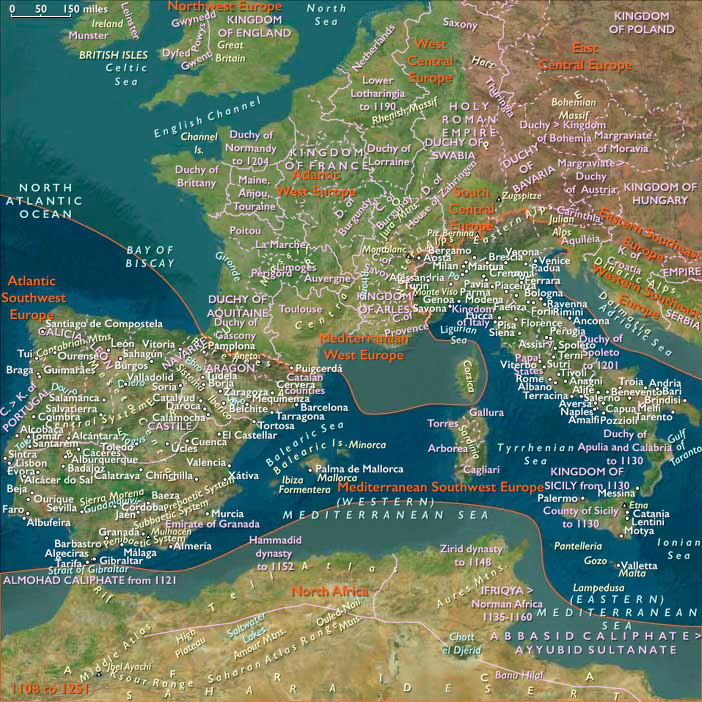
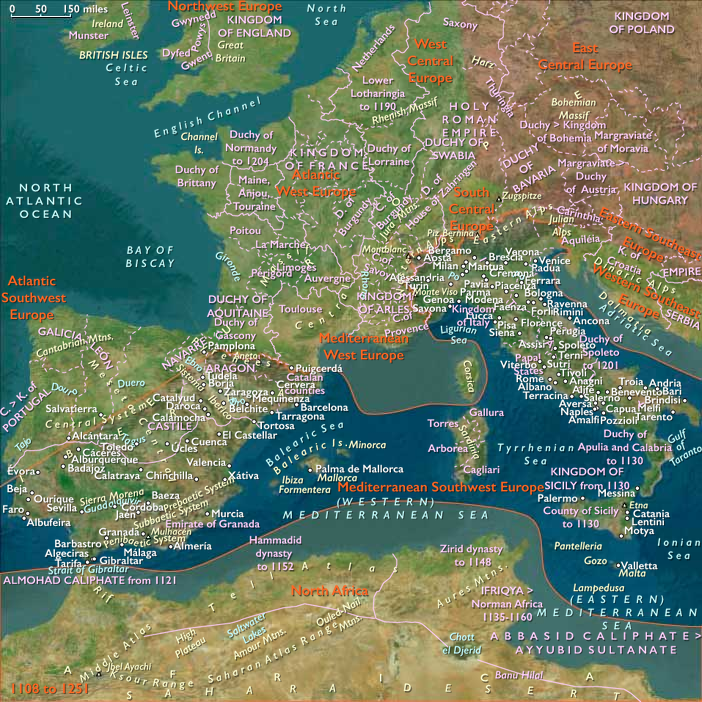
Paschal canonizes Charlemagne in 1165 in order to gain more support from Emperor Frederick Barbarossa.
The Catholic Church will never recognize this canonization, since Paschal is an antipope.
(In 1179, the Third Council of the Lateran will annul all of his ordinances, including the canonization.
Charlemagne will remain in good regard still, however, among Catholics, and Prosper Guéranger will even compose a prayer to Charlemagne.)
Locations
People
Groups
- Papal States (Republic of St. Peter)
- Italy, Kingdom of (Holy Roman Empire)
- Holy Roman Empire
- Christians, Roman Catholic
Topics
Commodoties
Subjects
Regions
Subregions
Related Events
Filter results
Showing 10 events out of 48458 total
The Liuhe Pagoda, literally Six Harmonies Pagoda, a multistory Chinese pagoda in southern Hangzhou, Zhejiang province, China, located at the foot of Yuelun Hill, facing the Qiantang River, was originally constructed in 970 during the Northern Song Dynasty (960–1127), destroyed in 1121, and reconstructed fully by 1165, during the Southern Song Dynasty (1127–1279).
The pagoda was originally constructed by the ruler of the Wuyue kingdom, some of which would later makeup Zhejiang province.
The name Liuhe comes from the six Buddhist ordinances and it is said that the reason for building the pagoda was to calm the tidal bore of the Qiantang River and as a navigational aid.
According to historian Joseph Needham, the pagoda also served as a lighthouse along the Qiantang River.
Being of considerable size and stature, it actually served as a permanent lighthouse from nearly its beginning, to aid sailors in seeking anchorage for their ships at night (as described in the Hangzhou Fu Zhi) (Needham, Joseph (1986).
Science and Civilization in China: Volume 4, Physics and Physical Technology, Part 3, Civic Engineering and Nautics.
Taipei: Caves Books, Ltd.)
Leipzig, first documented in 1015 in the chronicles of Bishop Thietmar of Merseburg, is endowed with city and market privileges in 1165 by Otto the Rich, Margrave of Meissen.
A fair held at Leipzig is first mentioned in this year.
The Leipzig Trade Fair will serve as a major fair for trade across Central Europe for nearly a millennium.
The influence of Emperor Manuel secures Bohemond's early release from captivity in 1165, but Raymond will remain in prison until 1173.
Abu'l-Barakāt al-Baghdaadi, famed as Awhad al-Zamān (Unique One of his Time), was born in Balad, a town on the Tigris above Mosul in modern-day Iraq.
As a renowned physician, he has served at the courts of the caliphs of Baghdad and the Seljuq sultans.
He has converted to Islam in old age.
Abu'l Barakat does not refer to his conversion in his writings, and the historical sources give contradictory episodes of his conversion.
According to the various reports, he had converted either out of "wounded pride", fear of the personal consequences of the death of Sultan Mahmud's wife while under his care as a physician or fear of execution when he was taken prisoner in a battle between the armies of the caliph and that of the sultan.
Isaac, the son of the Abraham Ibn Ezra and the son-in-law of Judah Halevi, was one of his pupils, to whom Abu'l-Barakāt, Jewish at the time, dictated a long philosophical commentary on Ecclesiastes, written in Arabic using Hebrew aleph bet.
Isaac wrote a poem in his honor as introduction to this work Al-Baghdaadi described an early scientific method emphasizing repeated experimentation, influenced by Ibn Sina.
Al-Baghdaadi's theory of motion distinguished between velocity and acceleration and showed that force is proportional to acceleration rather than velocity.
The 1fourteenth-century philosophers Jean Buridan and Albert of Saxony will later refer to Abu'l-Barakat in explaining that the acceleration of a falling body is a result of its increasing impetus.
Abu'l-Barakat also modified Ibn Sina's theory of projectile motion, and stated that the mover imparts a violent inclination (mayl qasri) on the moved and that this diminishes as the moving object distances itself from the mover.
Al-Baghdaadi also suggested that motion is relative, writing that "there is motion only if the relative positions of the bodies in question change."
He also stated that "each type of body has a characteristic velocity that reaches its maximum when its motion encounters no resistance."
Al-Baghdaadi criticized Aristotle's concept of time as "the measure of motion" and instead redefines the concept with his own definition of time as "the measure of being", thus distinguishing between space and time, and reclassifying time as a metaphysical concept rather than a physical one.
He upheld the unity of the soul, denying that there is a distinction between it and the intellect.
For him, the soul's awareness of itself is the definitive proof that the soul is independent of the body and will not perish with it.
He wrote a critique of Aristotelian philosophy and Aristotelian physics entitled Kitab al-Mu'tabar (the title may be translated as "The Book of What Has Been Established by Personal Reflection").
According to Abu'l-Barakāt, Kitāb al-Muʿtabar consists in the main of critical remarks jotted down by him over the years while reading philosophical text, and published at the insistence of his friends, in the form of a philosophical work.
The work "presented a serious philosophical alternative to, and criticism of, Ibn Sina".
He also developed concepts which resemble several modern theories in physics.
He dies in 1165 in Baghdad.
Abu'l-Barakāt's thought had a deep influence on Islamic philosophy but none on Jewish thought.
His works are not translated into Hebrew, and he is seldom cited in Jewish philosophy, probably because of his conversion to Islam.

Pope Alexander III’s Exile in France and His Role in the Becket Dispute (1163–1165 CE)
Pope Alexander III, despite securing the support of Henry II of England and Louis VII of France, was forced to flee Rome in 1162 due to the political pressures of the Holy Roman Emperor Frederick Barbarossa, who had backed the antipope Victor IV.
Taking refuge in France, Alexander III settled his papal court at Sens from 1163 to 1165, where he continued to act as the legitimate pontiff while maneuvering against imperial-backed rivals.
Alexander III in Exile at Sens (1163–1165)
- Sens, a major ecclesiastical center, provided a secure base for the Pope, as it was under the protection of King Louis VII of France.
- From here, Alexander continued to govern the Church, issuing decrees and reinforcing anti-imperial alliances.
- His presence in northern France further strengthened Capetian ties with the papacy, while also positioning him to intervene in English affairs.
The Becket Dispute: Alexander as Mediator
While in exile, English nobles and churchmen appealed to Alexander III to mediate the conflict between:
- Henry II of England, who sought greater control over the English Church, particularly through the Constitutions of Clarendon (1164).
- Thomas à Becket, Archbishop of Canterbury, who had opposed these royal policies and was exiled to France in 1164.
As Pope, Alexander was:
- Sympathetic to Becket, who defended ecclesiastical privileges against royal interference.
- Careful not to alienate Henry II, whose support he still needed against Frederick Barbarossa.
While in Sens, Alexander granted Becket asylum and protection, but sought a diplomatic resolution rather than outright confrontation with the English king.
Outcome and Legacy
- By 1165, Alexander III was able to return to Rome, although his struggles with Frederick Barbarossa and the imperial antipopes continued.
- His role in the Becket affair deepened papal involvement in English politics, foreshadowing later conflicts between the English crown and the Church.
- The papal court’s stay in Sens reinforced France’s long-standing relationship with the Papacy, strengthening Capetian influence in European religious affairs.
Though exiled from Rome, Alexander III’s papacy remained politically active, navigating the power struggles of Christendom while serving as a key mediator in one of the greatest church-state disputes of the Middle Ages.
Madog ap Maredudd had died in 1160, enabling Owain Gwynedd to regain territory in the east.
He had formed an alliance in 1163 with Rhys ap Gruffydd of Deheubarth to challenge English rule.
Henry II, who has ordered the reconstruction of a number of fortresses in the Welsh marches, gain invades Gwynedd in 1165, but instead of taking the usual route along the northern coastal plain, the king's army invades from Oswestry and takes a route over the Berwyn hills.
The invasion is met by an alliance of all the Welsh princes, with Owain as the undisputed leader.
However, apart from a small melee at the Battle of Crogen there is little fighting, for the Welsh weather comes to Owain's assistance as torrential rain forces Henry to retreat in disorder.
The infuriated Henry mutilates a number of Welsh hostages, including two of Owain's sons.
Henry now has additional fortresses built.
William the Lion succeeds his elder brother Malcolm IV to the Scottish throne.
In contrast to his deeply religious, frail brother, the redheaded William is powerfully built and headstrong.
He will prove an effective monarch whose reign is marred by his ill-fated attempts to regain control of Northumbria from the Normans.
Henry the Lion, Duke of Bavaria and Saxony, has a lion statue built during his reign in his Residenz at Brunswick around 1166 as a symbol of his ducal authority and jurisdiction.
The Brunswick Lion is the oldest, preserved large sculpture from the Middle Ages north of the Alps and the first large hollow casting of a figure since antiquity.
The bronze casting by an unknown artist, probably from Brunswick, weighs eight hundred and eighty kilograms, has a height of 1.78 meters, a length of 2.79 meters and a maximum thickness of twelve millimeters.
William I of Sicily dies in 1166; his son succeeds him as William II.
As William is only eleven years old, he is placed under the regency of his mother, Margaret of Navarre, who appeals to her cousin, Rotrou, Archbishop of Rouen, to send her a family member to aid and support her in government.
Coincidentally, another cousin, Stephen du Perche, is at that moment preparing to go on crusade to the Holy Land and so decides to visit Palermo, the capital of Sicily, for a few months; he will end up staying for two years.
He is very young at the time, described as puer and adolescens by William of Tyre, and may have still been in his teens.
Nevertheless, in November, Margaret appoints him chancellor.
His appointment is resented by the local nobility.
Gerald the Fearless (Geraldo Sem Pavor) had assembled a private army (a mesnada) around 1162, and had rapidly developed tactics that prove remarkably successful in seizing Muslim strongholds, though his technique—nocturnal surprise in wintry or stormy weather, stealthy scaling of walls by picked commandos, cutting down of sentries and opening of town gates to the larger force stationed without—is not adapted for siege warfare.
The town of Évora, which had been wrested from the Moors through a surprise attack by Gerald in September 1165, comes under the rule of the Portuguese king Afonso I in 1166.
The same year (or soon after), Gerald takes Cacéres, Trujillo, Montánchez, Lobon, Moura, Monsaraz and Alconchel.
Years: 1165 - 1165
Locations
People
Groups
- Papal States (Republic of St. Peter)
- Italy, Kingdom of (Holy Roman Empire)
- Holy Roman Empire
- Christians, Roman Catholic