Parmigianino returns to Parma in 1531 and …
Years: 1531 - 1531
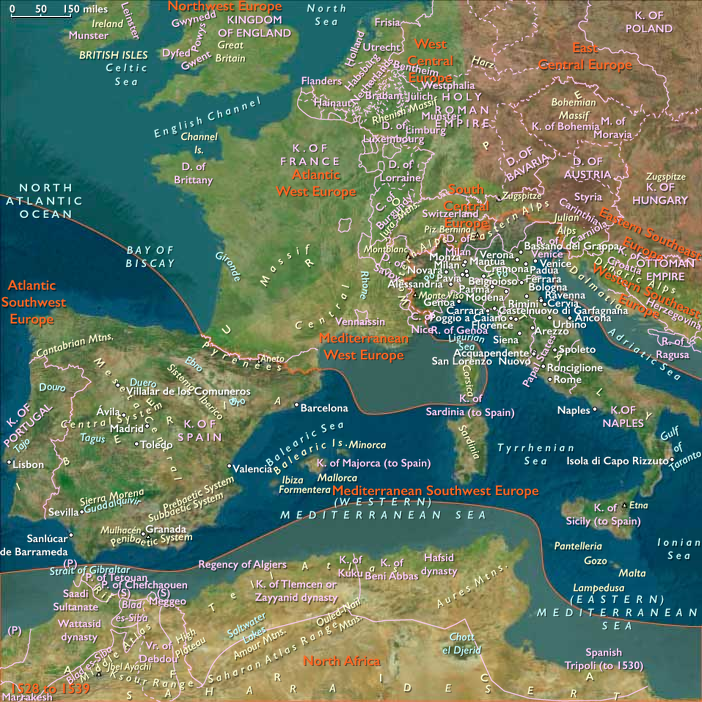
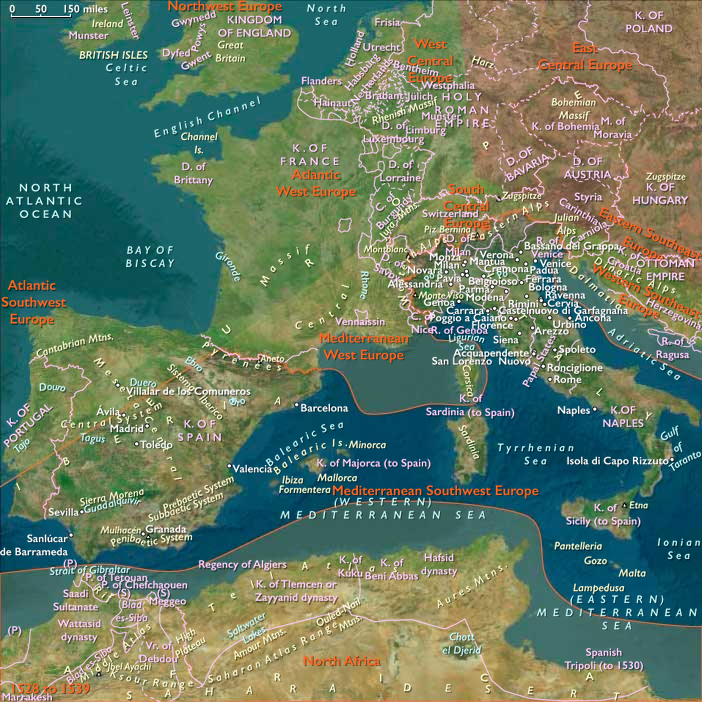
Parmigianino returns to Parma in 1531 and accepts a commission to paint frescoes in the Church of the Steccata.
Locations
People
Groups
Topics
Subjects
Regions
Subregions
Related Events
Filter results
Showing 10 events out of 37959 total
The future king of Arakan was born Min Pa to Crown Prince Raza of Mrauk-U and Princess Saw Nandi in 1493.
His parents were first cousins; his mother was a daughter of Raza's maternal uncle.
He has at least one younger brother named Min Aung Hla, and many half-siblings.
In 1502, his grandfather King Salingathu died, and his father succeeded the throne.
As king, his father had raised three new queens, and made his mother merely a minor queen.
A few years later, the king appointed Min Pa as a general in the army In 1513, Raza was overthrown by Gazapati, another son by a concubine.
Although Min Pa was older than Gazapati and had a more legitimate claim to the throne, he kept a low profile.
He managed to survive intrigues and power struggles at the court, which would see three different kings (Gazapati, Saw O and Thazata) in the next eight years.
In 1521, King Thazata died, and the king's younger brother Minkhaung succeeded in getting the throne.
Though he lost the throne to Minkhaung, Min Pa had managed to be appointed as the new governor of Thandwe (Sandoway), the second most important city in the kingdom.
At Thandwe, Min Pa had patiently built a loyal following, and collected arms.
Ten years later, he revolts, and marches to Mrauk-U with land and naval forces.
At Mrauk-U, his forces defeat the king's army, and he has Minkhaung executed.
Min Bin ascends to the throne on May 27, 1531, with the royal styles of Thiri Thuriya Sanda Maha Dhamma Yaza and Zabuk Shah.
As someone who has come to power by force, the new king immediately issues a decree to strengthen the defenses of Mrauk-U.
(In the following decade, Mrauk-U will receive an elaborate defensive works consisting of massive stone walls and a deep moat filled with tidal waters.
The defense works will later be extended to the rest of the kingdom, as after 1532, the coastal areas of the kingdom will become liable to pillage by Portuguese pirates.)
He also works to consolidate his rule, and is to face no opposition in this regard.
Lords from around the Arakanese kingdom come to pledge their allegiance on September 16, 1531, at the coronation ceremony held at the new palace in the capital.
According to chronicles, one notable absence at the coronation ceremony is Chittagong, which had paid tribute to strong Arakanese kings Ba Saw Phyu (r. 1459–1482) and Dawlya (r. 1482–1492).
Min Bin is determined to restore what he calls his forebears' rightful realm, which according to him, includes all of Bengal, not just Chittagong.

Sebald Beham, a German artist expelled, with his brother Barthel, from Nuremberg in 1525 for religious and political freethinking, returns briefly to the city in 1531 to complete the “Planets” engraving series.
The accusations against the Beham brothers were connected with their Lutheran beliefs, the city authorities then being Catholic, although they adopted Lutheranism as the city's official religion only two months later.
The three artists were soon allowed to return to Nuremberg, but in 1528 Beham had hurriedly left the city once more, following the threat of legal action over his treatise on the proportions of the horse, which was regarded as having been plagiarized from an unpublished manuscript by Albrecht Dürer, who had recently died.
He had then spent time working in various German cities; his woodcuts were published at Ingolstadt between 1527 and 1530, and in the latter year he was in Munich, where he recorded the triumphal entry of Emperor Charles V in a woodcut entitled The Military Display, June 10, 1530.
Babur's death at forty-seven had left Humayun, his twenty-two-year-old son and successor, with the task of territorial consolidation of Hindustan.
The new and somewhat feckless emperor’s true interests lie not in conquest but rather in wine, opium, poetry, and astrology.
He fails in 1531 in his first military adventure, the subjugation of the Hindu principality of Kalinjar in Bundelkhand, to the south of Delhi.
The victories that give the followers of Imam Ahmad the upper hand come in 1531.
The first is at Antukyah, where cannon fire at the start of the battle panics the Ethiopian soldiers.
The second is on October 28 at Amba Sel, when troops under the Imam not only defeat but disperse the Ethiopian army and capture items of the Imperial regalia.
These victories allow the Somalis to cross the Walaqa River and enter the Ethiopian highlands, where they begin to sack and burn numerous churches, including Atronsa Maryam, where the remains of several Emperors had been interred.
The country is looted by Ahmad's forces, who destroy several Christian monuments and oppress the non-Muslim Amhara and Tigray.
Southern Switzerland’s five-member Christian Union, convinced that the Thurgau is being forcibly Protestantized by Zürich, suddenly declares war on the Protestant canton.
Zürich hastily assembles an army to meet the Christian Union’s forces on October 11, 1531, at Kappel, where Swiss reformer Huldrych Zwingli, now fifty, is killed.
Most of the Thurgau's population between 1526 and 1531 has adopted the new Reformed faith spreading from Zurich; Zurich's defeat in the War of Kappel (1531) ends Reformed predominance.
Instead, the second peace of Kappel, concluded in 1531 between Zürich and the Catholic Christian Union of southern Switzerland, recognizes the rights and freedoms of Catholics within the union’s five cantons.
People of the Pfyn culture had inhabited the area of the present canton of Tyrgau along Lake Constance in the early fourth millennium.
The canton during Roman times was part of the province Raetia until the Alamanni settled the area in 450.
Thurgovia in the sixth century became a Gau of the Frankish Empire as part of Alemannia, passing in the early tenth century to the Duchy of Swabia.
Thurgovia at this time included not just what is now the canton of Thurgau, but also much of the territory of the modern canton of St. Gallen, the Appenzell and the eastern parts of the canton of Zurich.
The most important cities of Thurgovia in the early medieval period were Constance as the seat of the bishop, and St. Gallen for its abbey.
The dukes of Zähringen and the counts of Kyburg took over much of the land in the High Middle Ages.
When the Kyburg dynasty became extinct in 1264, the Habsburgs took over that land.
The Old Swiss Confederacy allied with ten freed bailiwicks of the former Toggenburg, seized the lands of the Thurgau from the Habsburgs in 1460, and it became a subject territory of seven Swiss cantons (Zurich, Lucerne, Uri, Schwyz, Unterwalden, Zug and Glarus).
Both the Catholic and emerging Reformed parties during the Protestant Reformation in Switzerland have sought to swing the subject territories, such as the Thurgau, to their side.
Local peasants in 1524, in an incident that resonated across Switzerland, had occupied the cloister of Ittingen in the Thurgau, driving out the monks, destroying documents, and devastating the wine-cellar.
The Lyonnais, a province of France that owes its name to the city of Lyon, is enlarged in 1531 with the addition of …
…Forez.
A college founded in Granada by Charles V in 1526 for the teaching of logic, philosophy, theology and canon law, is on July 14, 1531, established as a studium generale by a papal bull by Clement VII, marking the birth of the University of Granada.
Sebastiano del Piombo, a Venetian painter who, during his years in Rome, has assimilated the Roman style as exemplified by Michelangelo, is also a distinguished portraitist: he paints Pope Clement VII in 1531.
The Pope, during his half-year imprisonment in 1527, had grown a full beard as a sign of mourning for the sack of Rome.
This is a violation of Catholic canon law, which requires priests to be clean-shaven; however, it had the precedent of the beard that Pope Julius II had worn for nine months in 1511–12 as a similar sign of mourning for the loss of the papal city of Bologna.
Unlike Julius II, however, Clement VII will keep his beard until his death in 1534.
His example in wearing a beard will be followed by his successor, Paul III, and indeed by twenty-four popes who follow him, down to Innocent XII, who dies in 1700.
Clement VII is thus the unintentional originator of a fashion that will last well over a century.