
Paranthropus stands roughly one point three to …
Years: 2848653BCE - 2599822BCE
Paranthropus stands roughly one point three to one point four meters (four and a quarter to four and a half feet) tall and is well muscled.
More massively built craniodentally, Paranthropus tends to sport gorilla-like sagittal crests on the cranium that anchor massive temporalis muscles of mastication.
The emergence of the robusts could be either a display of divergent or convergent evolution.
Australopithecus afarensis and A. anamensis had, for the most part, disappeared by the time Paranthropus first appears, roughly two point seven million years ago, sharing the earth with some early examples of the Homo genus, such as Homo habilis, H. ergaster, and possibly even H. erectus.
Most species of Paranthropus have significantly larger braincases than Australopithecus, with a brain about forty percent of the size of a modern human.
Paranthropus is associated with stone tools both in southern and eastern Africa, although there is considerable debate whether they were made and utilized by these robust australopithecines or contemporaneous Homo.
Most believe that early Homo was the toolmaker, but hand fossils from Swartkrans, South Africa, indicate that the hand of this robust species was also adapted for precision grasping and tool use.
Most Paranthropus species seem almost certainly neither to have used language nor to have controlled fire, although they are directly associated with the latter at Swartkrans.
Its physiology specifically tailored to a diet of grubs and plants, Paranthropus is thought to have lived in wooded areas rather than the grasslands of the Australopithecus.
This would have made it more reliant on favorable environmental conditions than members of the genus Homo, such as Homo habilis, which would eat a much wider variety of foods.
Therefore, due to poor adaptation, Paranthropus boisei/Robust Australopithecus dies out, leaving no descendants.
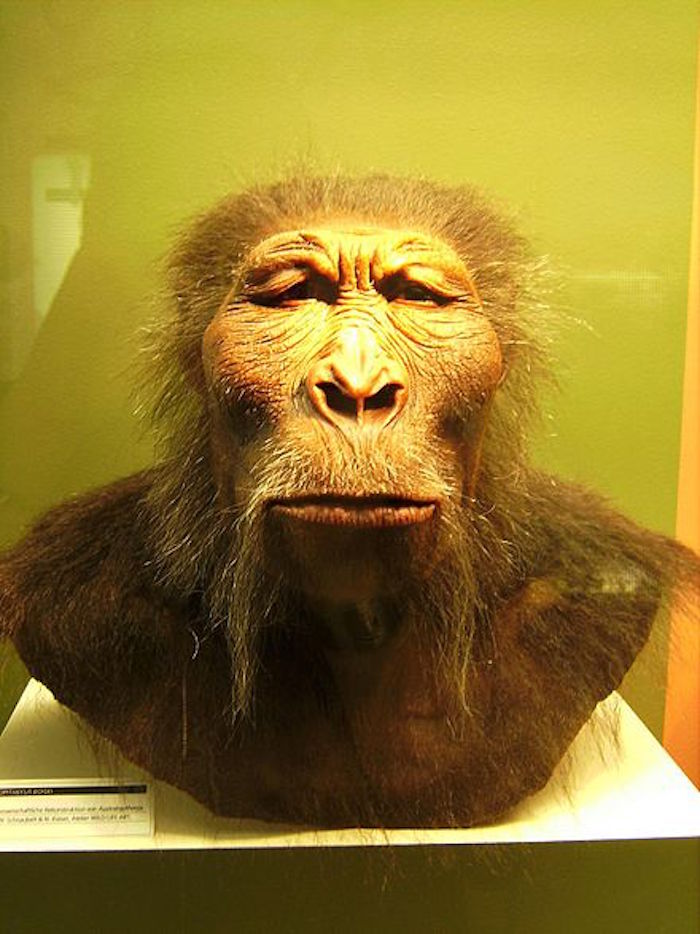
Scientific reconstruction of a Paranthropus boisei 25 March 2007Photographed at Westfälisches Museum für Archäologie, Herne Photographed by User:Lillyundfreya
Topics
Subjects
Years: 2848653BCE - 2599822BCE
Scientific reconstruction of a Paranthropus boisei 25 March 2007Photographed at Westfälisches Museum für Archäologie, Herne Photographed by User:Lillyundfreya