Filters:
Millennial Panic and the Fear of Apocalypse …
Years: 1024 - 1035
Millennial Panic and the Fear of Apocalypse (c. 1033 CE)
As the one-thousandth anniversary of Christ’s crucifixion approached, widespread apocalyptic anxiety gripped medieval Europe. Rooted in interpretations of the Book of Revelation, many believed that the year 1033—a millennium after the death of Christ—would mark the end of the world. This fear was intensified by extreme weather patterns, leading to an outburst of religious fervor across Christendom.
Origins of the Apocalyptic Fear
- The Book of Revelation spoke of a thousand-year period before the final judgment and the destruction of the world.
- While some earlier interpretations had focused on the year 1000, attention soon shifted to 1033, believed to be the millennial anniversary of Christ’s crucifixion, reinforcing expectations of divine reckoning.
- Religious preachers warned that the signs of the apocalypse were unfolding, driving people to acts of extreme penitence and devotion.
Harsh Weather and Omens of Doom
- The early 1030s saw a period of harsh spring weather, including floods, famines, and cold spells, which many interpreted as divine warnings of impending judgment.
- These climate anomalies heightened fears, prompting mass pilgrimages, public acts of penance, and donations to monasteries in hopes of securing divine mercy.
- Natural disasters, famines, and plagues—common in the Middle Ages—were woven into the apocalyptic narrative, reinforcing the collective anxiety.
Responses to the Millennial Panic
- Many abandoned their daily lives, seeking spiritual refuge in monasteries and pilgrimage sites, most notably Jerusalem and Santiago de Compostela.
- Religious reform movements gained momentum, as people sought to purify their souls in preparation for the expected Day of Judgment.
- Some local rulers and clerics exploited the fear, encouraging acts of piety, charity, and church-building, further strengthening the Church’s moral and social authority.
The Gradual Dissipation of Fear
- When 1033 passed without apocalyptic events, fear gradually subsided, and confidence in continued earthly existence was restored.
- The failure of the anticipated apocalypse led to shifts in religious thought, encouraging a more practical focus on Church reform, social order, and economic expansion.
- This period laid the foundation for new religious and cultural movements, including the Cluniac reforms, the Peace of God, and the intellectual revival of the later Middle Ages.
Legacy
- The millennial panic of 1033 was one of the first documented cases of widespread eschatological fear in medieval Europe, illustrating how scriptural interpretation, natural events, and social uncertainty could trigger mass hysteria.
- Although no apocalypse occurred, the religious fervor it inspired deepened faith, strengthened monastic institutions, and reinforced the Church’s moral authority.
- The failure of the prophecy also led some to rethink eschatological beliefs, shifting toward a more long-term, institutionalized approach to salvation rather than immediate end-times expectations.
The anxieties of 1033 serve as a reminder of how historical events, environmental changes, and religious beliefs have long shaped societal reactions to perceived existential threats, influencing the course of medieval Europe’s religious and cultural development.
Years: 1024 - 1035
Groups
Subjects
Regions


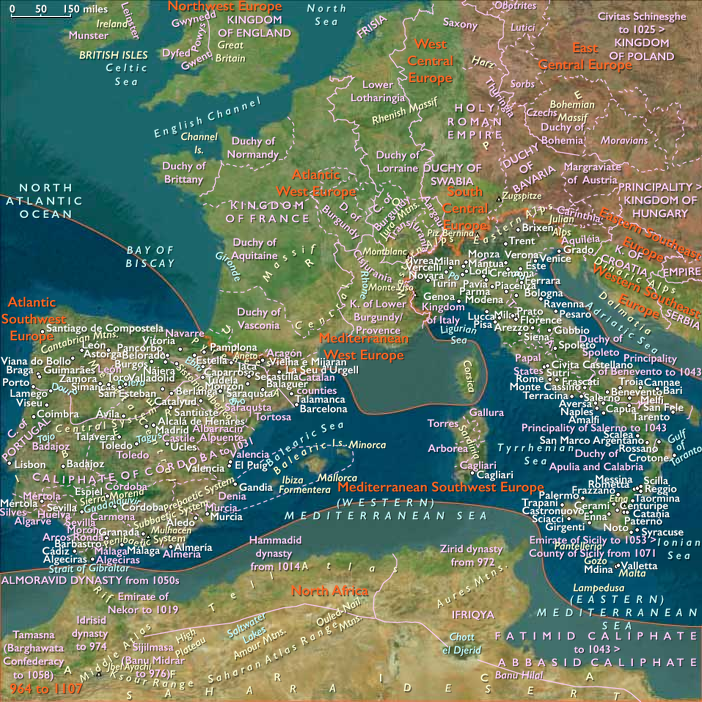
Subregions
- Northeast Europe
- East Central Europe
- Eastern Southeast Europe
- Western Southeast Europe
- South Central Europe
- Mediterranean West Europe
- Mediterranean Southwest Europe
- Atlantic Southwest Europe
- Atlantic West Europe
- West Central Europe
- Northwest Europe