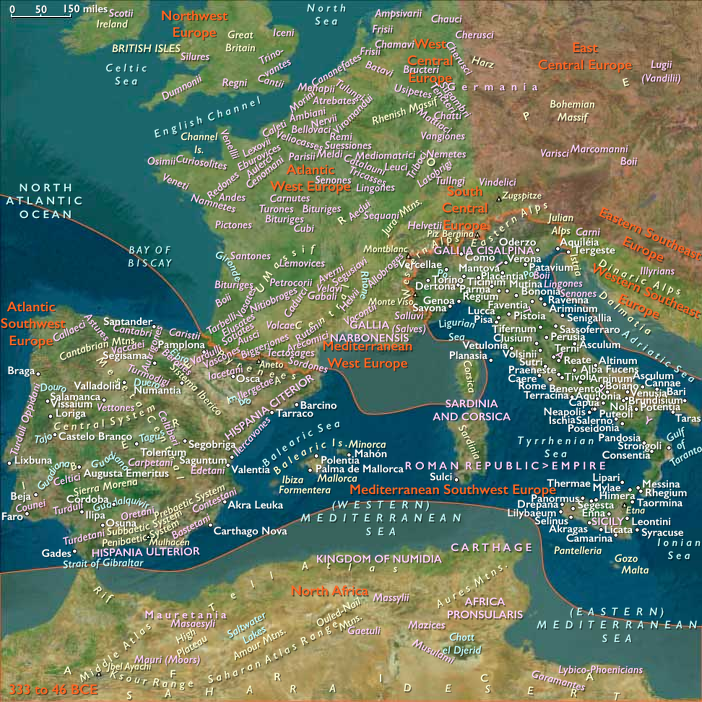
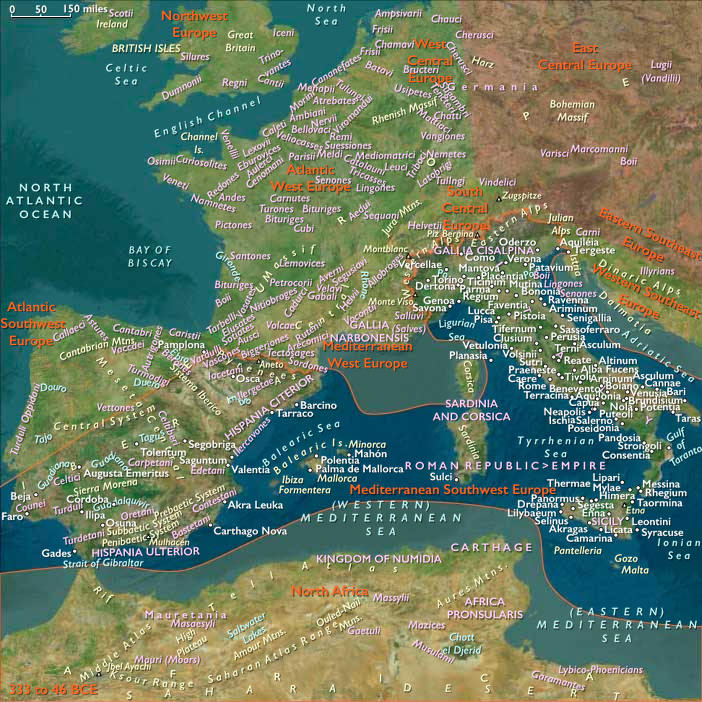
...Palma is to be the Roman port …
Years: 123BCE - 123BCE
Locations
People
Groups
Topics
Commodoties
Subjects
Regions
Subregions
Related Events
Filter results
Showing 10 events out of 62989 total
Details from Chinese sources seem to indicate that the nomad invasion did not end civilization in Bactria entirely.
Hellenized cities continue to exist for some time, and the well-organized agricultural systems are not demolished.
Some time after 124 BCE, possibly disturbed by further incursions of rivals from the north and apparently vanquished by the Parthian king Mithridates II, successor to Artabanus, the Yuezhi move south to Bactria.
Bactria had been conquered by the Greeks under Alexander the Great in 330 BCE and since settled by the Hellenistic civilization of the Seleucids and the Greco-Bactrians for two centuries.
This event is recorded in Classical Greek sources, when Strabo presented them as a Scythian tribe and explained that the Tocharians—together with the Assianis, Passianis and Sakaraulis—took part in the destruction of the Greco-Bactrian kingdom in the second half of the second century BCE: "Most of the Scythians, beginning from the Caspian Sea, are called Dahae Scythae, and those situated more towards the east Massagetae and Sacae; the rest have the common appellation of Scythians, but each separate tribe has its peculiar name.
All, or the greatest part of them, are nomads.
The best known tribes are those who deprived the Greeks of Bactriana, the Asii, Pasiani, Tochari, and Sacarauli, who came from the country on the other side of the Jaxartes, opposite the Sacae and Sogdiani."
(Strabo, 11-8-1) A description of the Greco-Bactrian kingdom is made by Zhang Qian after the conquest by Yuezhi: "Daxia (Greco-Bactria) is located over 2,000 li southwest of Dayuan, south of the Gui (Oxus) river.
Its people cultivate the land and have cities and houses.
Their customs are like those of Ta-Yuan.
It has no great ruler but only a number of petty chiefs ruling the various cities.
The people are poor in the use of arms and afraid of battle, but they are clever at commerce.
After the Great Yuezhi moved west and attacked the lands, the entire country came under their sway.
The population of the country is large, numbering some 1,000,000 or more persons.
The capital is called the city of Lanshi (Bactra) (modern Balkh) and has a market where all sorts of goods are bought and sold."
In a sweeping analysis of the physical types and cultures of Central Asia that he visited in 126 BCE, Zhang Qian reports that "although the states from Dayuan west to Anxi (Parthia), speak rather different languages, their customs are generally similar and their languages mutually intelligible.
The men have deep-set eyes and profuse beards and whiskers.
They are skillful at commerce and will haggle over a fraction of a cent.
Women are held in great respect, and the men make decisions on the advice of their women."

Aix (Aquae Sextiae; later known as Aix-en-Provence) is founded in 123 BCE on the principal routes to Italy and the Alps by the Roman consul Sextius Calvinus, who gives his name to its nearby mineral springs, following the destruction of the nearby Gallic oppidum at Entremon, which had been the capital of the Celtic-Ligurian confederation.
The Allobroges people are the Celtic inhabitants of the Savoy, a strategic region of southeastern France that extends from Lake Geneva to the Isere River and borders on the Italian frontier.
The name Savoy stems from the Late Latin Sapaudia, referring to a fir forest.
The Greek historian Polybius made the first recorded reference to the Allobroges people in 150-130 BCE, telling of their unsuccessful resistance to Hannibal when he crossed the Alps in 218 BCE.
In 123 BCE, the Allobroges give shelter to king Tutomotulus (or Teutomalius), of the Salluvii tribe that Rome had conquered and refuses to hand him over, Rome declares war and moves against them.
The Balearic Islands seem to have been virtually independent after the fall of Carthage.
The islanders, their celebrity in war notwithstanding, were generally very quiet and inoffensive.
The Romans, however, easily find a pretext for charging them with complicity with the Mediterranean pirates, and they are conquered by Q. Caecilius Metellus, thence surnamed Balearicus, in 123 BCE.
Metellus settles three thousand Roman and Spanish colonists on the larger island, and founds the cities of Palma and Pollentia, loosely incorporating the islands into the province of Tarraconensis.
Palma is founded as a Roman camp upon the remains of a Talaiotic settlement on the south of the island; Pollentia, on the site of a Phoenician settlement in the northeast.
While Pollentia is to serve as port to Roman cities on the northwestern Mediterranean Sea, …
Gaius Sempronius Gracchus, having taken on the reforms of his murdered brother, is elected tribune in 123 BCE.
He promotes further redistribution of land to the poor, grain subsidies, and public-works employment.
Gaius also presses for citizenship for Rome's Italian allies and increased power for the wealthy, nonsenatorial class of equestrians, through control of the courts trying provincial officials and control of provincial tax collecting.
Cleopatra Thea has ruled Syria from 125 BCE, sharing the throne with her son, Antiochus VIII Grypus, to legitimize her reign.
Either he or his half brother Antiochus IX Cyzicenus is probably identical with the ephemeral child ruler Antiochus Epiphanes, who was crowned by Cleopatra Thea after the death of Antiochus VII but before Demetrius II returned to Antioch.
Epiphanes, who is known from coins, was deposed—but not killed—when Demetrius II was restored in 129 BCE.
Since the demise of Demetrius, Alexander II Zabinas has ruled parts of Syria, but had soon run out of Egyptian support and is in his turn defeated by Grypus.
Zabinas flees to the Seleucid capital Antiochia, where he plunders several temples.
He is said to have joked about melting down a statuette of the goddess of victory Nike which was held in the hand of a Zeus statue, saying "Zeus has given me Victory".
Enraged by his impiety, the Antiochenes cast Zabinas out of the city.
He soon falls into the hands of robbers, who deliver him up to Antiochus, by whom he is put to death, in 122 BCE.
Equestrians replace the senators in Rome’s jury system in 122 BCE.
Opponents of Gaius’ reforms appeal to disparate interests among the Roman factions to deny Gaius their support, but he narrowly wins election to a second term.
Grypus (hook-nose) has become less controllable as he has grown up.
In 121 BCE, Cleopatra Thea decides to eliminate him.
As he returns from a hunt one day, she offers him a cup of wine.
Since this is not common behavior for her, Grypus is suspicious and forces her to drink the wine, which kills her.
(The story may have been inspired by the fact that Grypus was interested in toxicology; some poems about poisonous herbs believed to have been written by him are quoted by the famous physician Galen).
Hyspaosines' troops had moved north and occupied Babylon and Seleucia probably sometime in 127, when the Parthians were fighting nomadic invaders in the eastern part of their territory.
His rule there must have been short, however, for the Parthian governor of Babylon and the north, Himerus, was back in Seleucia and Babylon by 126.
Himerus cannot have been a rebel, since he strikes coins in the name of the Parthian rulers Phraates II and Artabanus II, both of whom had been killed in fighting in eastern Iran.
Himerus abuses his power and is said to have oppressed the cities of Mesopotamia, plundering them and killing their inhabitants.
Cuneiform documents from Babylon stop after this date, indicating that the city does not survive the depredations of Himerus.
He vanishes, however, and Parthian sovereignty is restored by the ninth Arsacid king, Mithridates II, who comes to the throne about 124; he is the son of Artabanus II, who had been slain fighting the Sakas.
Mithridates recovers all Mesopotamia and …
…conquers Characene, overstriking coins of Hyspaosines and driving him from his capital in 122 or 121.