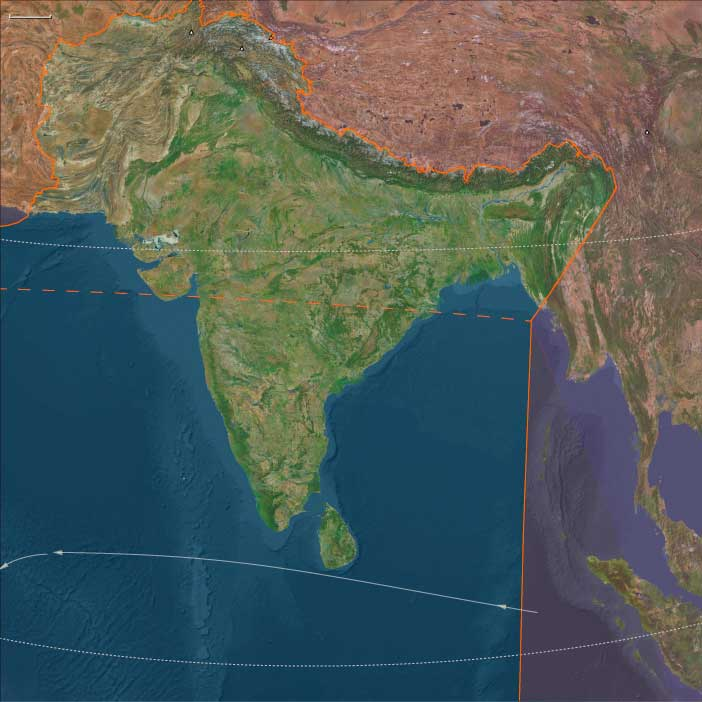
Pakistan's capital is transferred from Karachi to …
Years: 1959 - 1959
Pakistan's capital is transferred from Karachi to Rawalpindi in 1959.
The army maintains low visibility and seems content to uphold the traditional social order.
By early 1959, most army units have resumed their regular duties.
Pakistan's tentative approaches to China intensify after March 1959 when China's occupation of Tibet and the flight of the Dalai Lama to India end five years of Chinese-Indian friendship.
Ayub Khan is the architect of Pakistan's policy of close alignment with the United States, and his first major foreign policy act is to sign bilateral economic and military agreements with the United States.
Pakistan remains a member of the Baghdad pact, converted into the Central Treaty Organization (CENTO) after Iraq's withdrawal in 1959.
Ayub Khan generally leaves administration in the hands of the civil bureaucracy, with some exceptions.
The land-reform program begins to deal with the problems of large-scale, often absentee ownership of land and the excessive fragmentation of small holdings by introducing maximum and minimum area limits.
Under the Land Reform Commission, which was established the previous autumn, the government imposes a ceiling of 200 hectares of irrigated land and 400 hectares of unirrigated land in the West Wing for a single holding, thereby reducing the power of the landed aristocracy, which opposes Ayub Khan.
In the East Wing, the landholding ceiling is raised from thirty-three hectares to forty-eight hectares.
Landholders retain their dominant positions in the social hierarchy and their political influence, but heed Ayub Khan's warnings against political assertiveness.
The Export Bonus Vouchers Scheme and tax incentives stimulate new industrial entrepreneurs and exporters.
Bonus vouchers facilitate access to foreign exchange for imports of industrial machinery and raw materials.
The government offers tax concessions for investment in less-developed areas.
These measures have important consequences in bringing industry to Punjab and give rise to a new class of small industrialists.
Ayub Khan seeks to create political institutions that will express Islamic ideals and foster national development.
He initiates a plan for "basic democracies," directly elected by the people, as local units of development.
Ayub Khan's martial law regime, critics observe, is a form of "representational dictatorship," but the new political system, introduced in 1959, is an apt expression of what Ayub Khan calls the particular "genius" of Pakistan.
Ayub Khan does not believe that a sophisticated parliamentary democracy is suitable for Pakistan.
Instead, the Basic Democracies, as the individual administrative units are called, are intended to initiate and educate a largely illiterate population in the working of government by giving them limited representation and associating them with decision making at a "level commensurate with their ability." Basic Democracies are concerned with no more than local government and rural development.
They are meant to provide a two-way channel of communication between the Ayub Khan regime and the common people and allow social change to move slowly.
The Basic Democracy system establishes five tiers of institutions.
The lowest but most important tier is composed of union councils, one each for groups of villages having an approximate total population of 10,000.
Each union council is composed of ten directly elected members and five appointed members, all called Basic Democrats.
Union councils are responsible for local agricultural and community development and for rural law and order maintenance; they are empowered to impose local taxes for local projects.
These powers, however, are more than balanced at the local level by the fact that the controlling authority for the union councils is the deputy commissioner, whose high status and traditionally paternalistic attitudes often elicit obedient cooperation rather than demands.
The next tier consists of the tehsil (subdistrict) councils, which perform coordination functions.
Above them, the district (zilla) councils, chaired by the deputy commissioners, are composed of nominated official and nonofficial members, including the chairmen of union councils.
The district councils are assigned both compulsory and optional functions pertaining to education, sanitation, local culture, and social welfare.
Above them, the divisional advisory councils coordinate the activities with representatives of government departments.
The highest tier consists of one development advisory council for each province, chaired by the governor and appointed by the president.
The urban areas have a similar arrangement, under which the smaller union councils are grouped together into municipal committees to perform similar duties.
The National Assembly, consisting of 156 members (including six women) and elected by an electoral college of 80,000 Basic Democrats is established as the federal legislature.
Legislative powers are divided between the National Assembly and provincial legislative assemblies.
The National Assembly is to hold sessions alternatively in Islamabad and Dhaka; the Supreme Court will also hold sessions in Dhaka.