
Filters:
Admiral Gennady Nevelskoy demonstrates that the Strait …
Years: 1848 - 1848
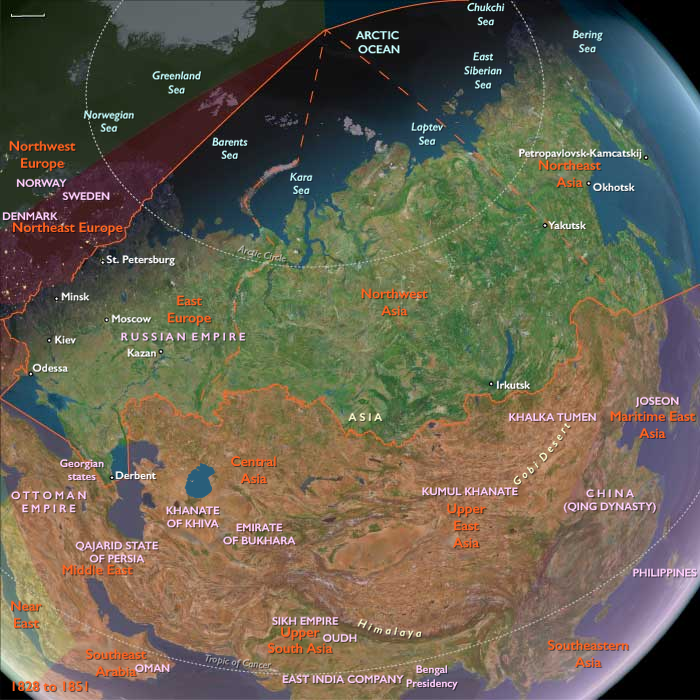
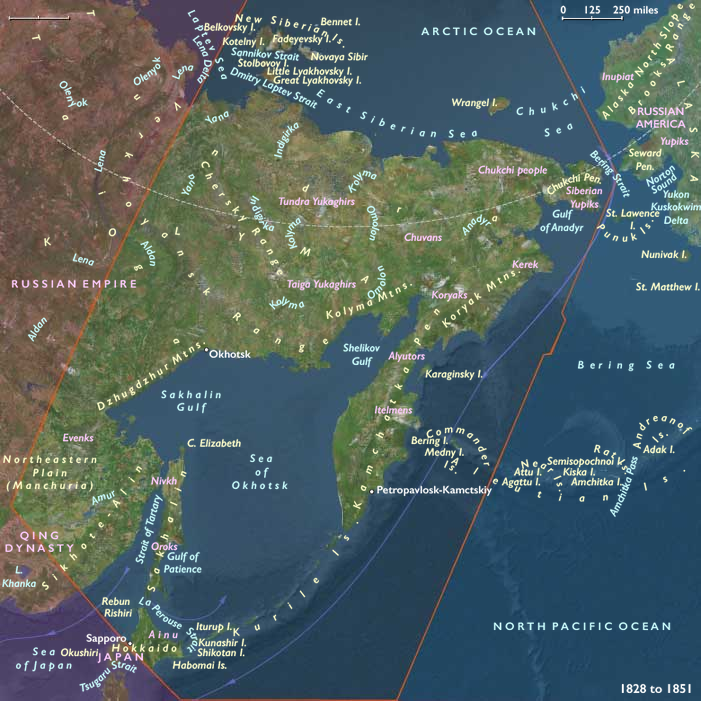
Admiral Gennady Nevelskoy demonstrates that the Strait of Tartary is strait in the Pacific Ocean dividing the Russian island of Sakhalin from mainland Asia (South-East Russia), connecting the Sea of Okhotsk on the north with the Sea of Japan on the south.
"Tartary" is an older name used by Europeans to refer to a vast region covering Inner Asia, Central Asia and North Asia.
The toponym is derived from the Medieval ethnonym "Tartars", which was applied to various Turco-Mongol semi-nomadic empires.
Since the Manchus' rise to prominence in 1644, the name "Tartars" had become applied to them as well, and Manchuria (and Mongolia) have become known to the Europeans as the "Chinese Tartary".
Accordingly, when La Pérouse charted most of the strait between Sakhalin and the mainland "Chinese Tartary" in 1787, the body of water had received the name of the Strait (or Channel, or Gulf) of Tartary.
In Japan, the strait is named after Mamiya Rinzō, who had traveled to the strait in 1808, whereof the name will be introduced by Philipp Franz von Siebold in his book Nippon: Archiv zur Beschreibung von Japan (1832–54).
On Russian maps, the short narrowest section of the strait (south of the mouth of the Amur) is called Nevelskoy Strait, after Admiral Gennady Nevelskoy, who explores the area in 1848; the body of water north of there, into which the Amur River flows, is the Amur Liman; and the name of "Strait of Tartary" is reserved for the largest section of the body of water, south of Nevelskoy Strait.
The Tartar Strait had been a puzzle to European explorers since, when approached from the south, it becomes increasingly shallow and looks like the head of a bay.
In 1787 La Perouse had decided not to risk it and turned south even though locals had told him that Sakhalin was an island.
In 1797 William Broughton had also decided that the Gulf of Tartary was a bay and turned south.
In 1805 Adam Johann von Krusenstern had failed to penetrate the strait from the north.
Mamiya Rinzō's journey of 1808 is little known to Europeans.
Admiral Nevelskoy passes the strait from the north in 1848.
The Russians will keep this a secret and use it to evade a British fleet during the Crimean War.
"Tartary" is an older name used by Europeans to refer to a vast region covering Inner Asia, Central Asia and North Asia.
The toponym is derived from the Medieval ethnonym "Tartars", which was applied to various Turco-Mongol semi-nomadic empires.
Since the Manchus' rise to prominence in 1644, the name "Tartars" had become applied to them as well, and Manchuria (and Mongolia) have become known to the Europeans as the "Chinese Tartary".
Accordingly, when La Pérouse charted most of the strait between Sakhalin and the mainland "Chinese Tartary" in 1787, the body of water had received the name of the Strait (or Channel, or Gulf) of Tartary.
In Japan, the strait is named after Mamiya Rinzō, who had traveled to the strait in 1808, whereof the name will be introduced by Philipp Franz von Siebold in his book Nippon: Archiv zur Beschreibung von Japan (1832–54).
On Russian maps, the short narrowest section of the strait (south of the mouth of the Amur) is called Nevelskoy Strait, after Admiral Gennady Nevelskoy, who explores the area in 1848; the body of water north of there, into which the Amur River flows, is the Amur Liman; and the name of "Strait of Tartary" is reserved for the largest section of the body of water, south of Nevelskoy Strait.
The Tartar Strait had been a puzzle to European explorers since, when approached from the south, it becomes increasingly shallow and looks like the head of a bay.
In 1787 La Perouse had decided not to risk it and turned south even though locals had told him that Sakhalin was an island.
In 1797 William Broughton had also decided that the Gulf of Tartary was a bay and turned south.
In 1805 Adam Johann von Krusenstern had failed to penetrate the strait from the north.
Mamiya Rinzō's journey of 1808 is little known to Europeans.
Admiral Nevelskoy passes the strait from the north in 1848.
The Russians will keep this a secret and use it to evade a British fleet during the Crimean War.
Locations
Groups
Topics
Subjects
Regions
Subregions
Years: 1848 - 1848
Locations
Groups
Topics
Subjects
Regions
Subregions