Outbreaks of measles and tertian fever supersede …
Years: 1670 - 1670
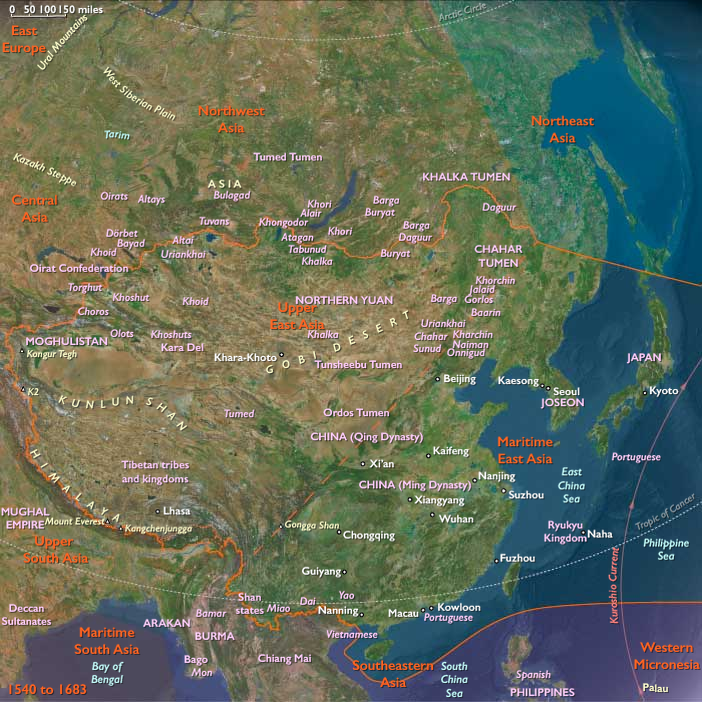
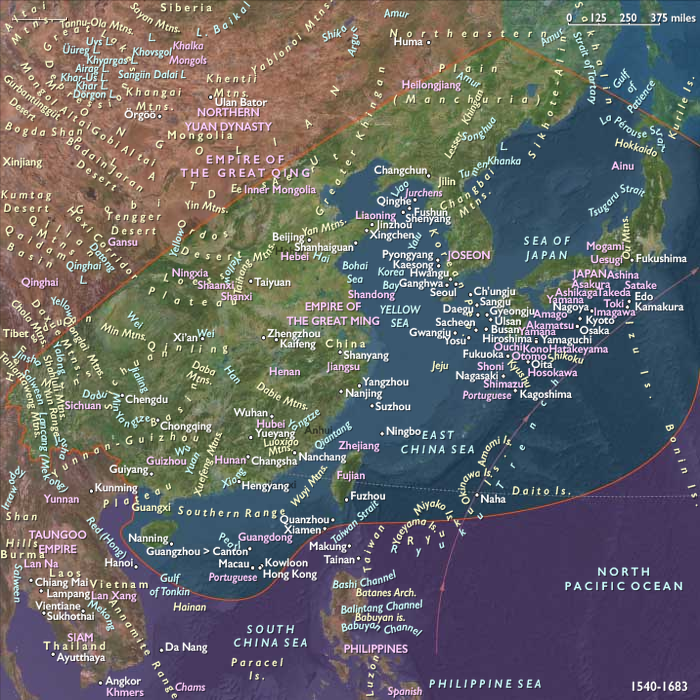
Outbreaks of measles and tertian fever supersede China’s cholera epidemic in 1670.
Locations
Groups
Subjects
Regions
Subregions
Related Events
Filter results
Showing 10 events out of 30826 total
While Razin is ostensibly on his way to report himself at the Cossack headquarters on the Don in 1670, he openly rebels against the government, capturing Cherkassk, ...
...Tsaritsyn and other places, and ...
Péter Zrínyi finally receives some encouragement from the sultan in 1670 and prepares to march into Styria.
Rákóczi, believing rumors that a formal alliance has been concluded, also assembles his forces and arrests Count Rüdiger von Starhemberg, the imperial commander in the northern Hungarian city of Tokay.
The Turks' chief interpreter, however, has revealed the plot to Habsburg officials in Vienna.
Imperial troops rescue Starhemberg and easily disperse the rebels.
Queen Nzinga’s death has accelerated the Portuguese occupation of the interior of South West Africa, fueled by the massive expansion of the Portuguese slave trade.
João Guterres Ngola Kanini, one of the late Queen’s relatives and most important councilors, had managed to temporarily oust Nzinga Mona in 1669, but is defeated and killed in 1670.
His son Francisco Guterres Ngola Kanini will eventually carry on the royal line in the kingdom.
The Fundamental Constitutions is designed to formalize a “Gothic” system of balanced government in the new province.
Although described as feudalism by some authorities, the system is arguably more advanced by virtue of its constitution and emphasis on basic rights and reciprocal benefits among classes.
It is nevertheless a pre-Enlightenment system predicated on class hierarchy.
The Fundamental Constitutions provide a framework for urban and regional development consistent with and supportive of the plan for governance and economic development.
Once settlement begins in 1670 a series of “instructions” are transmitted to the colonists with details that flesh out areas that are not addressed by the Fundamental Constitutions.
The design of towns in Carolina is influenced by the intensive planning that had gone on in London after the Great Fire of 1666.
The government of Charles II had solicited plans to rebuild the city, and inspired designs were submitted by the architect Christopher Wren, the scientist Robert Hooke, the cartographer Richard Newcourt, and landscape planner and polymath John Evelyn.
Their designs influence city planning in the areas of public health and safety, land use efficiency, and urban aesthetics.
The Iroquois, having established peace with the French, return to their westward conquest in their continued attempt to take control of all the land between the Algonquin-speakers and the French.
In the Ohio Country, where the Shawnee and Miami tribes dominate, the Iroquois quickly overrun Shawnee holdings in central Ohio forcing them to flee into Miami territory.
The Miami are a powerful tribe and bring together a confederacy of their neighboring allies including the Potawatomi and the Illinois tribe who inhabit modern Michigan and Illinois.
The majority of the fighting is between this Anishinaabeg Confederacy and the Iroquois Confederacy.
Having driven out the Shawnee and conquered and absorbed the Erie tribe, the Iroquois also control Ohio Valley lands as hunting ground from about 1670 onward, as far as can be determined from mostly French (Jesuit) accounts.
The Ohio country and the Lower Peninsula of Michigan have been virtually emptied of native people, as refugees fled west to escape Iroquois warriors. (This region will eventually be repopulated, although generally in multi-ethnic indigenous "republics", rather than homogeneous, discrete "tribes".)
The Doeg (also spelled Doages, Dogues, Taux, Dogi, Tacci, etc.), a native tribe who live in northern Virginia, speak an Algonquian language, thought to be Piscataway or some other dialect similar to Nanticoke.
They may have been a branch of the Nanticoke tribe, who in turn look to the Lenape as "grandfather".
According to Colonial Caroline: A History of Caroline County, Virginia, the Doeg had once lived in modern King George County, Virginia, but about fifty years before Jamestown (around 1557) had split into three sections, with one part moving to Caroline, one part moving to Prince William County, Virginia, and a third part remaining in King George.
Captain John Smith had visited the upper Potomac River in 1608, and indicated that the Taux lived on that river, above Aquia creek, with their capital, Tauxenent, located on "Doggs Island" (also known as Miompse or May-Umps, now Mason Neck, Virginia), where they lived on fishing and grew corn.
Other hamlets were at Pamacocack (later anglicized to "Quantico"), along Quantico Creek, Yosococomico (now Powell's Creek) and Niopsco (Neabsco Creek).
Associated with them were their neighboring Algonquian relatives, the Moyauns (Piscataway) on the Maryland side, and the Nacotchtanks (Anacostans) in what is now the DC area.
Smith's map also shows another settlement similarly called Tauxsnitania, thought to be near Waterloo in Fauquier County, in the territory of the Siouan Manahoac tribe.
John Lederer, who visited the Piedmont region of Virginia in 1670, wrote that the entire area had been "formerly possessed by the Tacci, alias Dogi, but... the Indians now seated here, are distinguished into the several [Siouan] nations of Mahoc, Nuntaneuck alias Nuntaly, Nahyssan, Sapon, Managog, Mangoack, Akernatatzy and Monakin etc."
He further says: "The Indians now seated in these parts [the Siouans] are none of those whom the English removed from Virginia [the Doeg], but a people driven by the enemy [Erie?] from the northwest, and invited to sit down here by an oracle above four hundred years since, as they pretend for the ancient inhabitants of Virginia were far more rude and barbarous, feeding only upon raw flesh and fish, until they taught them to plant corn..."
In the 1650s, as English colonists had begun to settle the Northern Neck frontier, then known as Chicacoan (Secocowon), some Doeg, Patawomeck and Rappahannock Indians began moving into the region as well, joining other tribes there in disputing the settlers' claims.
The colonists had declared war on them in July 1666, patented the land on the west of the Potomac as far north as My Lord's Island in 1669, and by 1670 have driven the Doegs completely out of Virginia, apart from those living beside the Nanzattico/Portobago in Caroline County.

Perrot serves in 1670 as an interpreter for Daumont de Saint-Lusson, a French commissary assigned to the country of the Ottawas, Amikwas, Illinois, and other indigenous tribes to be discovered in the direction of Lake Superior.
He continues to travel around these areas and engages in fur trading, giving the natives such items as cooking kettles and hatchets (to replace stone tools).
Le Moyne, who has served for years as an interpreter and as a soldier against the Iroquois nations, is rewarded by being made Seigneur of Longueil and of Chateauguay.