
Otto’s 955 victory over the Magyars has …
Years: 962 - 962
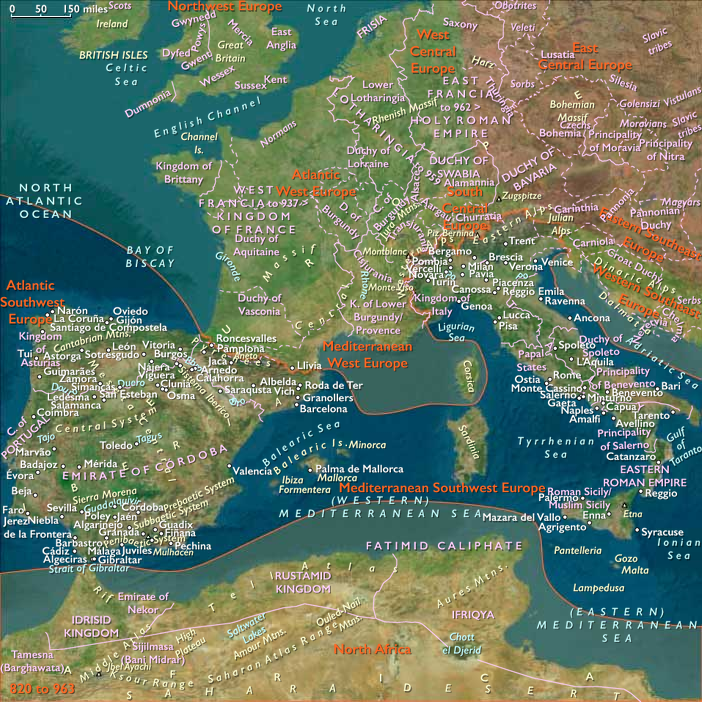
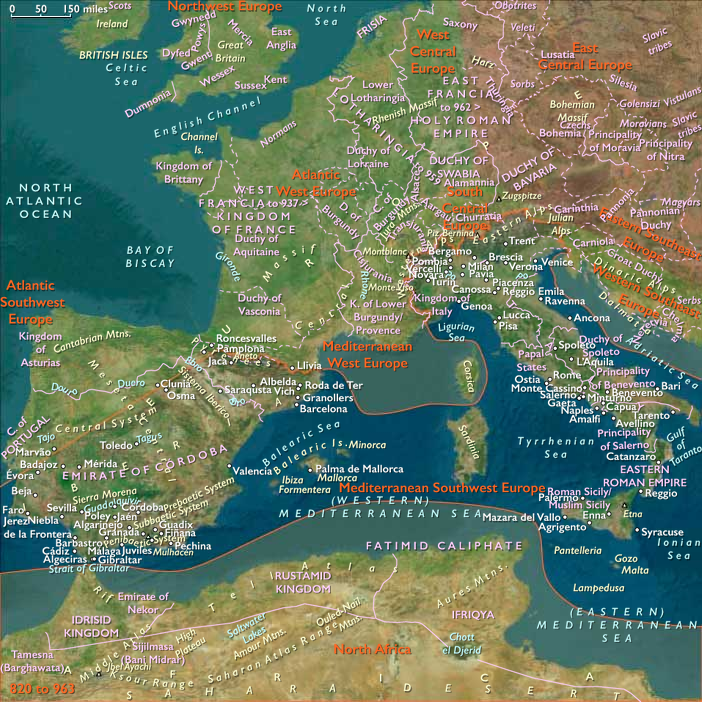
Otto’s 955 victory over the Magyars has brought the Slavs of Bohemia and Moravia and those of the Elbe and Oder basin into the sphere of empire, which the Germans declare themselves to be after swallowing the Kingdom of Italy—Pope, Papal States and all—in 961.
Otto now hopes to extend his influence east into Poland and Kievan Russia.
The forces of John XII had been defeated in the war against Pandolfo Testa di Ferro of Capua, and at the same time many strongholds in the Papal States are occupied by Berengar of Ivrea, effectively if not completely legally King of Italy, and his son Adalbert.
In this dilemma, the pope has recourse to Otto, who reappears in Italy at the head of a powerful army, as he had in the previous decade, now ostensibly as a papal champion.
Berengar, however, does not risk an encounter, but retired to his fortified castles.
Thus, without conclusive military encounters, on January 31, 962, Otto reaches Rome.
He takes an oath to recognize John as pope and ruler of Rome; to issue no decrees without the pope's consent; and, in case he should deliver the command in Italy to any one else, to exact from such person an oath to defend to the utmost of his ability the pope and the Patrimony of Peter.
The pope for his part swears to keep faith with Otto and to conclude no alliance with Berengar and Adalbert.
Consequently, Otto is solemnly crowned Holy Roman Emperor by the pope on February 2.
At a Roman synod ten days later, John, at Otto's desire, founds the Archbishopric of Magdeburg and the Bishopric of Merseburg, bestows the pallium on the Archbishop of Salzburg and Archbishop of Trier, and confirms the appointment of Rother as Bishop of Verona.
The next day, the emperor issues a decree, the famous Diploma Ottonianum, in which he confirms the Roman Church in its possessions, particularly those granted by the Donation of Pepin and by Charlemagne, and provides at the same time that in future the popes should be elected in canonical form, though their consecration is to take place only after the necessary pledges had been given to the emperor or his ambassadors.
In essence, the Emperor is to be the guarantor of papal independence, but to retain the right to confirm papal elections.
Historians debate, in terms of power and prestige, whether the Diploma Ottonianum was a prestigious advantage for the papacy or a political triumph for the emperor.
The emperor marches out of Rome with his army on February 14 to resume the war against Berengar and Adalbert.
From now on, the affairs of the German kingdom will be intertwined with those of Italy and the Papacy.
Otto's coronation as Emperor makes the German kings successors to the Empire of Charlemagne, which through translatio imperii, also makes them successors to Ancient Rome.
Locations
People
- Adalbert of Italy
- Alberic II of Spoleto
- Berengar II of Italy
- Marozia
- Otto I
- Pandulf I Ironhead
- Pope John XII
Groups
- Polabian Slavs (West Slavs)
- Slavs, West
- Wends, or Sorbs (West Slavs)
- Christianity, Chalcedonian
- Papal States (Republic of St. Peter)
- Italy, Carolingian Kingdom of
- Salerno, Lombard Principality of
- Francia Orientalis (East Francia), Kingdom of
- Kievan Rus', or Kiev, Great Principality of
- Capua-Benevento, Lombard Principality of
- Italy, Kingdom of (Holy Roman Empire)
Topics
Commodoties
Subjects
Regions
Subregions
Related Events
Showing 10 events out of 52812 total
Years: 962 - 962
Locations
People
- Adalbert of Italy
- Alberic II of Spoleto
- Berengar II of Italy
- Marozia
- Otto I
- Pandulf I Ironhead
- Pope John XII
Groups
- Polabian Slavs (West Slavs)
- Slavs, West
- Wends, or Sorbs (West Slavs)
- Christianity, Chalcedonian
- Papal States (Republic of St. Peter)
- Italy, Carolingian Kingdom of
- Salerno, Lombard Principality of
- Francia Orientalis (East Francia), Kingdom of
- Kievan Rus', or Kiev, Great Principality of
- Capua-Benevento, Lombard Principality of
- Italy, Kingdom of (Holy Roman Empire)
Topics
Commodoties
Subjects
Regions
Subregions