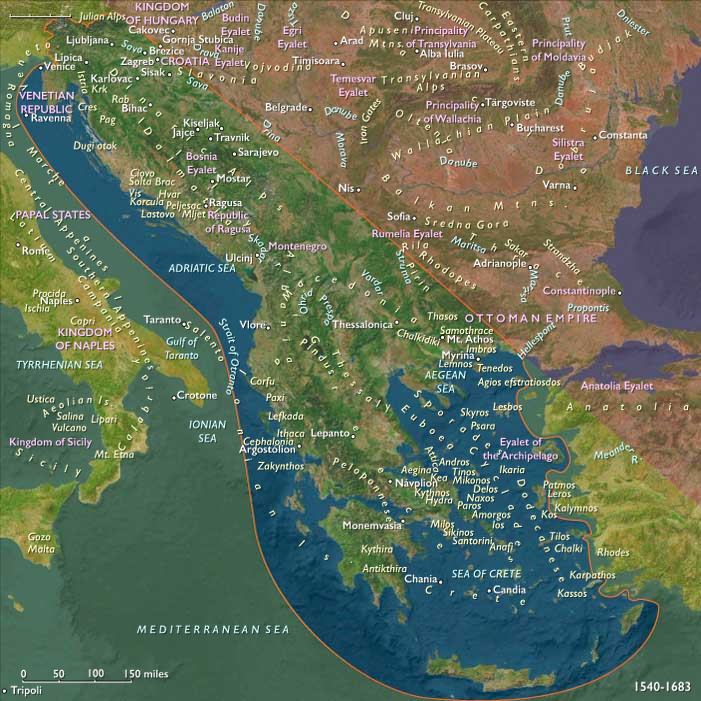
Turkish inroads in Croatia and Austria also …
Years: 1564 - 1575
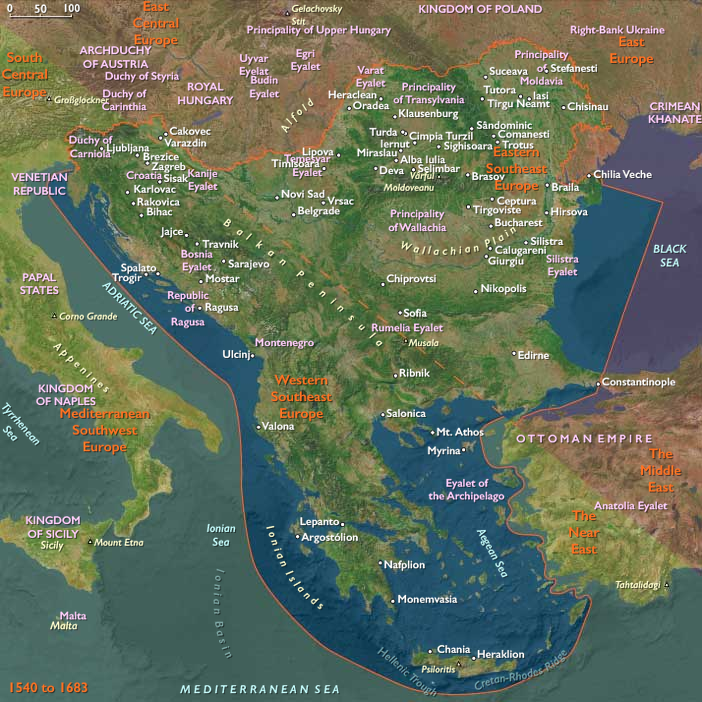
Turkish inroads in Croatia and Austria also trigger price increases for agricultural goods, and opportunistic landowners begin demanding payment in kind, rather than cash, from serfs.
Rural discontent explodes in 1573 when Matija Gubec leads an organized peasant rebellion that spreads quickly before panic-stricken nobles are able to quell it.
Groups
- Germans
- Hungarian people
- Slavs, South
- Christianity, Chalcedonian
- Greeks, Medieval (Byzantines)
- Venice, Duchy of
- Croats (South Slavs)
- Serbs (South Slavs)
- Dalmatia, Theme of
- Hungary, Principality of
- Hungary, Kingdom of
- Christians, Roman Catholic
- Christians, Eastern Orthodox
- Dalmatia region
- Croatia, Kingdom of
- Italians (Latins)
- Austria, Archduchy of
- Serbia, Kingdom of
- Slovenes (South Slavs)
- Ottoman Emirate
- Ottoman Emirate
- Serbian Empire
- Ottoman Empire
- Serbia, Moravian
- Slavonian Krajina (Military Frontier)
- Croatian Krajina (Military Frontier)
Topics
Commodoties
Subjects
Regions
Subregions
Related Events
Filter results
Showing 10 events out of 35736 total
Powerful military leaders arise between 1560 and 1600 to defeat the warring daimyo and unify Japan.
Three major figures dominate the period in succession: Oda Nobunaga (1534-82), Toyotomi Hideyoshi (1536-98), and Tokugawa Ieyasu (1542-1616), each of whom emerges as a major overlord with large military forces under his command.
As their power increases, they look to the imperial court in Kyoto for sanction.
In 1568 Nobunaga, who had defeated another overlord's attempt to attack Kyoto in 1560, marches on the capital, gains the support of the emperor, and installs his own candidate in the succession struggle for shogun.
Backed by military force, Nobunaga is able to control the bakufu.
Initial resistance to Nobunaga in the Kyoto region comes from the Buddhist monks, rival daimyo, and hostile merchants.
Surrounded by his enemies, Nobunaga strikes first at the secular power of the militant Tendai Buddhists, destroying their monastic center at Mount Hiei near Kyoto and killing thousands of monks in 1571.
By 1573 he has defeated the local daimyo, banished the last Ashikaga shogun, and ushered in what historians call the Azuchi-Momoyama period (1573-1600), named after the castles of Nobunaga and Hideyoshi.
Having taken these major steps toward reunification, Nobunaga now builds a seven-story castle surrounded by stone walls at Azuchi on the shore of Lake Biwa.
The castle is able to withstand firearms and becomes a symbol of the age of reunification.
Nobunaga's power increases as he enfeoffs the conquered daimyo, broke down the barriers to free commerce, and drew the humbled religious communities and merchants into his military structure.
He secures control of about one-third of the provinces through the use of large-scale warfare and he institutionalizes administrative practices, such as systematic village organization, tax collection, and standardized measurements.
At the same time, other daimyo, both those Nobunaga had conquered and those beyond his control, build their own heavily fortified castles and modernize their garrisons.
In 1577 Nobunaga dispatches his chief general, Hideyoshi, to conquer twelve western Honshu provinces.
The war is a protracted affair, and in 1582, when Nobunaga leads an army to assist Hideyoshi, he is assassinated.
East Europe (1564–1575 CE): Muscovite Challenges and Territorial Management
Political and Military Developments
Ivan IV’s Oprichnina and Internal Unrest
Between 1564 and 1575 CE, Muscovy faced significant internal challenges as Ivan IV implemented the Oprichnina, a policy that created a separate territory directly under his control. This era saw widespread internal repression, political purges, and considerable administrative disruption.
Ongoing Integration and Conflict with Ethnic Groups
The integration of ethnic territories, including the Bashkirs and other Ural and Volga populations, continued amidst periodic conflicts and complex diplomatic negotiations, challenging Muscovy's administrative capabilities.
Economic and Technological Developments
Economic Strains and Adjustments
Economic growth slowed due to internal turmoil and the disruptive effects of Ivan IV’s policies. Nevertheless, trade along key routes such as the Volga River continued, supporting limited commercial resilience.
Military Adjustments and Technological Advancements
Muscovy maintained its military infrastructure enhancements, especially in fortifications and siege warfare. These adaptations were crucial for managing internal conflicts and securing territorial boundaries.
Cultural and Artistic Developments
Cultural Patronage amid Turmoil
Despite internal political turmoil, cultural and artistic activities continued, though somewhat diminished. Religious architecture and iconography persisted, reflecting both Muscovite traditions and influences from newly integrated territories.
Continued Intellectual Productivity
Scholarly and chronicling endeavors persisted, documenting the political upheavals, administrative changes, and cultural developments of the era, contributing to a comprehensive historical record.
Settlement Patterns and Urban Development
Urban Stability and Struggles
Cities, particularly Moscow, faced pressures from internal political instability, though urban infrastructure development continued, albeit at a reduced pace. Strategic urban planning remained essential for administrative control and security.
Fortifications and Defense Priorities
Fortifications continued to receive attention, crucial for maintaining territorial integrity and urban security amidst ongoing internal and external challenges.
Social and Religious Developments
Social Unrest and Stabilization Efforts
Societal structures experienced significant stress due to Ivan IV’s Oprichnina policy, leading to social disruption and instability. Efforts were made to stabilize society through continued integration of diverse ethnic groups and administrative reforms.
Orthodox Church’s Stabilizing Role
The Orthodox Church played a pivotal role in maintaining social cohesion, providing moral authority, educational continuity, and community stability during this turbulent period.
Long-Term Consequences and Historical Significance
The period from 1564 to 1575 CE was characterized by significant internal upheaval, administrative restructuring, and continued territorial management challenges. These developments influenced Muscovy’s governance practices and shaped future political stability and social integration strategies in the evolving Russian state.
Under the demographic, cultural and political pressure of Polonization, which had begun in the late fourteenth century, many landed gentry of Polish Ruthenia (another name for the land of Rus) convert to Catholicism and become indistinguishable from the Polish nobility.
Deprived of native protectors among Rus nobility, the commoners (peasants and townspeople) begin turning for protection to the emerging Zaporozhian Cossacks, who by the seventeenth century become devoutly Orthodox.
The Cossacks do not shy from taking up arms against those they perceive as enemies, including the Polish state and its local representatives.
Ivan develops a hostility toward his advisers, the government, and the boyars during the late 1550s.
Historians have not determined whether policy differences, personal animosities, or mental imbalance caused his wrath.
In 1565 he divides Muscovy into two parts: his private domain and the public realm.
For his private domain, Ivan chooses some of the most prosperous and important districts of Muscovy.
In these areas, Ivan's agents attack boyars, merchants, and even common people, summarily executing some and confiscating land and possessions.
Thus begins a decade of terror in Muscovy.
As a result of this policy, called the oprichnina, Ivan breaks the economic and political power of the leading boyar families, thereby destroying precisely those persons who have built up Muscovy and are the most capable of administering it.
Trade diminishes, and peasants, faced with mounting taxes and threats of violence, begin to leave Muscovy.
Efforts to curtail the mobility of the peasants by tying them to their land brings Muscovy closer to legal serfdom.
In 1572 Ivan finally abandons the practices of the oprichnina.
Northeast Europe (1564–1575 CE): Escalation of the Livonian War, Strategic Rivalries, and Regional Reconfigurations
Between 1564 and 1575 CE, Northeast Europe experienced heightened geopolitical turmoil primarily driven by the ongoing Livonian War. This era was marked by aggressive territorial expansion by the Grand Duchy of Muscovy, growing intervention by Sweden, Denmark–Norway, and the Polish–Lithuanian Commonwealth, and significant religious, economic, and demographic transformations across the region.
Intensified Conflict in the Livonian War
The prolonged Livonian War (1558–1583) intensified significantly during this period. Ivan IV (the Terrible) of Muscovy escalated his military campaigns in Livonia, aiming for strategic Baltic access and regional dominance. Muscovite forces devastated much of Livonia, severely destabilizing the already weakened Livonian Confederation.
Polish–Lithuanian Commonwealth's Expansion
In response, the Polish–Lithuanian Commonwealth under Sigismund II Augustus became increasingly assertive. The Union of Lublin in 1569 formally unified Poland and Lithuania into a single Commonwealth, enhancing their geopolitical strength. Poland–Lithuania intervened decisively in Livonian affairs, securing key southern territories and actively contesting Muscovite aggression, thereby reinforcing its regional dominance.
Swedish Territorial Gains and Colonization Efforts
Sweden, under Eric XIV (until 1568) and subsequently John III, expanded territorial control in Estonia and northern Livonia. Sweden fortified critical Baltic cities, notably Reval (Tallinn) and Narva, enhancing defensive capabilities and securing crucial commercial routes. Concurrently, Swedish colonization policies promoted settlements of Forest Finns, traditional practitioners of slash-and-burn agriculture, into sparsely populated provinces of Eastern Finland and subsequently into Swedish territories such as Gästrikland, Ångermanland, and Hälsingland. This colonization aimed to secure frontier lands against eastern threats and alleviate population pressures within Finland.
Denmark–Norway’s Baltic Ambitions
Under King Frederick II, Denmark–Norway pursued strategic territorial and economic interests in the contested Baltic region. Engaging in diplomatic and military interventions, Frederick sought to secure maritime trade routes and bolster Danish influence in Courland and Livonian territories. Denmark's active participation intensified rivalries, especially with Sweden.
Duchy of Prussia’s Stability
The secularized Duchy of Prussia, now under Duke Albert Frederick (from 1568), navigated regional instability by maintaining cautious diplomatic neutrality and strong internal governance. Economically vibrant urban centers like Königsberg ensured regional stability and economic prosperity despite the broader geopolitical turmoil.
Economic Resilience in Urban Centers
Despite military conflicts, major urban centers such as Reval (Tallinn), Riga, Königsberg, and Visby on Gotland maintained economic resilience through continued maritime trade, commercial networks, and stable urban governance. This economic strength significantly mitigated disruptions from ongoing warfare.
Religious and Cultural Transformations
Protestantism, particularly Lutheranism, further reshaped the religious and cultural landscape, fostering educational innovation and vernacular literacy. Nonetheless, religious tensions between Protestant and Catholic communities increased, complicating regional alliances and political dynamics.
Scientific Advancements and Astronomical Observations
This period also saw significant scientific advancements, notably by the Danish astronomer Tycho Brahe. Brahe’s meticulous astronomical observations, the most accurate prior to the invention of the telescope, provided a comprehensive study of the solar system and precise measurements of more than seven hundred seventy-seven fixed stars, paving the way for future discoveries and scientific progress in Northeast Europe.
Strategic Diplomatic Maneuvers
Diplomatic activities intensified significantly as regional powers navigated complex alliances, territorial disputes, and religious divisions driven by the ongoing Livonian crisis. Temporary truces, shifting alliances, and strategic negotiations characterized diplomatic efforts to stabilize and manage escalating conflict.
Legacy of the Era
The era from 1564 to 1575 CE significantly reshaped Northeast Europe's geopolitical and cultural landscapes. Intensified warfare, territorial realignments, demographic shifts from colonization efforts, and scientific advancements established lasting regional alignments, territorial boundaries, and cultural identities, fundamentally influencing Northeast Europe's subsequent historical trajectory.

East Central Europe (1564–1575 CE): Maximilian II's Rule, Religious Moderation, Transylvanian Autonomy, and Polish-Lithuanian Stability
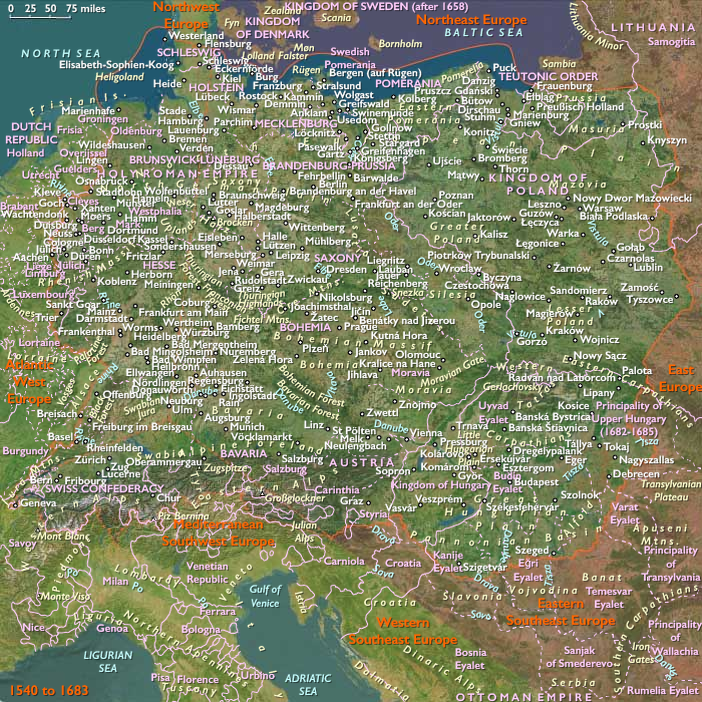
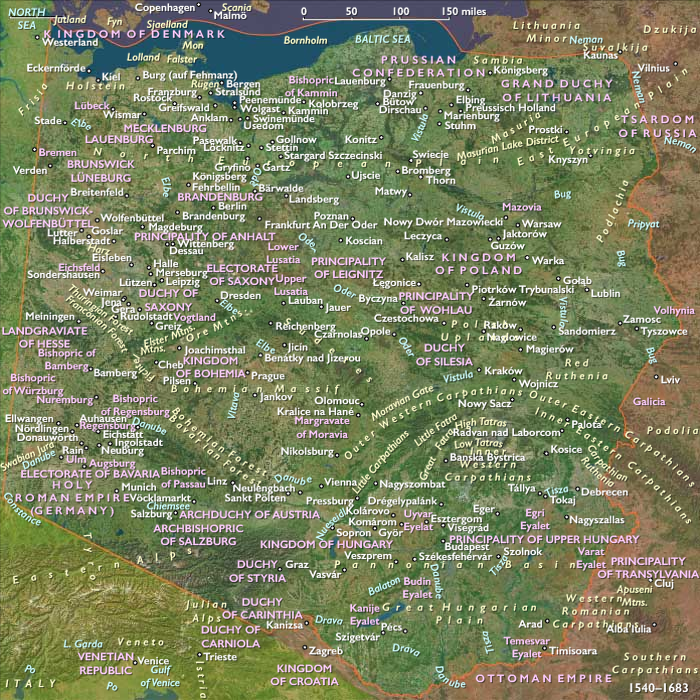
Between 1564 and 1575 CE, East Central Europe—including modern-day Poland, Czechia, Slovakia, Hungary, and eastern Germany and Austria—experienced a phase of political moderation, religious coexistence, and increased stability under the comparatively tolerant rule of Emperor Maximilian II. This era also saw the consolidation of Transylvania's political autonomy within the Ottoman sphere, continuing prosperity in the Polish-Lithuanian Commonwealth under Sigismund II Augustus, and intensified Protestant-Catholic interactions within the Holy Roman Empire.
Political and Military Developments
Moderate Rule of Emperor Maximilian II (1564–1576)
-
Emperor Maximilian II promoted moderate religious policies, advocating limited toleration between Protestants and Catholics, which temporarily eased confessional tensions, especially in Bohemia, Moravia, and the Austrian lands.
-
His pragmatic governance brought relative stability, balancing religious interests across his diverse territories while reinforcing Habsburg authority.
Strengthened Autonomy in Transylvania under John Sigismund Zápolya
-
John Sigismund Zápolya (r. 1540–1571) firmly established Transylvania as a semi-independent principality under Ottoman suzerainty, maintaining diplomatic and military neutrality between the Ottomans and Habsburgs.
-
He notably issued the Edict of Torda (1568), promoting unprecedented religious freedom in Transylvania, officially recognizing Catholic, Lutheran, Calvinist, and Unitarian denominations.
Stability and Dynastic Continuity in Poland-Lithuania
-
The rule of Sigismund II Augustus (r. 1548–1572) remained stable, emphasizing dynastic continuity and maintaining the Commonwealth’s internal cohesion and external diplomatic strength.
-
Upon Sigismund’s death in 1572, the lack of a direct heir initiated an elective monarchy, leading to political uncertainty and intensified aristocratic influence.
Saxon Electoral Strength under Augustus I
-
Electoral Saxony, under Elector Augustus I (r. 1553–1586), further solidified its political and economic influence, reinforcing Lutheran orthodoxy, enhancing administration, and expanding its cultural patronage and diplomatic stature within the empire.
Economic and Technological Developments
Ongoing Economic Prosperity and Trade Networks
-
Imperial Free Cities like Augsburg, Nuremberg, and Regensburg continued flourishing economically, benefiting from stable trade networks linking Baltic, central European, and Mediterranean markets.
-
Increased agricultural productivity and artisanal specialization promoted regional prosperity, especially within Silesia, Saxony, and Bohemia.
Advances in Military and Urban Fortifications
-
Persistent Ottoman threats led to continued advancements in military engineering and fortifications along the Habsburg-Ottoman frontier, notably in Vienna, Graz, and Győr, strengthening defensive capabilities.
Cultural and Artistic Developments
Moderate Religious Climate and Cultural Exchange
-
Maximilian II’s moderate religious stance fostered relative cultural openness, encouraging intellectual exchange and tolerance between Catholic and Protestant scholars and theologians, particularly in Prague, Vienna, and Augsburg.
Renaissance Flourishing in Poland-Lithuania
-
Under Sigismund II Augustus, Poland-Lithuania enjoyed significant cultural patronage, exemplified by Renaissance architecture, humanist scholarship, artistic innovation, and expansion of printing and literary culture.
Protestant Intellectualism in Transylvania
-
Transylvania emerged as a vibrant center of Protestant theology, scholarship, and education, largely due to the principality’s exceptional religious tolerance and the establishment of influential schools in cities like Cluj (Kolozsvár).
Settlement and Urban Development
Expansion of Urban Centers and Infrastructure
-
Stable governance promoted urban growth and infrastructural expansion, particularly in Vienna, Prague, Kraków, and Wrocław, reinforcing their importance as political, economic, and cultural centers.
Continued Defensive Urbanization
-
Continued Ottoman pressures reinforced defensive urbanization, especially in frontier cities along the Hungarian, Austrian, and Transylvanian borders, significantly shaping their urban landscapes and architecture.
Social and Religious Developments
Religious Pluralism under Maximilian II and John Sigismund
-
Religious pluralism expanded, especially due to Maximilian II’s tolerant policies in Bohemia, Austria, and Moravia, and John Sigismund Zápolya’s groundbreaking Edict of Torda in Transylvania, significantly influencing regional religious dynamics.
Aristocratic Power in Poland-Lithuania
-
The Polish-Lithuanian nobility (szlachta) increased their political power upon Sigismund II Augustus’s death in 1572, laying the foundation for future elective monarchies and strengthened aristocratic governance.
Long-Term Consequences and Historical Significance
The era 1564–1575 CE proved a significant moment of moderation, cultural openness, and relative stability within East Central Europe, largely shaped by Emperor Maximilian II’s moderate policies and Transylvania’s progressive religious tolerance. Sigismund II Augustus’s stable rule concluded the Jagiellonian dynasty, initiating an era of elective monarchy and intensified aristocratic governance in Poland-Lithuania. Electoral Saxony maintained Protestant strength, reinforcing confessional divisions codified by the Peace of Augsburg. These developments collectively laid important foundations for East Central Europe's political and religious dynamics into the late 16th and early 17th centuries.
Castrati had first appeared in Italy in the mid-sixteenth century, though at first the terms describing them were not always clear.
The unbroken voices of these male soprano or contralto singers have been preserved by castration performed—illegally and inhumanely—before puberty so that the larynx remains undeveloped.
The voice of the castrato consequently retains its high range, but because his lungs and chest mature, he is able to produce sounds of extraordinary power.
The phrase soprano maschio (male soprano), which could also mean falsettist, occurs in the Due Dialoghi della Musica of Luigi Dentice, an Oratorian priest, published in Rome in 1553.
On November 9, 1555 Cardinal Ippolito II d'Este (famed as the builder of the Villa d'Este at Tivoli), had written to Guglielmo Gonzaga, Duke of Mantua (1538–1587), that he has heard that His Grace was interested in his cantoretti and offered to send him two, so that he could choose one for his own service.
This is a rare term but probably does equate to castrato.
The Cardinal's brother, Alfonso II d'Este, Duke of Ferrara, is another early enthusiast, inquiring about castrati in 1556.
There were certainly castrati in the Sistine Chapel choir in 1558, although not described as such: on April 27 of that year, Hernando Bustamante, a Spaniard from Palencia, had been admitted (the first castrati so termed who join the Sistine choir are Pietro Paolo Folignato and Girolamo Rossini, who will be admitted in 1599).
Surprisingly, considering the later French distaste for castrati, they certainly exist in France at this time also, being known of in Paris, Orléans, Picardy and Normandy, though they are not abundant: the King of France himself has difficulty in obtaining them.
By 1574 there are castrati in the Ducal court chapel at Munich, where the Kapellmeister (music director) is the famous Orlando di Lasso.
Eastern Southeast Europe (1564–1575 CE): Religious Change and Ottoman Consolidation
Settlement and Migration Patterns
Continued Ottoman Settlements
Between 1564 and 1575 CE, the Ottoman Empire continued resettlement initiatives, strategically placing Muslim settlers to strengthen control in key urban centers and fertile rural areas. This policy reinforced Ottoman authority, particularly in Bulgaria and Thrace, fostering stable administrative control.
Economic and Technological Developments
Agricultural and Economic Shifts
Ottoman incursions into neighboring regions triggered economic disruptions but also opportunities. Increased agricultural demands by the Ottoman military spurred shifts from cash payments to payments in kind by landlords, which led to economic strain and social unrest, notably exemplified by the Croatian peasant rebellion led by Matija Gubec in 1573. These economic pressures were felt throughout the broader region under Ottoman influence.
Cultural and Artistic Developments
Ottoman Cultural Patronage
The period continued to see cultural flourishing under Ottoman patronage. Architecture and artistic expression developed significantly, with further mosque construction and public building projects in prominent cities such as Adrianople (Edirne) and Constantinople. Artistic styles continued blending regional traditions with Ottoman aesthetics.
Social and Religious Developments
Religious Diversity and Tensions
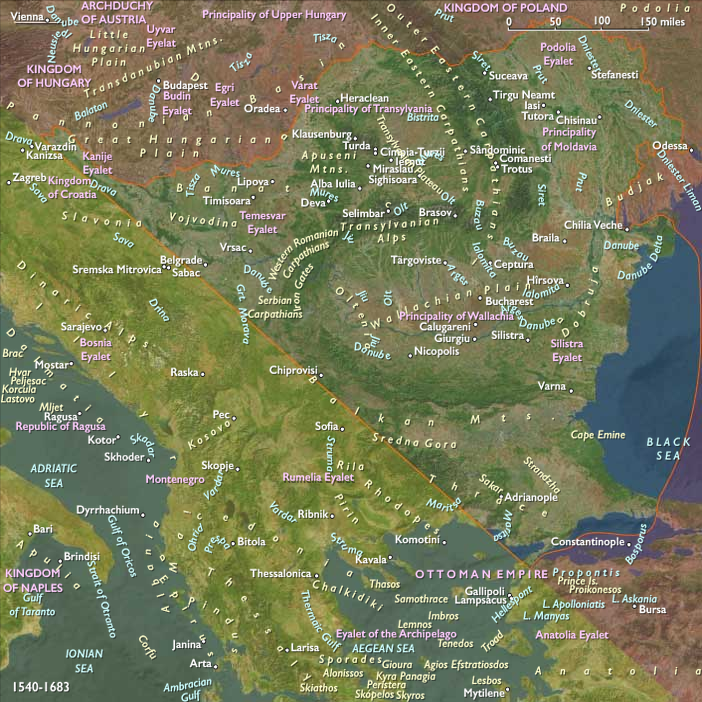
Transylvania experienced substantial religious changes, emerging as a center of the Protestant Reformation. The Transylvanian Diet’s landmark 1571 legislation guaranteed religious freedom to Roman Catholics, Lutherans, Calvinists, and Unitarians, representing one of Europe’s earliest legislative acknowledgments of religious pluralism. Nevertheless, the Orthodox Romanian population, although permitted to practice their faith, did not receive equal recognition, creating underlying social tensions.
Millet System in Ottoman Lands
Elsewhere in the Ottoman Empire, the millet system remained central, allowing substantial autonomy to Jewish and Christian communities. Yet, Ottoman policies continued emphasizing Islam, while actively incorporating non-Muslim communities, including Sephardic Jews, into economic and administrative frameworks.
Political Dynamics and Regional Rivalries
Consolidation and Stability under the Ottomans
Under Suleyman the Magnificent and his immediate successors, the Ottoman Empire reinforced administrative structures, extending direct control over strategic territories. By 1566, when Suleyman died, Ottoman authority encompassed most major Islamic cities, including Mecca, Medina, Cairo, and Damascus. Wallachia, Moldavia, Transylvania, and Ragusa remained tributary vassals, solidifying Ottoman political and economic influence throughout Eastern Southeast Europe.
Key Historical Events and Developments
-
1566: Death of Suleyman the Magnificent, marking the end of a significant era of expansion and cultural achievement.
-
1571: Transylvania’s Diet enacts a pioneering religious freedom law, shaping the religious landscape of Eastern Southeast Europe.
-
1573: Croatian peasant rebellion under Matija Gubec, highlighting underlying social tensions within the region’s feudal structures.
Long-Term Consequences and Historical Significance
This era saw critical religious transformations, significant economic shifts, and Ottoman administrative consolidation, leaving a lasting impact on the region’s social structure, religious landscape, and cultural identity. These developments significantly shaped the historical evolution and long-term stability of Eastern Southeast Europe under Ottoman rule.
Transylvania's Germans adopt Lutheranism, and many Hungarians convert to Calvinism.
However, the Protestants, who print and distribute catechisms in the Romanian language, fail to lure many Romanians from Orthodoxy.
In 1571 the Transylvanian Diet approves a law guaranteeing freedom of worship and equal rights for Transylvania's four "received" religions: Roman Catholic, Lutheran, Calvinist, and Unitarian.
The law is one of the first of its kind in Europe, but the religious equality it proclaims is limited.
Orthodox Romanians, for example, are free to worship, but their church is not recognized as a received religion.
Years: 1564 - 1575
Groups
- Germans
- Hungarian people
- Slavs, South
- Christianity, Chalcedonian
- Greeks, Medieval (Byzantines)
- Venice, Duchy of
- Croats (South Slavs)
- Serbs (South Slavs)
- Dalmatia, Theme of
- Hungary, Principality of
- Hungary, Kingdom of
- Christians, Roman Catholic
- Christians, Eastern Orthodox
- Dalmatia region
- Croatia, Kingdom of
- Italians (Latins)
- Austria, Archduchy of
- Serbia, Kingdom of
- Slovenes (South Slavs)
- Ottoman Emirate
- Ottoman Emirate
- Serbian Empire
- Ottoman Empire
- Serbia, Moravian
- Slavonian Krajina (Military Frontier)
- Croatian Krajina (Military Frontier)