Otto, in 965, gives the Bishop of …
Years: 965 - 965
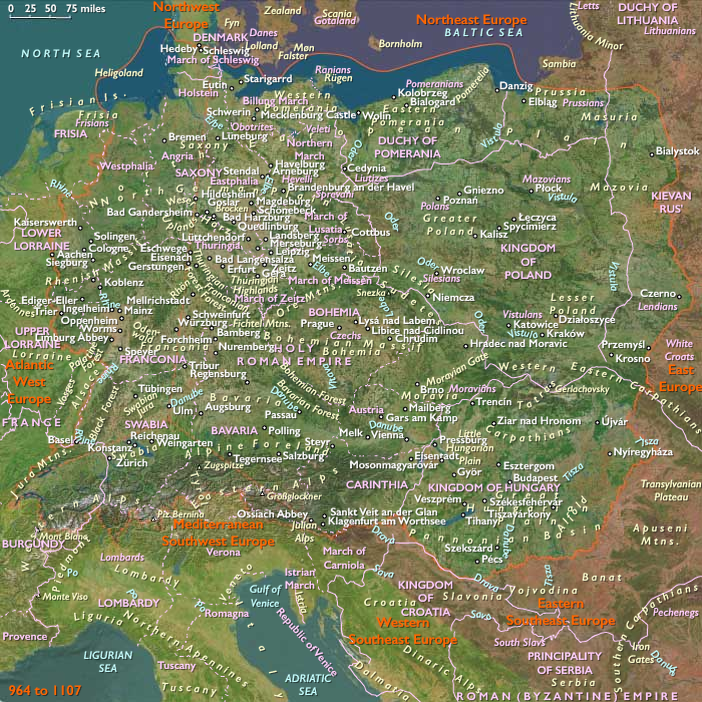
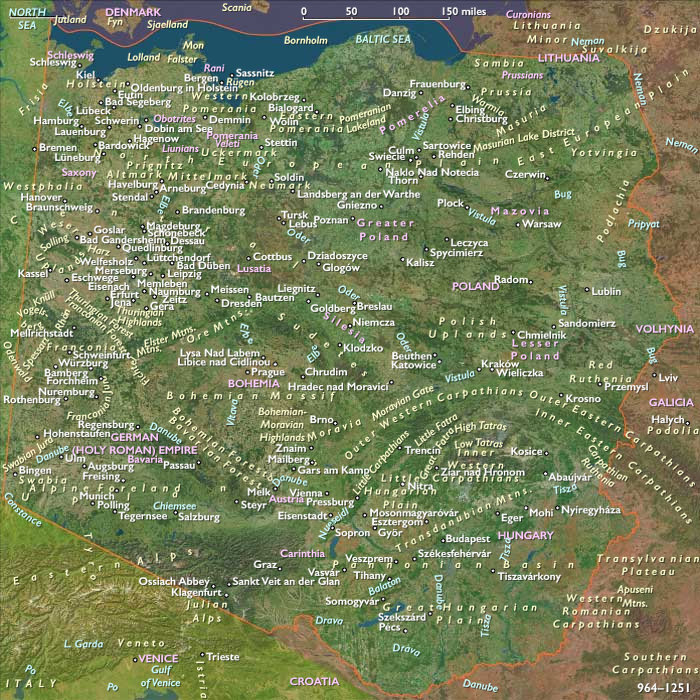
Otto, in 965, gives the Bishop of Magdeburg jurisdiction over all merchants and Jews for taxation purposes.
Locations
People
Groups
Commodoties
Subjects
Regions
Subregions
Related Events
Filter results
Showing 10 events out of 52539 total
Northern Song armies invade the Later Shu Kingdom and force it to surrender in 965.
The Khazar city of Sarkel, a large limestone-and-brick fortress on the left bank of the lower Don River, had been built in 833 to protect the northwestern border of the Khazar state, when the Khazars had asked their ally, emperor Theophilus, for engineers to build them a fortified capital, and Theophilus had sent his chief engineer Petronas.
In recompense for these services, the Khazar khagan had ceded Chersonesos and some other Crimean dependencies to Constantinople.
The city serves as a bustling commercial center, as it controls the Volga-Don portage, which is used by the Rus to cross from the Black Sea to the Volga and thence to the Caspian; the route is known as the "Khazarian Way".
A garrison fortified at Sarkel includes Oghuz and Pecheneg mercenaries.
Around 965, Sviatoslav destroys Sarkel and possibly sacks (but does not occupy) the Khazar city of Kerch on the Crimea.
At Sarkel, Sviatoslav establishes a Rus' settlement called Belaya Vyezha ("the white tower" or "the white fortress", the East Slavic translation for "Sarkel").
The efforts of Kievan ruler Olga to bring Christianity to Russia are resisted by her son Sviatoslav, grand prince of Kiev from 945, who, after coming of age around 963, had begun a series of bold military expeditions, leaving his mother to manage the internal affairs of the Kievan state.
Sviatoslav is the son of Grand Prince Igor, who was himself probably the grandson of Rurik, prince of Novgorod.
Virtually nothing is known about his childhood and youth, which he spent reigning in Novgorod.
Sviatoslav's father, Igor, had been killed by the Drevlyans around 942.
The Russian Primary Chronicle says that Sviatoslav “sent messengers to the other lands announcing his intention to attack them.” Shortly after his accession to the throne, Sviatoslav had begun campaigning to expand the Rus' control over the Volga valley and the Pontic steppe region.
Between 963 and 965, he has attacked the Ossetes and Circassians in the northern Caucasus; …
…he has also attacked the Volga Bulgars.
Sviatoslav’s greatest success is the conquest of Khazaria, the Jewish state between the Volga and the Don, which for centuries has been one of the strongest states of Eastern Europe.
The sources are not clear about the roots of the conflict between Khazaria and Rus', so several possibilities have been suggested.
The Rus' had an interest in removing the Khazar hold on the Volga trade route because the Khazars collected duties from the goods transported by the Volga.
Historians have suggested that Constantinople may have incited the Rus' against the Khazars, who had fallen out with the Empire after the persecutions of the Jews in the reign of Romanus I Lecapenus.
Sviatoslav began by rallying the Khazars' East Slavic vassal tribes to his cause.
Those who would not join him, such as the Vyatichs, are attacked and forced to pay tribute to the Kievan Rus' rather than the Khazars.
Proceeding by the Oka and Volga rivers, he invades Volga Bulgaria and exacts tribute from the local population, thus bringing under Kievan control the upper Volga River.
He employs Oghuz and Pecheneg mercenaries in this campaign, perhaps to counter the Khazars' and Bulgars' superior cavalry.
Gero, called the Great, had ruled an initially modest march centered on Merseburg, created probably for Thietmar (in the 920s) and passed to his two sons consecutively: Siegfried and Gero, who has expanded it into a vast territory named after him the marca Geronis.
During the mid-tenth century, he has been the leader of the Saxon Drang nach Osten, participating in general Saxon campaigns against the Slavs in 957, 959, and 960, as well as campaigning against the Wends and forcing Mieszko I of the Polans to pay tribute, grant land lien, and recognize German sovereignty during Otto's absence in Italy (962–963).
Lusatia, according to Widukind, had been subjected "to the last degree of servitude."
Gero is responsible for subjecting the Liutizi and Milzini (or Milciani) and extending German suzerainty over the whole territory between the Elbe and the Bober, reducing the native Slavic populace to serfdom and converting "tribute-paying peoples" into "census-paying peasants."
After his death in May, 965, the huge territory he had conquered is divided by the Emperor Otto into several different marches: the Northern March (under Dietrich of Haldensleben), the Eastern March (under Odo I), the March of Meissen (under Wigbert), the March of Merseburg (under Günther) and the March of Zeitz (under Wigger I).
Later, the Northern March will be subdivided into the marches of Landsberg, Lusatia, and Brandenburg.
Nikephoros II Phokas mounts a campaign to check incursions into eastern Anatolia by the Hamdanid Emirate, based at Mosul on the Tigris.
His forces seize the province of Cilicia in 965, capturing Adana and …
…Tarsus.
Al-Mutanabbi, the son of a water carrier who claimed noble and ancient southern Arabian descent, had, owing to his poetic talent, received an education.
When Shi'ite Qarmatians sacked Al-Kufah in 924, he had joined them and lived among the Bedouin, learning their doctrines and Arabic.
Claiming to be a prophet—hence the name al-Mutanabbi (“The Would-be Prophet”)—he led a Qarmatian revolt in Syria in 932.
After its suppression and two years' imprisonment, he recanted in 935 and became a wandering poet.
Beginning to write panegyrics in the tradition established by the ninth-century poets Abu Tammam and al-Buhturi, he had attached himself to Sayf ad-Dawla, the Hamdanid poet-prince of northern Syria, writing in praise of his patron panegyrics that rank as masterpieces of Arabic poetry.
Sayf ad-Dawla had bestowed fame and fortune on him during their association but the latter part of the period had been clouded with intrigues and jealousies that culminated in al-Mutanabbi's leaving Syria for Egypt, now ruled in name by the Ikhshidids.
Attaching himself to the regent, the black eunuch Abu al-Misk Kafur, who had been born into slavery, al-Mutanabbi offended Kafur with scurrilous satirical poems and fled Egypt in 960.
He had lived in Shiraz, Iran, under the protection of the emir 'Adud ad-Dawla of the Buyid dynasty until 965, when he returns to Iraq and is killed by bandits near Dayr al-'Aqulin, a suburb of Baghdad, in 965.
Al-Mutanabbi's pride and arrogance had set the tone for much of his verse, which is ornately rhetorical, yet crafted with consummate skill and artistry.
He has given to the traditional qasida, or ode, a freer and more personal development, writing in what can be called a neoclassical style.
Regarded by many as one of the greatest poets in the Arabic language, his work will influence Arabic poetry until the nineteenth century and will be widely quoted.)

Cyprus had experienced a break in direct rule from Constantinople in 688, when Justinian II and the Umayyad caliph 'Abd al-Malik had signed an unusual treaty neutralizing the island, which had been subject to Arab raids.
For almost three hundred years, Cyprus has been a kind of condominium of the Empire and the Caliphate, and although both sides have frequently violated the treaty, the arrangement lasts until Emperor Nikephoros in 965 gains Cyprus completely for the Empire.
The revived morale and confidence of Constantinople in the East shows itself in the crusading zeal of Nikephoros and his nephew John Tzimiskes for the reconquest of Syria and the Holy Land, for which the Empire is now poised.
The Islamic Empire had eventually taken control of the Red Sea and most of the Nile, forcing Aksum into economic isolation.
Northwest of Aksum in modern day Sudan, the Christian states of Makuria and Alodia will last until the thirteenth century before becoming Islamic.
Aksum, isolated, nonetheless still remains Christian.
After a second golden age in the early sixth century, the empire began to decline, eventually ceasing its production of coins in the early seventh century.
Around this same time, the Aksumite population had been forced to go farther inland to the highlands for protection, abandoning Aksum as the capital.
Arab writers of the time continued to describe Ethiopia (no longer referred to as Aksum) as an extensive and powerful state, though they had lost control of most of the coast and their tributaries.
While land was lost in the north, it was gained in the south, and though Ethiopia was no longer an economic power it still attracted Arab merchants.
The capital was moved to a new location, currently unknown, though it may have been called Ku'bar or Jarmi.
Local history holds that around 960 a Jewish Queen named Yodit (Judith) or "Gudit" defeated the empire and burned its churches and literature, but while there is evidence of churches being burned and an invasion around this time, her existence has been questioned by some modern authors.
Another possibility is that the Aksumite power was ended by a southern pagan queen named Bani al-Hamwiyah, possibly of the tribe al-Damutah or Damoti (Sidama).
It is clear from contemporary sources that a female usurper did indeed rule the country at this time, and that her reign ended some time before 1003.