
Otto further offends the nobility in 937 …
Years: 937 - 937
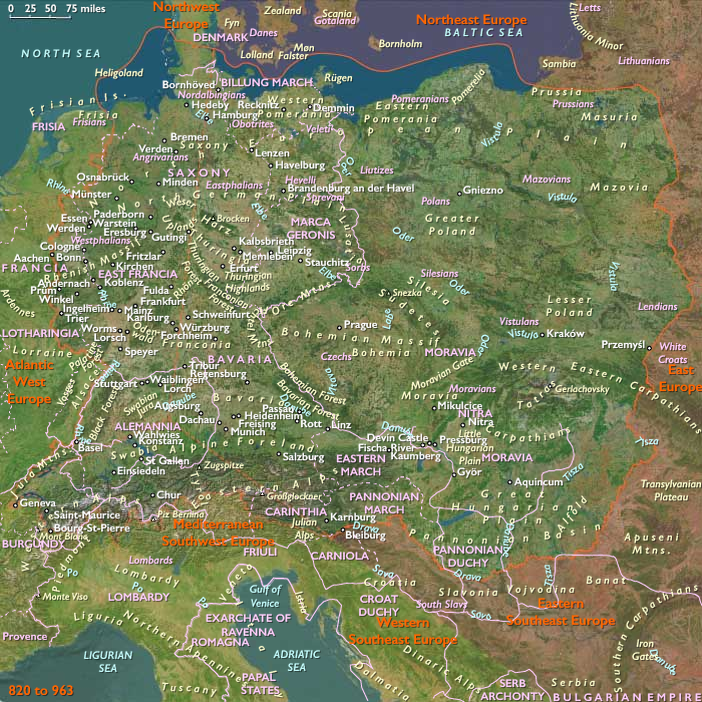
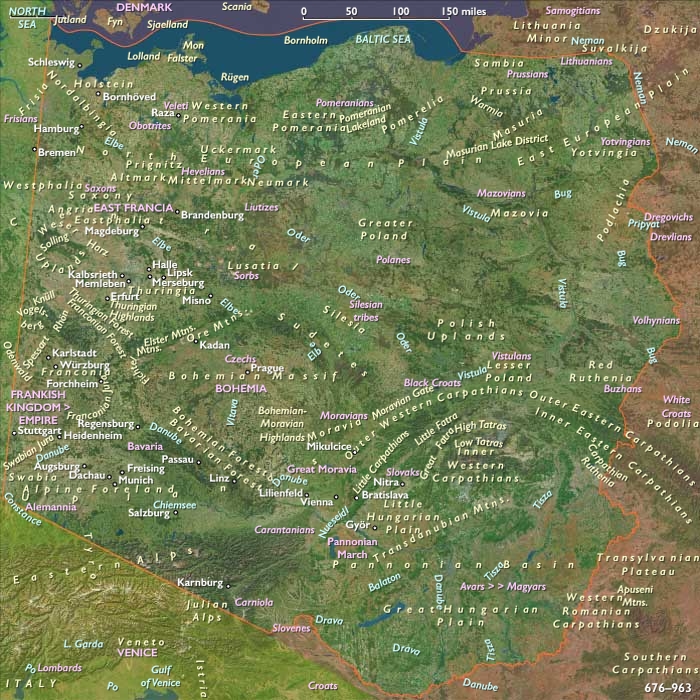
Otto further offends the nobility in 937 through his appointment of Gero to succeed his older brother, Siegfried, as Count and Margrave of a border region abutting the Wends on the lower Saale.
His decision frustrates Thankmar, Otto's half-brother and Siegfried's cousin, who feels that he holds a greater right to the appointment.
People
- Arnulf the Bad
- Eberhard of Franconia
- Gero
- Gilbert
- Henry the Fowler
- Herman I
- Hermann Billung
- Otto I
- Thankmar
- Wichmann the Elder
- Æthelstan
Groups
- Saxons
- Polabian Slavs (West Slavs)
- Wends, or Sorbs (West Slavs)
- Obotrites (Slavic tribal confederation)
- Saxony, Duchy of
- Francia Occidentalis (West Francia, or France), Kingdom of
- Francia Orientalis (East Francia), Kingdom of
- Lotharingia, Duchy of
- Franconia, Duchy of
- Bavaria, Luitpolding Duchy of
- Swabia, Duchy of
- March of Gero, or Marca Geronis
- England, (Anglo-Saxon) Kingdom of
- Billung March
Subjects
Regions
Subregions
Related Events
Filter results
Showing 10 events out of 13 total
Northwest Europe (1108 – 1251 CE): Plantagenet–Capetian Rivalry, Scottish Consolidation, and Norse Atlantic Retreat
Geographic and Environmental Context
Northwest Europe includes Iceland, Ireland, the United Kingdom, the Faroe, Shetland, and Orkney Islands, the Channel Islands, and the western coastal zones of Norway and Denmark (west of 10°E).
-
Anchors: London–Canterbury–York, Dublin–Waterford, Edinburgh–St Andrews, Bergen–Trondheim, Reykjavík–Thingvellir, Channel ports (Dover, Southampton, Bristol).
Climate and Environmental Shifts
-
High-medieval prosperity; population growth in England, Scotland, Ireland.
-
Agricultural expansion into uplands; North Atlantic fisheries sustained Iceland and Norway.
Societies and Political Developments
-
England: Norman/Angevin monarchy consolidated; Henry II (1154–1189) created Angevin Empire; Magna Carta (1215) constrained King John.
-
Ireland: Anglo-Norman invasion (from 1169), with Dublin seized; native kings retreated to peripheries.
-
Scotland: Kings David I–Alexander II fostered feudal and ecclesiastical reforms.
-
Wales: marcher lordships clashed with native princes (Llywelyn the Great).
-
Norway: civil wars (1130s–1240s), followed by consolidation; control of Orkney, Shetland, Hebrides contested with Scotland.
-
Iceland: chieftains (goðar) dominated politics; subordination to Norway formalized in 1262 (just beyond this age).
Economy and Trade
-
English wool exports grew, feeding Flemish industry.
-
London rose as a financial hub; Bristol developed trans-Channel trade.
-
Irish ports (Dublin, Waterford) tied into Anglo-Norman trade.
-
Norwegian timber, stockfish (dried cod) exported to Europe.
-
Iceland exported wool and fish to Norway.
Belief and Symbolism
-
Gothic cathedrals in England (Canterbury, Lincoln, York Minster).
-
Monastic expansion in Scotland, Ireland, Wales.
-
Norse pagan remnants disappeared; Christianity universalized.
Long-Term Significance
By 1251, England was a centralized monarchy with parliamentary roots, Ireland under Anglo-Norman dominance, Scotland and Wales in resistance, and Norse Atlantic power waning as stockfish trade rose.
Northwest Europe (1204–1215 CE): Struggles for Power and Territorial Reconfigurations
England: Magna Carta and Rebellion
The reign of King John (r. 1199–1216) was marked by political turmoil, territorial losses, and clashes with the nobility. John's failed campaigns to reclaim territories in France, notably Normandy in 1204, weakened his authority and led to heavy taxation at home. His strained relationship with the barons culminated in rebellion, forcing him to seal the Magna Carta in 1215, a pivotal document limiting royal authority and establishing fundamental legal protections.
Scotland: Continued Stability and Expansion
Under William the Lion (r. 1165–1214), Scotland maintained its internal stability and territorial integrity. William effectively managed alliances with English nobles and skillfully navigated tensions with King John, preserving Scotland's sovereignty. His death in 1214 transitioned power smoothly to his son, Alexander II, ensuring continued stability and laying groundwork for further consolidation of Scottish royal power.
Ireland: Anglo-Norman Integration and Resistance
In Ireland, Anglo-Norman lords expanded their territories and strengthened control through the building of fortresses and establishment of towns. Yet, resistance persisted from Gaelic Irish clans. The period witnessed ongoing conflict, with alliances forming and dissolving between Norman settlers and native rulers, creating a complex landscape of power dynamics throughout the island.
Denmark: Dominance and Expansion under Valdemar II
Valdemar II (the Victorious) (r. 1202–1241) consolidated Danish supremacy in the Baltic region through military conquests and diplomatic alliances. His capture of key strategic locations such as Estonia in 1219 further elevated Denmark’s regional power. Domestically, Valdemar's reign was characterized by administrative reforms and strengthened royal authority.
Norway: Succession and Civil Strife
After Sverre Sigurdsson's death in 1202, Norway faced renewed internal conflict and civil strife. Sverre's successors struggled to maintain his centralized authority, as disputes erupted between rival factions, notably the Baglers and Birkebeiner. King Inge Bårdsson (r. 1204–1217) sought to stabilize the kingdom but faced continual challenges and periodic violence, undermining Norway’s unity.
Iceland: Continued Cultural Achievement
Iceland continued to flourish culturally during this era, maintaining its unique political system governed by the Althing. Literary achievements, including the recording and preservation of Norse sagas, underscored the island’s cultural vibrancy. Icelandic autonomy and relative peace allowed cultural and scholarly pursuits to thrive.
Economic and Cultural Exchanges
Crusaders returning from the Holy Land introduced new commodities, notably sugar, which supplemented honey as Europe's primary sweetener. Venetian sugar estates near Tyre exported sugar to Europe, praised by chroniclers like William of Tyre for its health benefits. Almonds, cinnamon, ginger, and nutmeg were also imported, becoming valued additions to royal banquets and shaping the tastes of Europe's elite.
Religious and Cultural Developments
Throughout Northwest Europe, monastic orders, especially the Cistercians and the newly founded Franciscan order, expanded their influence. These groups emphasized poverty, preaching, and direct engagement with local populations, significantly influencing religious life and education throughout the region.
Legacy of the Era
By 1215 CE, Northwest Europe had witnessed transformative shifts. England’s Magna Carta became a cornerstone of constitutional governance. Scotland retained internal stability and independence, while Ireland experienced deepening Anglo-Norman settlement alongside resilient native resistance. Denmark reached new heights under Valdemar II, consolidating Baltic dominance. Norway, however, grappled with succession struggles, compromising national stability. Iceland sustained its cultural golden age, contributing lasting literary and historical legacies.
William the Lion, King of Scots, dies on December 4, 1214; he is succeeded by his son, who has spent time in England (John of England knighted him at Clerkenwell Priory in 1213) as Alexander II, being crowned at Scone on December 6.
John needs money for armies, but the loss of the French territories, especially Normandy, has greatly reduced the state income, and a huge tax would need to be raised to reclaim these territories.
Yet, it is difficult to raise taxes because of the tradition of keeping them unchanged.
John relies on clever manipulation of preexisting rights, including those of forest law, which regulate the king's hunting preserves, which are easily violated and severely punished.
John has also increased the preexisting scutage (feudal payment to an overlord replacing direct military service) eleven times in his seventeen years as king, as compared to eleven times during the reign of the preceding three monarchs.
The last two of these increases have been double the increase of their predecessors.
He has also imposed the first income tax, raising the (then) extortionate sum of seveny thousand pounds.
John’s failed expedition to Poitou in 1214, coupled with the defeat of his ally, Holy Roman Emperor Otto IV, in the Battle of Bouvines, provides the restive English barons with their excuse for rebellion.
Their act stems from a royal demand for overseas service that they feel is not owed, from the king’s policies of ensuring their personal loyalties by intimidation, and from the domestic policies—especially increased financial exactions—not only of the king himself but also of his immediate Angevin predecessors.
The baronial opposition initially swears, in the church of Bury St. Edmunds, to force the king to restore its powers under the Norman kings.
Realistic considerations lead, however, to an insistence on pragmatic reforms aimed at controlling, rather than nullifying, the innovations introduced by Henry II, Richard, and John.
The barons request of Scotland’s new monarch, Alexander II, that he invade England against their king, pledging their support, but Alexander demurs.
The barons draw up a document later called Magna Carta (“Great Charter” of King John)—some of it framed by Stephen Langton, archbishop of Canterbury—setting forth the law on several points and targeted at the reform of specified abuses.
Many of the charter’s sixty-three clauses deal with feudal privileges of benefit only to the barons, who acquiesce in the growth of royal jurisdiction since 1154, but seek, under certain clauses, to control the direction of legal reforms.
The Magna Carta, in specifying ecclesiastical concessions, states that the church is to be free.
Following these concessions, Magna Carta specifies liberties for all free men so that all might be defended from royal whim, and stipulates that certain taxes may not to be levied without the common consent of the kingdom, whose representatives' decisions are binding on all.
The Magna Carta, which places the king under the rule of law, is the first legal document to enunciate, if vaguely, due process of law: "No free man shall be arrested or imprisoned...except by the lawful judgment of his peers or by the law of the land."
The clans Meic Uilleim and MacHeths, inveterate enemies of the Scottish crown, break into revolt the year after Alexander’s accession; but loyalist forces speedily quell the insurrection.
Alexander in the same year joins the English barons in their struggle against John of England.
Northwest Europe (1216–1227 CE): Consolidation and New Realities
England: Restoration and Governance
The death of King John in 1216 brought his young son, Henry III (r. 1216–1272), to the throne under regency, leading to the stabilization of English politics after the turmoil surrounding Magna Carta. Regent William Marshal, one of the most respected knights in Europe, successfully defended the young king’s reign, defeating rebellious barons and French invaders at the decisive Battle of Lincoln in 1217. The reissued Magna Carta in 1225, under Henry III, marked a pivotal moment in solidifying its place in English law and governance.
Scotland: Strengthening Royal Authority
Under Alexander II (r. 1214–1249), Scotland experienced growing royal authority and territorial consolidation. Alexander maintained Scotland’s independence from English influence, expanding royal control northward and westward, reducing the power of local magnates, and further centralizing governance. His diplomatic strategies and political marriages also reinforced Scotland's international position.
Ireland: Norman Settlements and Irish Resistance
Ireland continued to see the deepening of Anglo-Norman control, with increased fortifications and town-building activities strengthening the Norman presence. Native Gaelic resistance persisted, particularly in regions less accessible to Norman power, maintaining a complex political landscape. The interplay of Norman authority and indigenous resilience defined the era.
Denmark: Challenges to Baltic Dominance
Despite Valdemar II’s earlier successes, his rule encountered significant setbacks during this period. Captured in 1223 by his vassal, Count Henry of Schwerin, Valdemar was imprisoned until 1225, significantly weakening Danish influence in the Baltic. Upon his release, Denmark was compelled to concede territories and influence, limiting further expansion.
Norway: Steps Toward Stability
The death of King Inge Bårdsson in 1217 led to the ascent of the young Håkon IV Håkonsson (r. 1217–1263), who, under regency initially, gradually brought stability to a fragmented Norway. By 1223, Håkon’s regency began consolidating power, significantly diminishing internal conflicts and laying the groundwork for a more unified Norwegian state.
Iceland: Cultural and Political Continuity
Iceland maintained its political independence and cultural richness during this period, governed by the Althing, its traditional assembly. The era continued the flourishing tradition of saga writing and historical recording, preserving an invaluable literary heritage. The society, largely free of external conflicts, remained culturally vibrant and politically autonomous.
Economic and Cultural Developments
Trade and economic activity grew steadily, with merchants from England, Flanders, and the Baltic states actively engaged in commerce. Commodities like wool, fish, timber, and increasingly popular imported spices and luxury goods continued to shape the economies of Northwest Europe, enhancing urban growth and prosperity.
Religious Orders and Education
The Dominican Order, founded in the previous decade, established itself significantly during this era, emphasizing preaching, education, and combating heresies. Alongside existing monastic communities, these mendicant friars began influencing urban centers profoundly, fostering intellectual debate, education, and religious reform.
Legacy of the Era
By 1227 CE, Northwest Europe had emerged from a period of turmoil into greater stability. England had solidified its constitutional frameworks; Scotland strengthened royal authority; Ireland navigated Norman control and Gaelic resistance; Denmark faced setbacks limiting its Baltic dominance; Norway began the path toward internal unity; and Iceland sustained its distinctive political and cultural identity. These developments collectively established lasting political, economic, and cultural frameworks for future generations.
The barons, mollified by the regency’s reforms, have by now deserted Louis; in September 1217 de Burgh and Marshal persuade him to leave England, concluding a peace treaty with him.
Giving up his claim to the English throne and signing the Treaty of Lambeth, Louis returns to France to take a principal role in the Albigensian Crusade.
Alexander II recognizes Henry III as his overlord in 1217.
The failed Magna Carta agreement is resuscitated in 1217 by Marshal's protectorate and reissued in an edited form as a basis for future government.
Alexander II marries Joan Plantagenet, the sister of English king Henry III, in 1221.
Northwest Europe (1228–1239 CE): Stability, Expansion, and Cultural Flourishing
England: Governance and Diplomacy
The reign of Henry III (r. 1216–1272) continued to solidify, as he emerged from regency and began exercising personal authority. His rule was characterized by ongoing negotiations with the baronial class and consolidating royal power, reinforced by his diplomatic marriage in 1236 to Eleanor of Provence, which strengthened international ties. Henry's governance, however, remained challenged by financial pressures and baronial tensions, foreshadowing future conflicts.
Scotland: Territorial Consolidation
Under Alexander II (r. 1214–1249), Scotland further expanded royal authority northward and westward into the Highlands and Isles. His military and diplomatic endeavors, including successful campaigns against rebellious nobles, further secured his internal power and continued to bolster Scotland's independence from English interference.
Ireland: Anglo-Norman Integration and Gaelic Resilience
The Anglo-Norman presence deepened, characterized by the expansion of feudal holdings, fortifications, and towns. However, significant Gaelic resistance persisted, especially in regions like Connacht and Ulster, highlighting the ongoing tension and complex integration between Anglo-Norman settlers and the indigenous Gaelic population.
Denmark: Reassertion and Renewal
Following his release from imprisonment, Valdemar II (r. 1202–1241) worked to restore Denmark’s dominance. While territories lost were difficult to fully reclaim, Valdemar's administration refocused on internal governance and maintaining influence through strategic diplomacy and consolidation of existing holdings.
Norway: Centralization and Cultural Renaissance
Håkon IV Håkonsson (r. 1217–1263) further consolidated Norway, reducing internal conflicts significantly by 1239. He enhanced royal authority and fostered economic growth through trade expansion, particularly with England and continental Europe. Cultural prosperity continued as the translation and adaptation of continental literature into Old Norse flourished, highlighted by Brother Robert’s literary adaptations, significantly enriching Norwegian literary traditions.
Iceland: Literary and Cultural Prosperity
Iceland remained politically autonomous under its traditional governance through the Althing, and experienced continued literary vibrancy. The period saw further growth of Icelandic saga traditions and historical literature, notably through the ongoing works of Snorri Sturluson. His contributions continued to profoundly shape Icelandic identity and cultural heritage.
Economic and Trade Expansion
Commerce across Northwest Europe expanded markedly during this era. England, Flanders, Denmark, and Norway were actively engaged in increasingly sophisticated trade networks. Commodities like wool, timber, fish, and exotic spices such as sugar, cinnamon, ginger, and nutmeg were traded extensively, bolstering urban growth and economic prosperity throughout the region.
Religious Influence and Education
The Dominican Order firmly established itself during this era, significantly influencing religious life, education, and intellectual discourse. Dominican friars became prominent educators and preachers, significantly shaping theological thought and urban spiritual life across Northwest Europe, fostering reform and scholarly exchange.
Legacy of the Era
By 1239 CE, Northwest Europe experienced enhanced stability, economic growth, and cultural enrichment. England navigated the challenges of royal governance; Scotland expanded and strengthened its territorial and royal authority; Ireland continued the complex interplay between Anglo-Norman settlers and Gaelic traditions; Denmark focused on internal stabilization and renewal; Norway achieved internal unity and cultural prosperity; and Iceland continued its rich literary and cultural traditions. Collectively, these developments provided a robust foundation for the political, economic, and cultural trajectories of Northwest Europe in subsequent decades.
Years: 937 - 937
People
- Arnulf the Bad
- Eberhard of Franconia
- Gero
- Gilbert
- Henry the Fowler
- Herman I
- Hermann Billung
- Otto I
- Thankmar
- Wichmann the Elder
- Æthelstan
Groups
- Saxons
- Polabian Slavs (West Slavs)
- Wends, or Sorbs (West Slavs)
- Obotrites (Slavic tribal confederation)
- Saxony, Duchy of
- Francia Occidentalis (West Francia, or France), Kingdom of
- Francia Orientalis (East Francia), Kingdom of
- Lotharingia, Duchy of
- Franconia, Duchy of
- Bavaria, Luitpolding Duchy of
- Swabia, Duchy of
- March of Gero, or Marca Geronis
- England, (Anglo-Saxon) Kingdom of
- Billung March
