
Otto, after having put down a rebellion …
Years: 955 - 955
June
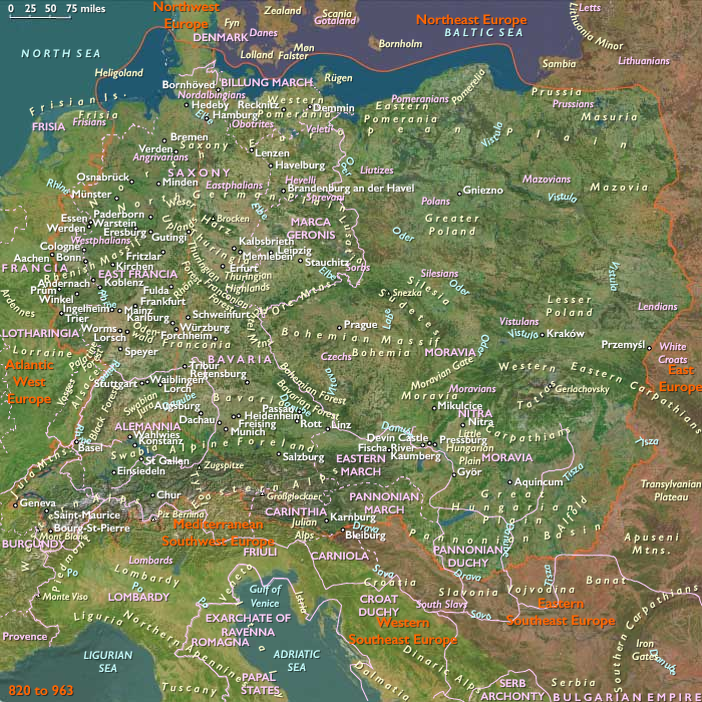
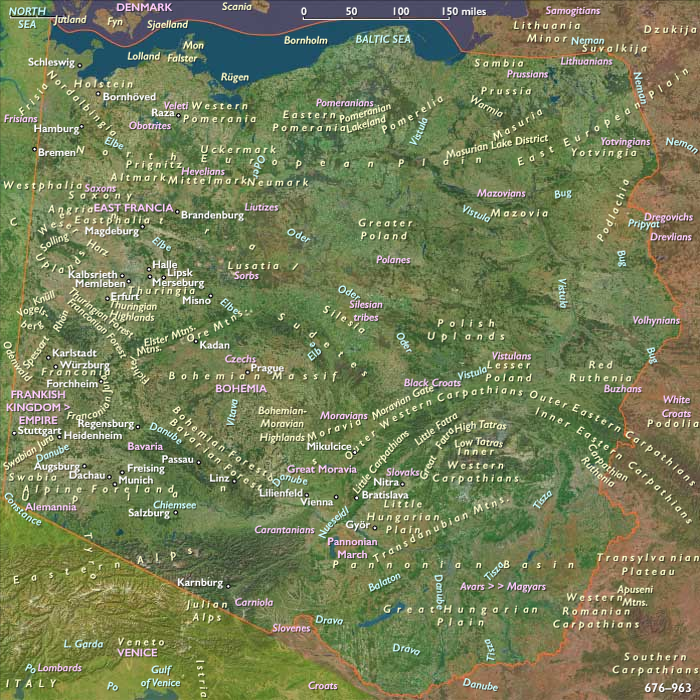
Otto, after having put down a rebellion by his son, Liudolf, Duke of Swabia and son-in-law, Conrad, Duke of Lorraine, sets out to Saxony, his duchy.
Upon arriving in Magdeburg, he receives reports of the Hungarian invasion.
The Hungarians had already invaded once before during the course of the rebellion, immediately after he had put down a revolt in Franconia.
Because of unrest among the Polabian Slavs on the lower Elbe, Otto has had to leave most of his Saxons at home.
In addition, Saxony is distant from Augsburg and its environs, and considerable time would have elapsed waiting for their arrival.
(The Battle of Lechfeld takes place six weeks after the first report of an invasion, and historian Hans Delbrück asserts that they could not have possibly made the march in time.)
The king orders his troops to concentrate on the Danube, in the vicinity of Neuburg and Ingolstadt.
He does this in order to march on the Hungarian line of communications and catch them in their rear while they are raiding northeast of Augsburg.
It is also a central point of concentration for all the contingents that are assembling.
Strategically, therefore, this is the best location for Otto to concentrate his forces before making the final descent upon the Hungarians.
There are other troops that are to have an influence on the course of the battle.
On previous occasions, in 932 and 954 for example, there had been Hungarian incursions that had invaded the Germanic lands to the south of the Danube, and then retreated back to their native country via Lotharingia, to the West Frankish Kingdom and finally, through Italy.
That is to say, a wide sweeping U-turn that initially started westward, then progressed to the south, and then finally to the east back to their homeland; and thus escaping retribution in Germany.
The king is aware of the escape of these Hungarians on the above mentioned occasions, and is determined to trap them.
He therefore orders his brother, Archbishop Bruno, to keep the Lotharingian forces in Lorraine.
He has done this with the fear that the Hungarians will follow their plan of retreat on the previous occasions.
However, with a powerful enough force of knights pressing them in the front from the west, and a powerful force of knights chasing them from the East, the Hungarians will be unable to escape.
Locations
People
Groups
- Polytheism (“paganism”)
- Saxons
- Hungarian people
- Polabian Slavs (West Slavs)
- Christianity, Chalcedonian
- Saxony, Duchy of
- Francia Orientalis (East Francia), Kingdom of
- Bohemia, Duchy of
- Hungary, Principality of
- March of Gero, or Marca Geronis
- Bavaria, Ottonian Duchy of
Topics
Commodoties
Subjects
Regions
Subregions
Related Events
Showing 10 events out of 52873 total
Years: 955 - 955
June
Locations
People
Groups
- Polytheism (“paganism”)
- Saxons
- Hungarian people
- Polabian Slavs (West Slavs)
- Christianity, Chalcedonian
- Saxony, Duchy of
- Francia Orientalis (East Francia), Kingdom of
- Bohemia, Duchy of
- Hungary, Principality of
- March of Gero, or Marca Geronis
- Bavaria, Ottonian Duchy of
Topics
Commodoties
Subjects
Regions
Subregions