
As Luis de La Cerda's influence waned, …
Years: 1360 - 1371
As Luis de La Cerda's influence waned, other parties eagerly resumed their adventures in the Canary Islands.
Majorcan expeditions, now under the rule of Aragon, continued to explore the region.
In 1346, Jaume Ferrer set sail, aiming for Senegal but possibly making contact with the Canaries along the way.
Arnau Roger followed suit in 1352, and in 1366, Joan Mora led a royal-sponsored expedition, instructed to patrol for interlopers as well.
These expeditions, along with many unrecorded ones by Majorcans, merchants from Seville, and Lisbon, were primarily driven by commercial interests.
The main objective was capturing native islanders to be sold as slaves in European markets.
However, peaceful trade with the locals also took place, particularly for orchil and dragon's blood, valuable dyes for the European cloth industry, which grew abundantly on the islands.
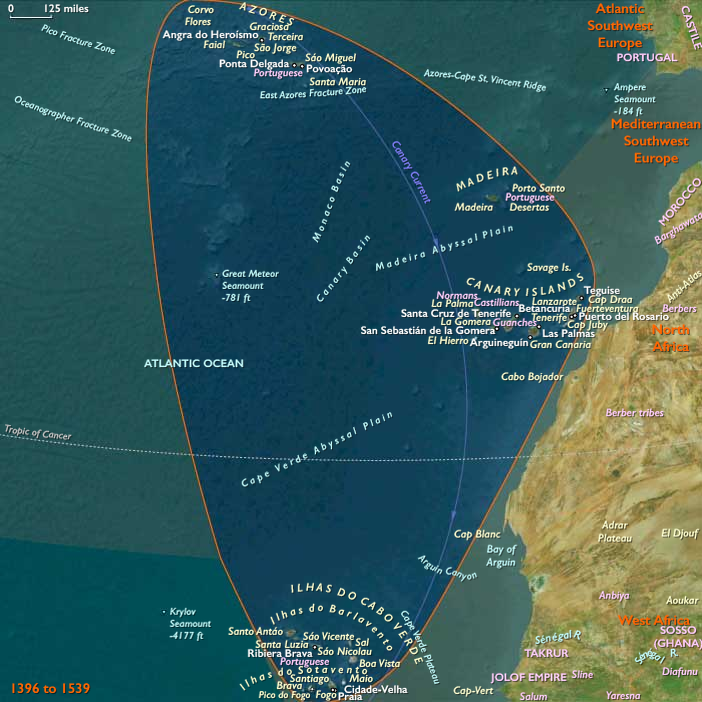
With these expeditions, geographic knowledge of the Canary Islands began to solidify.
In the 1367 portolan chart created by Domenico and Francesco Pizzigano, La Gomera and El Hierro were depicted.
The Catalan Atlas of 1375 provided an almost complete and accurate map of the Canaries, with only La Palma missing.
The Catalan Atlas listed the eleven islands in order from east to west: Graciosa (La Graciosa), Laregranza (Alegranza), Rocho (Roque), Insula de Lanzaroto Maloxelo (Lanzarote), Insula de li Vegi Marin (Lobos), Forteventura (Fuerteventura), Insula de Canaria (Gran Canaria), Insula del infernio (Tenerife), Insula de Gomera (La Gomera), and Insula de lo Fero (El Hierro).
During the dynastic wars between Portugal and Castile in the 1370s, Portuguese and Castilian privateers, engaged in conflict with each other, sought shelter or conducted slave-raiding expeditions in the Canary Islands.
Ferdinand I of Portugal, disregarding the 1344 bull, granted the islands of Lanzarote and La Gomera to the adventurer known as 'Lançarote da Franquia,' who some believe to be the seemingly ageless Lanceloto Malocello.
This Lanzarote attempted to seize control of the islands, leading to reported fights with "Guanches and Castilians."
Locations
People
Groups
- Canary Islands, precolonial
- Guanches
- Castillian people
- Christians, Roman Catholic
- Aragón, Kingdom of
- Aragon, Crown of
- Castile, Crown of
- Portugal, Burgundian (Alfonsine) Kingdom of
- Comtat Venaissin (Papal enclave)
Topics
Commodoties
Subjects
- Origins
- Commerce
- Painting and Drawing
- Labor and Service
- Conflict
- Exploration
- Faith
- Government
- Custom and Law
- Technology
- Cartography
- Movements
Regions
Subregions
Years: 1360 - 1371
Locations
People
Groups
- Canary Islands, precolonial
- Guanches
- Castillian people
- Christians, Roman Catholic
- Aragón, Kingdom of
- Aragon, Crown of
- Castile, Crown of
- Portugal, Burgundian (Alfonsine) Kingdom of
- Comtat Venaissin (Papal enclave)
Topics
Commodoties
Subjects
- Origins
- Commerce
- Painting and Drawing
- Labor and Service
- Conflict
- Exploration
- Faith
- Government
- Custom and Law
- Technology
- Cartography
- Movements
Regions
Subregions