
Ostorius is honored with triumphal insignia but …
Years: 51 - 51
Ostorius is honored with triumphal insignia but his victory over Caratacus has not entirely quelled resistance in the Welsh borders.
The Silures especially continue to harass Roman troops, supposedly after Ostorius had publicly said that they posed such a danger that they should be either exterminated or transplanted.
A large legionary force occupied in building forts in Siluran territory is surrounded and attacked and only rescued with difficulty and considerable loss.
This violent desperation on the part of the Silures can be attributed to their reaction to what Peter Salway, author of Roman Britain (1981), a volume in the Oxford History of England series, calls Ostorius' lack of political judgment.
The Silures, galvanized by Ostorius' ill-thought out threats to destroy them, begin taking Roman prisoners as hostages and distributing them among their neighboring tribes.
This has the effect of binding them all together and creating a new resistance movement.
According to Tacitus's biography of Agricola, the Silures usually had a dark complexion and curly hair.
Due to their appearance, Tacitus hinted that they may have crossed over from Spain at an earlier date.
The Iron Age hillfort at Llanmelin near Caerwent has sometimes been suggested as a pre-Roman tribal center, but the view of most archaeologists is that the people who became known as the Silures were a loose network of groups with some shared cultural values, rather than a centralized society.
Although the most obvious physical remains of the Silures are hillforts such as those at Llanmelin and Sudbrook, there is also archaeological evidence of roundhouses at Gwehelog, Thornwell (Chepstow) and elsewhere, and evidence of lowland occupation notably at Goldcliff.
Locations
People
Groups
- Catuvellauni (Celtic tribe)
- Silures (Celtic tribe)
- Ordovices (Celtic tribe)
- Brigantes (Celtic tribe )
- Roman Empire (Rome): Julio-Claudian dynasty
- Britain, Roman
Topics
- Classical antiquity
- Pre-Roman Iron Age of Northern Europe
- Roman Age Optimum
- Pax Romana
- Roman Conquest of Britain
Commodoties
Subjects
Regions
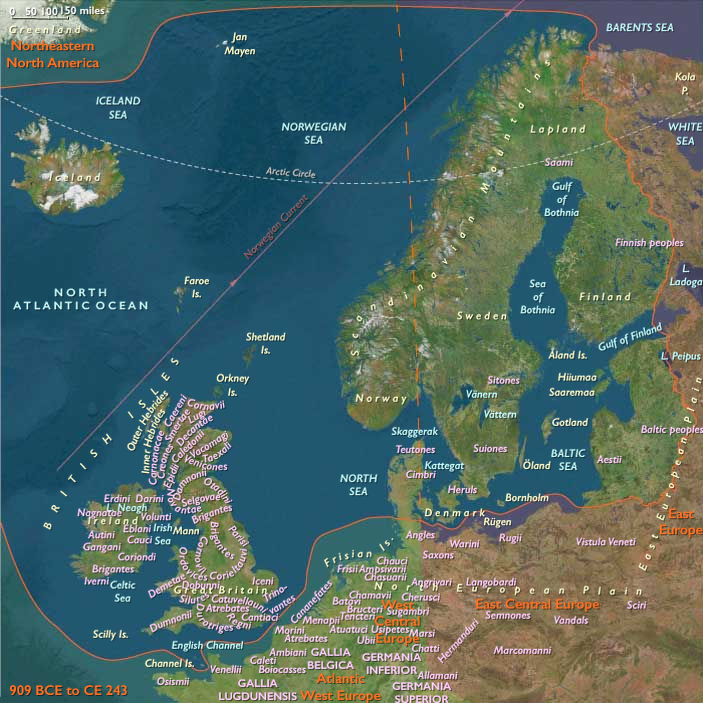
Subregions
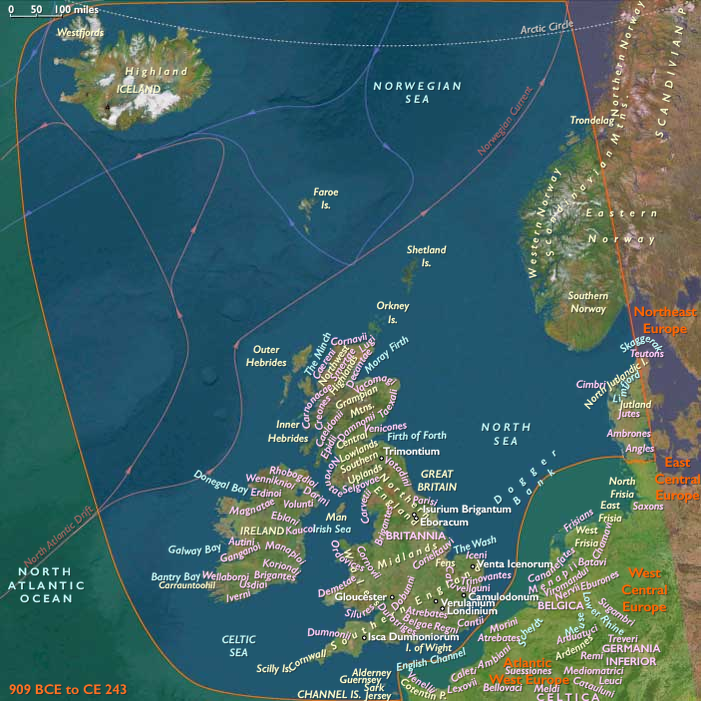
Related Events
Showing 10 events out of 61749 total
Years: 51 - 51
Locations
People
Groups
- Catuvellauni (Celtic tribe)
- Silures (Celtic tribe)
- Ordovices (Celtic tribe)
- Brigantes (Celtic tribe )
- Roman Empire (Rome): Julio-Claudian dynasty
- Britain, Roman
Topics
- Classical antiquity
- Pre-Roman Iron Age of Northern Europe
- Roman Age Optimum
- Pax Romana
- Roman Conquest of Britain
Commodoties
Subjects
Regions
Subregions