Osroes, following Roman withdrawal from the area, …
Years: 117 - 117
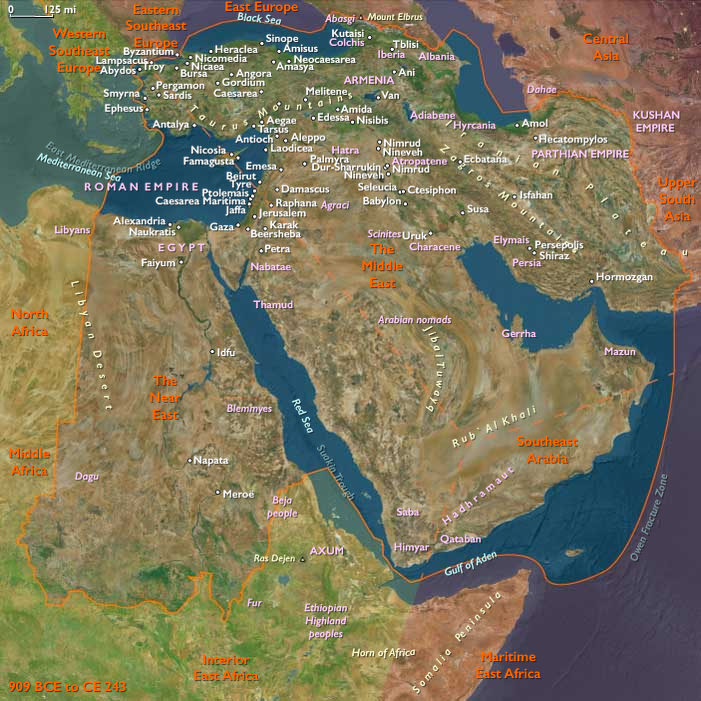
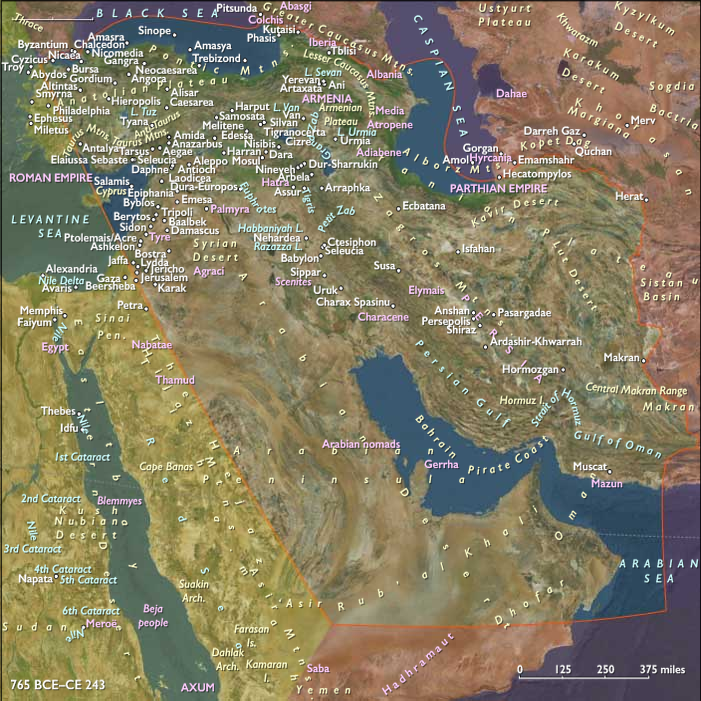
Osroes, following Roman withdrawal from the area, easily defeats Parthamaspates and reclaims the Parthian throne.
Locations
People
Groups
- Persian people
- Jews
- Parthian Empire
- Osroene, Kingdom of
- Characene (Mesene)
- Adiabene, Kingdom of
- Roman Empire (Rome): Nerva-Antonine dynasty
Topics
- Classical antiquity
- Portraits, Classical
- Pax Romana
- Jewish–Roman wars
- Kitos War, or Second Jewish-Roman War, or Jewish Revolt of 115-17
Commodoties
Subjects
Regions
Subregions
Related Events
Filter results
Showing 10 events out of 61221 total
Many Getae resist Roman authority, and some flee northward, away from the centers of Roman rule.
Trajan counters local insurrection and foreign threat by stationing two legions and a number of auxiliary troops in Dacia and by colonizing the province with legionnaires, peasants, merchants, artisans, and officials from lands as far off as Gaul, Spain, and Syria.
This provides land for Roman settlers, opens for exploitation rich mines of gold and salt, and establishes a defensive zone to absorb movements of nomads from the steppes of southern Russia.
Agriculture and commerce flourish, and the Romans build cities, fortresses, and roads that stretch eastward into Scythia.
Serdica becomes a municipium, or center of an administrative region, during the reign of Emperor Trajan (98-117).
The city expands, as turrets, protective walls, public baths, administrative and cult buildings, a civic basilica and a large amphitheater called Bouleutherion, are built.
Hadrian is at Antioch in Syria when word arrives of the death of Trajan, but he is in no position to return to Rome, as he is advised that Quadratus Bassus, ordered by Trajan to protect the new Dacian territories north of the Danube, had died there while on campaign.
As a result of taking several legions and numerous auxiliary regiments with him to Parthia, Trajan has left Dacia and the remaining Danubian provinces below strength.
The Roxolani, angry over a Roman decision to cease the payments to which Trajan had agreed, ally themselves with the Iazyges and both tribes revolt against Rome.
Therefore, Hadrian dispatches the armies from the east ahead of him, and departs Syria as soon as he is able.
Trajan grows ill early in 117 and sets out to sail back to Italy.
His health declines throughout the spring and summer of the year, something publicly acknowledged by the fact that a bronze bust displayed at the time in the public baths of Ancyra show him clearly aged and emaciated.
By the time he reaches Selinus in Cilicia, which is afterwards called Trajanopolis, he suddenly dies from edema on August 9.
Some say that he had adopted Hadrian as his successor, but others that it was his wife Pompeia Plotina who hired someone to impersonate him after he had died.
The rebellious Jews of Egypt, in addition to the decimation of perhaps hundreds of thousands of Jews in Cyrenaica and Cyprus, fall under the swords of the Romans.
According to the Haggadah (Babylonian Talmud, Gittin, 57b), “[Hadrian, successor to Trajan] slaughtered in Egypt six hundred thousand and again six hundred thousand, twice as many as had gone forth from Egypt [at the time of the exodus]... so that the blood ran in the sea as far as Cyprus.”
The Cypriot Jews under the leadership of one Artemion, a Jew with a Hellenized name as is the practice of the time participate in the great uprising against the Romans under Trajan, killing thousands of civilians.
They are reported in the years 115 and 116 to have massacred two hundred and forty thousand Greek and Roman civilians.
Although this number may be exaggerated, there are few or no Roman troops stationed on the island to suppress the insurrection as the rebels wreak havoc.
A small Roman army in late 117 is dispatched to the island under Turbo, who soon reconquers the capital.
Laws are created after the revolt has been fully defeated, forbidding any Jews to live on the island.
Lukuas flees from Alexandria to Judea.
Marcius Turbo, the Praetorian prefect, pursues him and sentences to death the brothers Julian and Pappus, who had been key leaders in the rebellion in Judaea.
Lusius Quietus, who in early 116 had been in charge of the Roman division who had recovered Nisibis and Edessa from the rebels, is now in command of the Roman army in Judaea, and lays siege to Lydda, where the rebel Jews have gathered under the leadership of Julian and Pappus.
The distress becomes so great that the patriarch Rabban Gamaliel II, who is shut up here and dies soon afterwards, permits fasting even on Ḥanukkah.
Other rabbis condemn this measure.
Lydda is next taken and many of the Jews are executed; the "slain of Lydda" are often mentioned in words of reverential praise in the Talmud.
Pappus and Julian were among those executed by the Romans in the same year.
The Arch of Trajan, a triumphal arch in Benevento, southern Italy, is erected between 114 and 117 CE to celebrate emperor Trajan across the Via Appia, at its entrance in the city.
The arch has a single, barrel-vaulted archway, and is 15.60 meters high and 8.60 meters wide.
Each façade has four semicolumns in correspondence of the two side pillars, supporting an entablature.
Above the architraves is an attic which, like the latter, juts out above the archway.
The arch is built in limestone covered by opus quadratum with Parian marble slabs.
It has a rich sculpted decoration on the two main façades.
The attic features a dedicatory inscription and, at the sides, two base-relief panels: the left one on the external sides, not entirely preserved, represented the homage the provincial countryside divinities, while the right one the deduction of provincial colonies.
On the internal side, on the left, is the depiction of Trajan welcomed by the Capitoline Triad and, on the right, Trajan in the Forum Boarium.
The frieze of the entablature portrays the triumph of Trajan against Dacia.
On each of the pylons, between the angular semicolumns, are two superimposed panels with scenes and allegories of imperial activities (advent of Trajan, the concession of Roman citizenship to the auxiliaries, Trajan welcomed by the Senate, the Roman People and the Equestrian order and others).
They are separate by lower decorative panels with Victories during sacrifices of bulls in the center and Amazons at the top.
The pendentives of the archway depict personifications of the Danube and of Mesopotamia in the external side, and the Victory and Military Loyalty on the city one, accompanied by the genii of the Four Seasons.
In the arch's keys are other personification: Fortune on the external, and Rome on the city side.
The internal side of the archway has two wide sculpted panels, portraying scenes of Trajan in Benevento: on the left (from inside the city) is the Sacrifice for the opening of the Via Traiana, with the emperor sided by lictors; on the right is instead the institution of the alimentaria (a beneficent institution created by Trajan to help children in Roman Italy), symbolized by pieces of bread on the table in the center, with personifications of Italic cities with children.
The vault has a coffered ceiling, with, in the center, a personification of the emperor crowned by a Victory.

Hadrian may be the obvious choice as Trajan's successor but he had never been adopted as the emperor's heir.
As Trajan lay dying, nursed by his wife, Plotina (a supporter of Hadrian), he had at last adopted Hadrian as heir.
Since the document was signed by Plotina, it has been suggested that Trajan may have already been dead.
Hadrian quickly secures the support of the legions—one potential opponent, Lusius Quietus, whom Trajan had held in high regard and who has served Rome so well, is quietly stripped of his command once Hadrian has secured the Imperial title.
The Senate's endorsement follows when possibly falsified papers of adoption from Trajan were presented (although he had been the ward of Trajan).
The rumor of a falsified document of adoption carries little weight—Hadrian's legitimacy arises from the endorsement of the Senate and the Syrian armies.
Hadrian takes the unpopular, but far-sighted, decision to end the war in the East, abandoning much of Trajan's eastern conquests and stabilizing the eastern borders.
Tacitus dies at sixty-one or so, having completed his two major works, the Annals and the Histories, which span the period from the death of Augustus in CE 14 to the death of Domitian in 96.
In these, the author pointedly contrasts Rome’s often-mythologized republican liberty with the imperial tyranny of such rulers as Tiberius and Nero.
(About one third of the Annals are lost to us; the surviving four and one-half volumes of the Histories end with the civil war after the death of Nero and the beginning of Vespasian’s reign.
Special forces dispatched to Cyreneaica by Trajan, led by Marcus Turbo, one of his best generals from the Dacian war, brutally crush the revolt there and in Egypt in 117.
The fourth-century Christian historian Paulus Orosius records that the violence so depopulated the province of Cyrenaica that new colonies had to be established by Hadrian: "The Jews ... waged war on the inhabitants throughout Libya in the most savage fashion, and to such an extent was the country wasted that, its cultivators having been slain, its land would have remained utterly depopulated, had not the Emperor Hadrian gathered settlers from other places and sent them thither, for the inhabitants had been wiped out."
(Orosius, Seven Books of History Against the Pagans, 7.12.6.)
Years: 117 - 117
Locations
People
Groups
- Persian people
- Jews
- Parthian Empire
- Osroene, Kingdom of
- Characene (Mesene)
- Adiabene, Kingdom of
- Roman Empire (Rome): Nerva-Antonine dynasty
Topics
- Classical antiquity
- Portraits, Classical
- Pax Romana
- Jewish–Roman wars
- Kitos War, or Second Jewish-Roman War, or Jewish Revolt of 115-17