
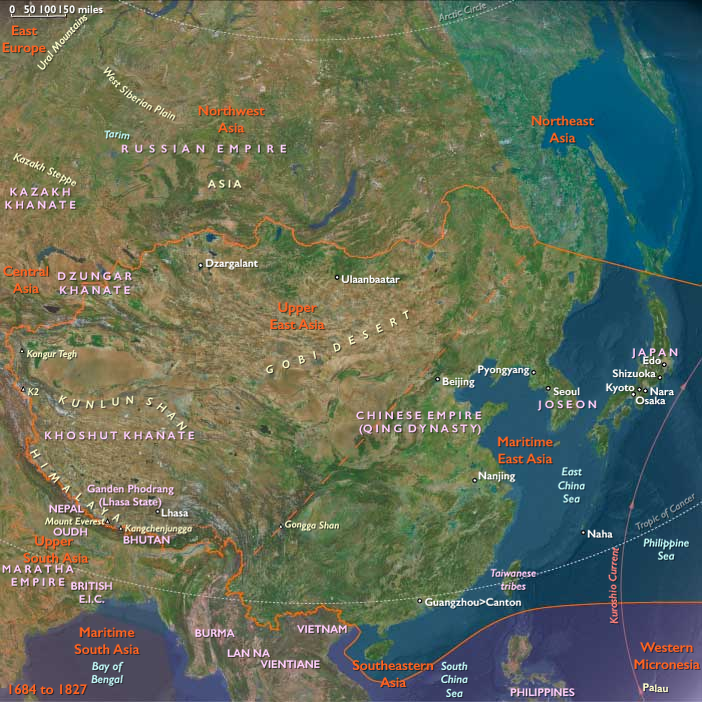
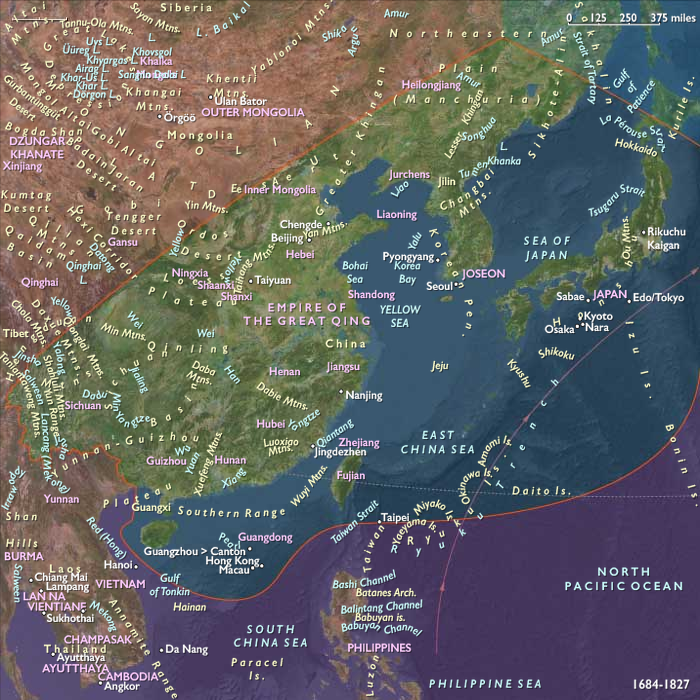
…Osaka serves as the country's commercial hub. …
Years: 1695 - 1695
…Osaka serves as the country's commercial hub.
Wealthy Osaka merchants generally are the ones who define Genroku culture, which is to set the standards for an urban culture that will continue to flourish throughout the Tokugawa period.
Townsmen, free of the rigid codes that have long restricted samurai, can spend their leisure in the pursuit of pleasure, while their newfound profits have created a cultural explosion.
Bunraku, a modern term for a form of Japanese puppet theater founded in Osaka in 1684 and known as ningyo joruri, becomes closely associated with kabuki, a form of theater that originated in Kyoto in 1603, known for the stylization of its drama and for the elaborate make-up worn by some of its performers (now all male, women having been banned from performing since 1629).
From this era, each of the the two forms influence the development of the other, developing into a high dramatic art with the works of Chikamatsu Monzaemon, one of the first professional playwrights of kabuki.
The stories of the poet Ihara Saikaku, creator of the "floating world" genre of Japanese prose, humorously depict urban life, while Matsuo Basho perfects haiku poetry.
The prints of Hishikawa Moronobu, who died in 1694 at 76, rank among the earliest masterpieces of wood-block prints (ukiyo-e).
Locations
People
Groups
Subjects
Regions
Subregions
Years: 1695 - 1695
Locations
People
Groups
Subjects
Regions
Subregions