
Orso I Participazio, the fourteenth (traditional) and …
Years: 864 - 864
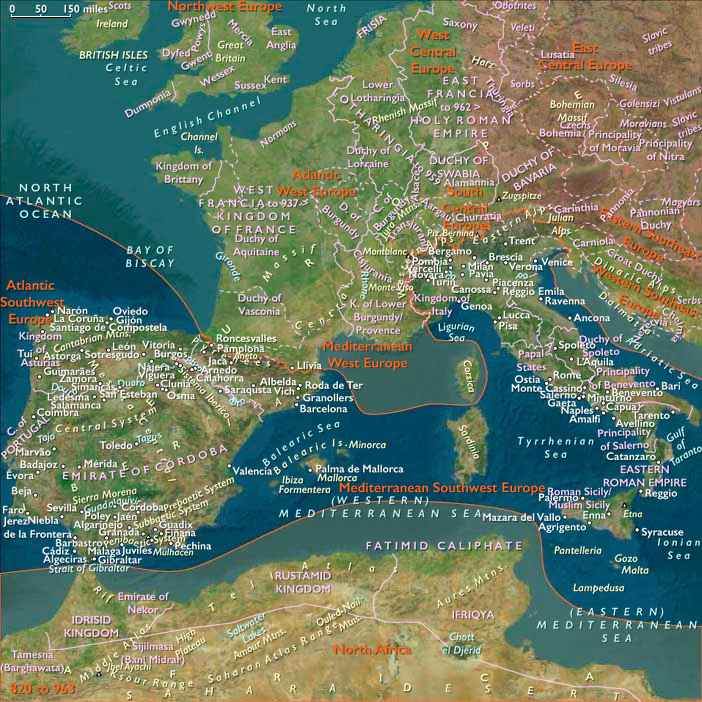
Orso I Participazio, the fourteenth (traditional) and twelfth (historical) Doge of Venice, is elected in 864 immediately after the assassination of his predecessor, Pietro Tradonico, probably by acclamation.
By the end of the year, the assassins are captured, convicted, and executed, probably beheaded.
Orso continues, like Tradonico, to fight the pirates, Slavic or Saracen, that ply the Adriatic coast, aided by a newly constructed fleet of larger ships.
Locations
People
Groups
Subjects
Regions
Subregions
Related Events
Filter results
Showing 10 events out of 54013 total
The Khazar royalty and nobility had converted to Judaism at some point in the last decades of the eighth century or the early ninth century, and part of the general population had followed; to what extent is debated.
Concerning the Khazars, Christian of Stavelot writes in Expositio in Matthaeum Evangelistam 9864), “...in the lands of Gog and Magog who are a Hunnish race and call themselves Gazari there is one tribe, a very belligerent one—Alexander enclosed them and they escaped—and all of them profess the Jewish faith in its entirety.” Some researchers have suggested part of the reason for this mass conversion was political expediency to maintain a degree of neutrality: the Khazar empire is between growing populations, Muslims to the east and Christians to the west.
Both religions recognize Judaism as a forebear and worthy of some respect.
The exact date of the conversion is hotly contested.
It may have occurred as early as 740 or as late as the mid 800s.
Recently discovered numismatic evidence suggests that Judaism was the established state religion by around 830, and though St. Cyril (who visited Khazaria in 861) did not identify the Khazars as Jews, the khagan of that period, Zachariah, had a biblical Hebrew name.
Devín Castle, a Slavic castle founded in the eighth century, has played a crucial role during frequent wars between Great Moravia and the Franks.
The claims that Devín or neighboring Bratislava was the center of Samo's Empire cannot be proven.
The ancient name of the castle (Dowina, from the Slavic/Slovak word deva for girl) is mentioned for the first time in written resources in 864, when Louis the German successfully besieges Prince Rastislav in the "castle of Dowina".
Louis forces Rastislav to acknowledge the supremacy of Eastern Frankish Realm over his kingdom.
Louis is forced in 864 to grant Carloman the kingdom of Bavaria, which he himself had once held under his father.
The removal of the eastern threat and the rise of the Empire’s confidence also opens up opportunities in the west, where the Bulgarian ruler Boris has been negotiating with the Pope and Louis the German for a possible conversion of himself and his pagan people to Christianity.
This expansion of Rome's ecclesiastic influence up to Constantinople's very doorstep cannot be tolerated by the imperial government.
The victorious eastern armies are in 864 transferred to Europe and invade Bulgaria, in a demonstration of military might that persuades Boris to accept Constantinople’s missionaries instead.
Boris is baptized, taking the name Michael in honor of the emperor, thus beginning the Christianization of Bulgaria and initiating the nation's absorption into the Greek-influenced, Eastern Orthodox world.
Boris had originally intended to accept Roman Christianity, but an unsuccessful war with the empire forces him to adopt the Orthodox faith of Constantinople in 864.
At night and in secret, a Greek bishop and priests who have been sent to Pliska, the Bulgarian capital, baptize Boris (who at his baptism takes the Christian name Michael), his family, and the nobles who support his policy.
There is serious opposition by both the nobility and the common people to Boris' attempt to enforce mass baptism.
A pagan rebellion breaks out, and Boris retaliates by executing fifty-two boyars, together with their families.
Oppressive policies in Tabaristan, another dependency of Khorasan, result in the people of this province revolting against Tahirid governance and declaring their allegiance to the independent ruler Hasan ibn Zayd in 864.
Charles the Bald succeeds in gaining control of Aquitaine in 864 after his capture of Pepin II.
Lotharingia’s archbishops, who had been deposed by Nicholas for proclaiming Lothair’s marriage to Teutberga invalid, obtain the support of Emperor Louis, who reaches Rome with an army in February 864; but, having been seized with fever, he makes peace with the pope and leaves the city.
Pope Nicholas now forces Lothair to repudiate the adulterous relationship with Waldrada and reinstate his wife.
Other than adding some lands south of the Jura to his realm and mounting a few feeble expeditions against the Norse pirates, Lothair seems to have done little for its government or its defense.
A report that the emperor Louis II is dead leads to peace between father and sons and attempts by Louis the German to gain the imperial crown for Carloman.
These efforts are thwarted by Louis II, who is not in fact dead, and Louis's old adversary, Charles the Bald.
The Edict of Pistres (864): Charles the Bald’s Military and Economic Reforms
On July 25, 864, Charles the Bald, King of West Francia, promulgates the Edict of Pistres at Pîtres (modern-day Eure, France), implementing significant military, political, and economic reforms to address the growing Viking threat and consolidate his authority. This edict is often regarded as one of the few strong governmental measurestaken by Charles, who is sometimes considered the first true King of France due to his role in shaping a more centralized and defensive monarchy.
Military Reforms: Strengthening West Francia’s Defenses
1. Creation of a More Mobile Army
- The edict mandates the formation of a cavalry element, making the Frankish army more mobile in response to the fast-moving Viking raiders.
- This cavalry force is considered the precursor to French chivalry, which will dominate medieval warfare for the next 600 years.
2. Fortification of River Towns and Bridges
- Charles orders that fortified bridges be built at all towns along all major rivers to block Viking incursions via longship.
- The first bridge is built at Pistres, across the Seine, marking the beginning of a new defensive strategy.
- At Paris, two bridges are soon built on both sides of the Île de la Cité, fortifications that will later save the city during the Viking Siege of 885–886.
3. Prohibition of Trade in Weapons with the Vikings
- The edict bans all trade in weapons, armor, and war horses with Norsemen, preventing them from establishing permanent bases in Gaul.
- This measure attempts to counteract Viking mercenaries who had previously used Frankish weapons against their own employers.
Political Consequences: The Deposition of Pepin II of Aquitaine
- Charles had been fighting a long-standing war against his rebellious nephew, Pepin II of Aquitaine, who had been captured earlier in 864.
- At Pistres, Pepin is formally deposed, consolidating Charles’ control over Aquitaine and ending decades of civil war.
- This act eliminates one of Charles’ key internal rivals, allowing him to focus more on Viking incursions and feudal administration.
Economic Reforms: Coinage and Local Defense
1. Tightening Control Over the Mints
- To centralize economic power, Charles reduces the number of authorized mints to ten, limiting the ability of local lords to debase currency and weaken royal authority.
2. Attempt to Regulate the Construction of Private Castles
- Charles attempts to prevent local lords from building private fortifications, recognizing that uncontrolled castle-building could weaken royal power.
- However, this measure fails, as minor lords across West Francia begin constructing their own fortresses on hilltops, seeking protection from constant Viking attacks.
- This unintended consequence contributes to the rise of feudalism, where local lords take on greater military and administrative responsibilities in the absence of strong central authority.
The Edict of Pistres: A Lasting Impact
- First Coordinated Defense Against Vikings → The bridge fortification system begins a long-term Frankish military strategy, later expanded by the Capetians and Normans.
- Beginnings of Feudalism → The failure to control castle-building marks a turning point, allowing regional lords to gain more autonomy, accelerating the decentralization of power.
- Precursor to the French Monarchy → Charles' efforts to centralize coinage, establish cavalry forces, and defend key territories lay the foundation for the future French kingdom.
Though Charles the Bald’s reign is often characterized by Viking devastation and internal struggles, the Edict of Pistres (864) represents one of the few moments where he effectively strengthens royal authority, shaping the military and economic structures of medieval France for centuries to come.
