Opium cultivation and trade flourishes in the …
Years: 1949 - 1949
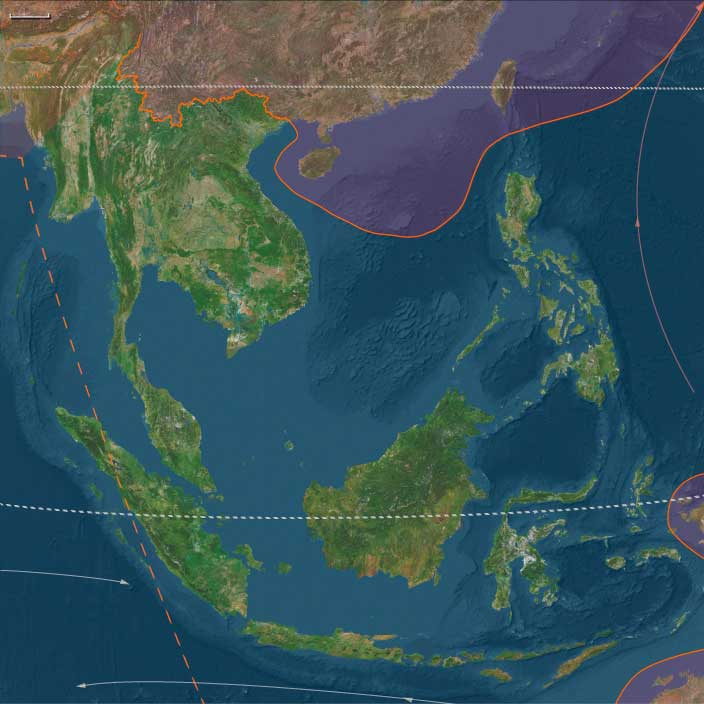
Opium cultivation and trade flourishes in the Shan States of Burma, which gains independence from Britain in 1948.
From 1949, remnants of the defeated Kuomintang (Chinese Nationalist) Army who shelter in the North East of Burma are helped by the United States to partly finance their resistance by selling opium, and subsequently heroin.
Locations
Groups
- United States of America (US, USA) (Washington DC)
- China, Republic of
- Burma, Union of
- China, People's Republic of
- Thailand, Kingdom of
- China, Republic of (Taiwan)
Topics
Commodoties
Subjects
Regions
Related Events
Filter results
Showing 10 events out of 4691 total
After a brilliant campaign by the Australian Liberal party, Robert Menzies defeats Labor’s Chifley and returns as prime minister in 1949.
The MNLA commonly employsguerrilla tactics, sabotaging installations, attacking rubber plantations and destroying transportation and infrastructure.
Support for the MNLA is mainly based on around 500,000 of the 3.12 million ethnic Chinese living in Malaya at this time.
These 500,000 have been referred to as 'squatters' and the majority of them were farmers living on the edge of the jungles where the MLNA is based.
This allows the MLNA to supply themselves with food, in particular, as well as providing a source of new recruits.
The ethnic Malay population supports them in smaller numbers.
The MNLA gains the support of the Chinese because they are denied the equal right to vote in elections, have no land rights to speak of, and are usually very poor.
The MNLA's supply organization is called "Min Yuen."
It has a network of contacts within the general population.
Besides supplying materiel, especially food, it is also important to the MNLA as an information gatherer.
The MNLA's camps and hideouts are in the rather inaccessible tropical jungle with limited infrastructure.
Most MNLA guerrillas are ethnic Chinese, though there are some Malays, Indonesians and Indians among its members.
The MNLA is organized into regiments, although these have no fixed establishments and each encompasses all forces operating in a particular region.
The regiments have political sections, commissars, instructors and secret service.
In the camps, the soldiers attend lectures on Marxism–Leninism, and produce political newsletters to be distributed to the locals.
The MNLA also stipulates that their soldiers need official permission for any romantic involvement with local women.
In the early stages of the conflict, the guerrillas envisage establishing "liberated areas" from which the government forces have been driven, with MNLA control being established, but does not succeed at this.

The Dutch cede Indonesia to the nationalist movement in 1949.
In 1949, communist leaders take mainland China; Mao Zhe Dong’s forces proclaim the Peoples Republic of China on Oct. 1, 1949.
Jiang Jeishei (Chaing Kai-shek) flees to Formosa; his Guomintang Nationalists set up a Republic of China in Taiwan.
The Social Affairs Dept.
and other Chinese secret police are created.
The French, based primarily in Saigon and Hue, ignore Vietnam’s independent status under President Ho and make former emperor Bao Dai Vietnam’s chief of state.
The US steps up financial aid to France, earmarked for the colonial war in Indochina.
Following the July, 1949 agreement by the French and Laotian governments to Laotian “independence within the French Union, most of the Laotian government-in-exile returns to Laos, with many of its members joining the new government at Vientiane.
Prince Souphamouvong remains in Bangkok and forms the Pathet Lao (Lao Country) political party and revolutionary organization.
Prominent among its leaders is Bishop Makarios, spiritual and secular leader of the Greek Cypriots. Born Michael Christodoulou Mouskos in 1913 to peasant parents in the village of Pano Panayia, about thirty kilometers northeast of Paphos in the foothills of the Troodos Mountains, the future archbishop and president had entered Kykko Monastery as a novice at age thirteen.
His pursuit of education over the next several years had taken him from the monastery to the Pancyprian Gymnasium in Nicosia, where he finished secondary school.
From there, he moved to Athens University as a deacon to study theology.
After earning his degree in theology, he remained at the university during the Second World War occupation, studying law.
He was ordained as a priest in 1946, adopting the name Makarios. A few months after ordination, he received a scholarship from the World Council of Churches that took him to Boston University for advanced studies at the Theological College.
Before he had completed his studies at Boston, he was elected in absentia bishop of Kition.
He returned to Cyprus in the summer of 1948 to take up his new office.
Rapid expansion of the oil industry follows because of the increasing postwar demand.
The United States becomes the most influential foreign power in Saudi Arabia.
American interest is directed toward the oil industry, which is owned by US companies.
A considerable number of employees of Aramco arrive in Saudi Arabia, as the country itself is unable to supply the oil company with sufficient skilled workers.
Aramco pays more taxes to the US government in 1949 than the yield to Saudi Arabia in royalties.
The UN Security Council-brokered cease-fire in Kashmir takes effect on January 1, 1949, thus ending the first Indo-Pakistani War.
The Security Council directs that a plebiscite be held.
In July, India and Pakistan define a cease-fire line that divides the administration of the territory, formalizing the military status quo and leaving about 30 percent of Kashmir under Pakistani control.
(Regarded at the time as a temporary expedient, this partition along the cease-fire line still exists.)
Although there was a clear Muslim majority in Kashmir before the 1947 partition and its economic, cultural, and geographic contiguity with the Muslim-majority area of the Punjab could be convincingly demonstrated, the political developments during and after the partition result in a division of the region.
Pakistan is left with territory that, although Muslim in character, is thinly populated, relatively inaccessible, and economically underdeveloped.
The largest Muslim group, situated in the Vale of Kashmir and estimated to number more than half the population of the entire state, lies in Indian-administered territory, with its former outlets via the Jhelum valley route blocked.
Although fighting ends in Kashmir, Pakistan faces serious internal problems.
The Muslim League is held responsible for the deterioration of politics and society after independence and is called to answer for its failure to fulfill people's high expectations.
There is a rising level of opposition and frustration, and an increasing use of repressive laws inherited from the British or enacted by Pakistan that include preventive detention and rules prohibiting the gathering of more than five persons.
In 1949, the Public and Representative Office Disqualification Act (PRODA) allows the government to disqualify persons found guilty of "misconduct," a term that acquires a broad definition.
Pakistan's Constituent Assembly is made up of members of the pre-partition Indian Constituent Assembly who represent areas that had gone to Pakistan.
The body's eighty members function as the legislature of Pakistan.
As a constitution-making body, the assembly's only achievement is the Objectives Resolution of March 1949, which specifies that Pakistan will be Islamic, democratic, and federal.
However, the assembly can not reach agreement on how these objectives will take form, raising fears among minorities and concern among East Bengalis.
A liberal statement of constitutional principles is promulgated, but parts of the proposed constitution encounter orthodox Muslim opposition.
On the economic front, Pakistan's trade war with India reaches a crisis in September 1949 when Britain devalues the pound, to which both the Pakistani rupee and the Indian rupee are pegged.
India follows Britain's lead, but Pakistan does not, so India severs trade relations with Pakistan.
Pakistan initiates an industrialization effort based on the processing of domestic agricultural raw materials for the home market and for export.
This leads to the establishment of cotton textile mills (a development that now accounts for a large part of the total employment in industry).
Independence-minded terrorists wage a campaign in Cyprus.
Bhutan gains independence from Britain in 1949 under Indian guidance.
In 1949, the three Western powers consolidate their German occupation sectors into the Federal Republic of Germany (West Germany), a constitutional democracy.
The USSR establishes the Communist government of the German Democratic Republic (East Germany) in the sector they control.
In 1949, Trans-Jordan becomes the kingdom of Jordan under King Abdullah.
(In the Interwar Era, the departing British erected both the Jordanian and Iraqi dynasties as the means of fulfilling the promise of royal thrones made to the Sharifs of the Hejaz.
As the fact of Saudi hegemony had obviated all claim to former Arabian thrones, the British invented two in the North.
(Iraq’s British-installed king, Abdullah’s brother, lasted from 1932 until 1958, when a pan-Arab revolt massacred the entire dynasty.)
The Gehlen Organization is transferred to CIA control in 1949.
Cardinal Mindszenty is tried in Hungary in 1949 following his brainwashing and confession of conspiracy.
Author Maxwell Anderson and composer Kurt Weill set Alan Paton’s “Cry, the Beloved Country” to music in 1949’s “Lost in the Stars.”
The ANC Youth League, led by Oliver Tambo, Nelson Mandela, Walter Sisula and Anton Lemde, gains control of the parent organization in 1949.
Years: 1949 - 1949
Locations
Groups
- United States of America (US, USA) (Washington DC)
- China, Republic of
- Burma, Union of
- China, People's Republic of
- Thailand, Kingdom of
- China, Republic of (Taiwan)