
Open war between Rome and the Etruscan …
Years: 479BCE - 479BCE
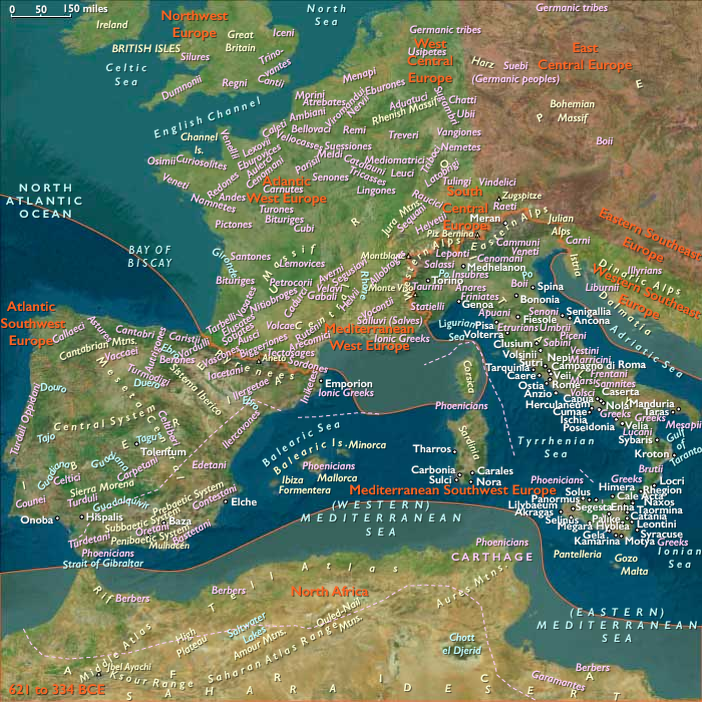
Open war between Rome and the Etruscan city of Veii, after a pacific coexistence between the close cities, had in 475 BCE broken out after the Romans mounted a cross-border raid that Veii successfully resisted.
The conflict had escalates into a battle in 480 BCE, in which the Roman army, close to defeat, had been saved by consul Kaeso Fabius Vibulanus.
After the battle, the Veientes had continued raiding Roman territory, retreating in front of Roman legions to deny them open battle.
Engaged in a conflict with Aequi and Volsci, the Romans are fighting on two fronts.
Thus, in 479 BCE, the gens Fabia offers to deal with Veii on its own, while the Republican legions have to fight against the other enemies.
Livy says that all of the three hundred and six adult (i.e., more than fifteen years old) Fabii went to the war, together with their clients.
The Fabii build a stronghold on the river Cremera, close to Veii, from which they manage to limit Veiian raids.
The Veientes engage an open battle near the Roman stronghold, but are defeated by Fabii and a Roman army led by consul Lucius Aemilius Mamercinus, and obliged to ask for a truce.
After the truce is broken, the Veientes renew their raid, but are repeatedly defeated by the Fabii, who, encouraged by the successes, become bold and attack and pillage Veii territory.
In the end, however, the Fabii fall in the trap laid by the Veientes.
Considering the enemies far from the stronghold, the Romans exit from the stronghold to capture a herd, scattering in pursuit of the animals.
In that moment, the outnumbering Veientes exit and surround the Fabii.
Adopting the wedge formation, the Romans break through and reach a hill, where they successfully repulse the Etruscan attacks, until a Veienite formation arrives to their back.
All of the Fabii are slaughtered save Quintus Fabius Vibulanus, who was too young to be sent to war.
The preserved account of the battle, written by Livy, is an elaboration of the real events, and celebrates the sacrifice of the gens Fabia.
Probably, its aim is to give a reason of the absence of Fabii from consular lists in the years following the battle.
Furthermore, this account is clearly influenced by the Spartan last stand at the Battle of Thermopylae.
Locations
People
Groups
Topics
- Younger Subboreal Period
- Iron Age Europe
- Iron Age Cold Epoch
- Classical antiquity
- Roman-Etruscan Wars, Early
- Roman War with Veii, First
Commodoties
Subjects
Regions
Subregions
Related Events
Showing 10 events out of 65565 total
Years: 479BCE - 479BCE
Locations
People
Groups
Topics
- Younger Subboreal Period
- Iron Age Europe
- Iron Age Cold Epoch
- Classical antiquity
- Roman-Etruscan Wars, Early
- Roman War with Veii, First
Commodoties
Subjects
Regions
Subregions