
Marcus Terentius Varro anticipates microbiology and epidemiology …
Years: 35BCE - 35BCE
Marcus Terentius Varro anticipates microbiology and epidemiology in Rerum rusticarum libri III (or Agricultural Topics in Three Books), warning his contemporaries to avoid swamps and marshland, since such areas "breed certain minute creatures which cannot be seen by the eyes, but which float in the air and enter the body through the mouth and nose and cause serious diseases."
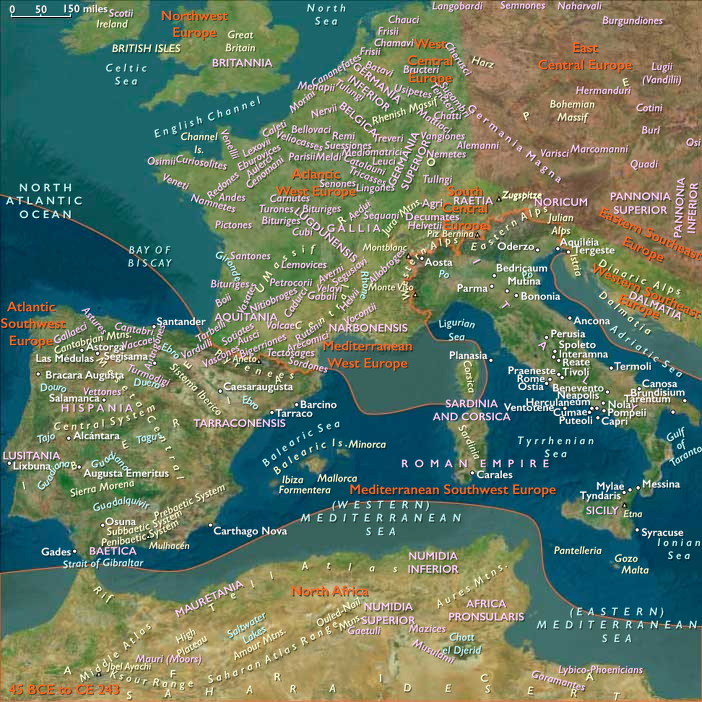
The Roman scholar and writer, also known as Varro Reatinus to distinguish him from his contemporary Varro Atacinus, was born in 116 in or near Reate (now Rieti) to a family thought to be of equestrian rank, has always remained close to his roots in the area, owning a large farm in the Reatine plain, probably near Lago di Ripa Sottile, until his old age.
He had studied under the Roman philologist Lucius Aelius Stilo, and later at Athens under the Academic philosopher Antiochus of Ascalon.
Politically, he had supported Pompey, reaching the office of praetor, after having been tribune of the people, quaestor and curule aedile.
He had escaped the penalties of being on the losing side in the civil war through two pardons granted by Julius Caesar, before and after the Battle of Pharsalus.
He had been one of the commission of twenty that carried out the great agrarian scheme of Caesar for the resettlement of Capua and Campania in 59 BCE.
Caesar had later appointed him to oversee the public library of Rome in 47 BCE, but following Caesar's death Mark Antony had proscribed him, resulting in the loss of much of his property, including his library.
Restored to favor by Octavian, Varro devotes himself fully to research and writing.
Among his many works, one that stands out for historians is his compilation of the Varronian chronology, an attempt to determine an exact year-by-year timeline of Roman history up to his time.
It is based on the traditional sequence of the consuls of the Roman Republic, eked out, where that did not fit, by inserting dictatorial and anarchic years.
It has been demonstrated to be somewhat erroneous but has become the widely accepted standard chronology, in large part because it was inscribed on the arch of Augustus in Rome; though that arch no longer stands, a large portion of the chronology has survived under the name of Fasti Capitolini.
Locations
People
Groups
Subjects
Regions
Subregions
Related Events
Showing 10 events out of 62261 total
Years: 35BCE - 35BCE
Locations
People
Groups
Subjects
Regions
Subregions