
The collapse of Tang's erstwhile vassal and …
Years: 840 - 840
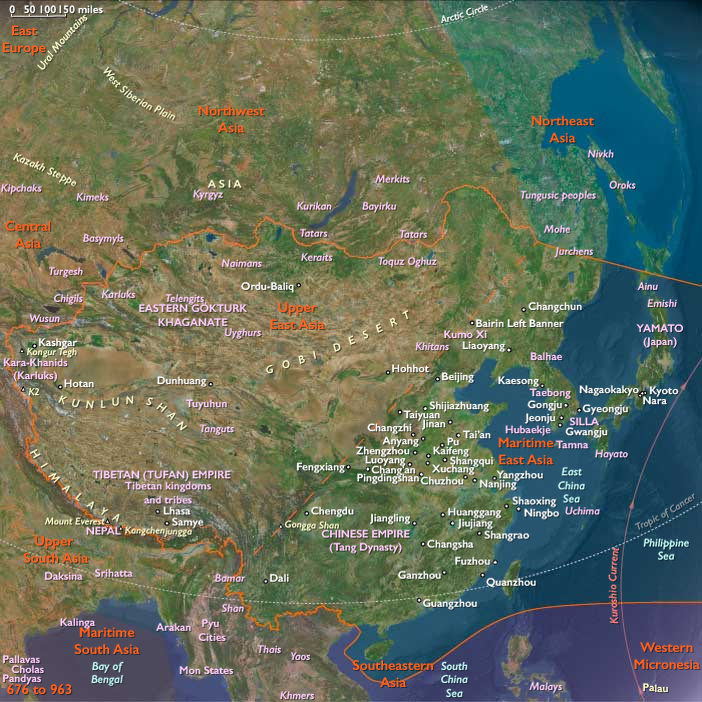
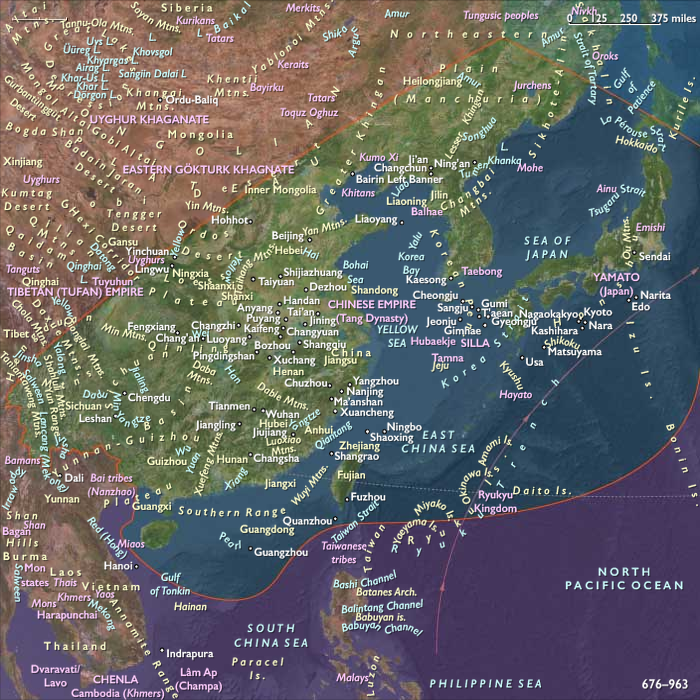
The collapse of Tang's erstwhile vassal and ally the Uyghur Khaganate—which had supported the Tang Dynasty in various campaigns through the decades—is one of the first things with which Emperor Wuzong has to deal.
The Uyghur Khaganate had weakened due to internal power struggles to the point that when the Xiajiasi (Kirghiz) khan Are attacks them in 840, the Uyghur khan Yaoluoge Hesa is killed.
The Uyghur tribespeople scatter, fleeing in various directions.
One major group, under the leadership of the prince Wamosi and the nobles Chixin, Pugu, and Najiachuo, heads for the Tang border city of Tiande (in modern Hohhot, Inner Mongolia) and seeks to submit to the Tang.
The leader of another major group, the noble Yaoluoge Wuxi, claims the khan title for himself (as Wujie Khan); Wujie Khan subsequently seizes Emperor Wuzong's aunt, Princess Taihe, who had married a previous khan (Chongde Khan) and holds her hostage.
Various Uyghur remnants pillage the Tang border regions, causing much disturbance for the Tang people.
At Li Deyu's suggestion, Emperor Wuzong supplies food to the Uyghur remnants to try to calm them, while accepting Wamosi's submission.
When Wujie Khan subsequently demands that Tang turn Wamosi over to him as a traitor, Emperor Wuzong refuses.
Locations
People
Groups
Commodoties
Subjects
Regions
Subregions
Related Events
Filter results
Showing 10 events out of 14 total
Atlantic Southwest Europe (1252 – 1395 CE): Wool, Iron, Wine, and the Atlantic Turn
Geographic and Environmental Context
Atlantic Southwest Europe includes Portugal’s Lisbon, Beira, Minho, Trás-os-Montes, and Spain’s Galicia, Asturias, Cantabria, Basque Country, Castile and León, northern Rioja, and northern Navarra.
-
Anchors: the Cantabrian coast (A Coruña–Gijón–Santander–Bilbao–San Sebastián), the Douro/Minho estuaries, and the Meseta–Cantabrian passes binding the plateau to Atlantic ports.
Climate and Environmental Shifts
-
Little Ice Age onset (~1300) brought cooler, wetter weather; stormier Bay of Biscay; good fisheries persisted.
-
Black Death (1348–1352) hit towns hard; ports recovered quickest via maritime trade.
Societies and Political Developments
-
Castile and León unified under Alfonso X (r. 1252–1284), then fractured and reconsolidated amid the Trastámara coup (Pedro I vs Enrique II, 1366–1369).
-
Portugal strengthened under Afonso III and Dinis (reforestation of Leiria for ship timber; University of Coimbra 1290), then defended independence in the Crisis of 1383–1385; João I and Aljubarrota (1385) sealed the Anglo-Portuguese alliance (Treaty of Windsor, 1386).
-
Navarre navigated between France and Castile; Basque towns (Bilbao, charter 1300; San Sebastián) grew as maritime communes.
Economy and Trade
-
Wool complex: Castilian wool—organized by the Mesta (founded 1273)—flowed through Burgos, León, and Cantabrian ports to Flanders and England.
-
Basque iron & shipbuilding: forges supplied anchors, nails, artillery shot; yards built cogs and naos for Atlantic service and whaling.
-
Wine & salt fish: Douro/Minho wines, Galician/Portuguese salt fish (cod, sardine) and tuna moved north; Lisbon/Porto emerged as major entrepôts.
-
Finance & law: municipal fueros, urban consulates, and English–Portuguese treaties stabilized credit, convoys, and tariffs.
Subsistence and Technology
-
Mixed Atlantic polyculture (rye/wheat, vines, chestnuts, cattle); stern-rudder hulls, improved rigging, magnetic compass and portolan practice diffused into Iberian waters.
Movement and Interaction Corridors
-
Sea: Lisbon ⇄ London/Bristol; Cantabria ⇄ Flanders; Galicia ⇄ Brittany; pilgrim sailings to Santiago.
-
Land: Meseta passes fed Burgos, León, Salamanca; Douro road/river linked Castile to Porto.
Belief and Symbolism
-
Cathedrals and monasteries in Santiago, León, Burgos, Salamanca; confraternities of sailors and merchants venerating St. James and St. Nicholas kept social cohesion in plague decades.
Adaptation and Resilience
-
Route redundancy (many ports, multiple passes), portfolio exports (wool–iron–wine–fish–salt), and crown–town compacts hedged risk from war, weather, and plague.
Long-Term Significance
By 1395, the Atlantic façade from Lisbon to San Sebastián had become a maritime-industrial platform: wool, iron, wine, and shipbuilding—backed by Portugal’s English alliance—set the stage for the 15th-century Atlantic turn and overseas exploration.
Mediterranean Southwest Europe (1360–1371 CE): Dynastic Struggles, Mercenary Warfare, and Literary Advances
The era 1360–1371 CE in Mediterranean Southwest Europe is characterized by intricate dynastic struggles in Granada, the prominent role of mercenary forces in Italy, and significant literary and intellectual developments.
Dynastic Struggles in Granada
Muhammed V of Granada, having initially inherited the throne from Yusuf I, faces turbulent political challenges. Overthrown by his half-brother Ismail II in 1359, Muhammed seeks refuge with the Marinid Sultan of Fez, where he is exposed to influential architectural innovations. Ismail II is quickly overthrown and killed by his brother-in-law Abu Said (Muhammed VI) in 1360. Muhammed V capitalizes on political opportunities, ultimately regaining the throne in 1362 after Muhammed VI is lured to Seville by King Peter I of Castile (Pedro el Cruel) and assassinated. Muhammed V secures diplomatic ties through the marriage of his eldest son, Yusuf II, to the Marinid Sultan’s daughter and completes the construction of an important hospital in Granada in 1366. He employs the renowned scholar and diplomat Ibn Khaldun in negotiations with Pedro the Cruel.
Sir John Hawkwood and Mercenary Warfare in Italy
The cessation of Anglo-French hostilities in 1360 provides an opportunity for Sir John Hawkwood, an English soldier of fortune, to lead his mercenary force, the White Company, into Italy. Hawkwood’s background, obscured by legends, suggests humble beginnings in Essex, with experience gained through service in the early stages of the Hundred Years' War. By the 1360s, Hawkwood commands the White Company, engaging in various military actions across Italy. His forces fight under multiple banners, including those of Milan, Florence, Pisa, Perugia, and the papacy. Notable engagements include battles against the Green Count in Lanzo Torinese, conflicts with Milan, warfare between Pisa and Florence in 1364, and supporting Perugia against Papal forces in 1369. In 1370, Hawkwood aligns with Bernabò Visconti in a conflict involving Pisa, Florence, and other city-states.
Literary and Intellectual Advances: Boccaccio
Giovanni Boccaccio completes a decade-long project, his encyclopedic work On the Genealogy of the Gentile Gods, an influential mythological reference and vigorous defense of poetry. Boccaccio's shift in literary style during this period results from declining health, personal disappointments, and an evolving worldview, partly influenced by interactions with Petrarch. After a crisis of faith in 1362, during which he nearly destroys his literary works, Boccaccio is dissuaded by Petrarch. He retires to Certaldo in 1363, turning from imaginative literature to critical studies, biographies, and geographical works, notably producing the satirical and misogynistic work Il Corbaccio in 1365.
Castilian Civil War
The Castilian civil war from 1366 to 1369 emerges as part of the broader conflict between England and France, the Hundred Years' War. Primarily fought between King Peter I (Pedro el Cruel) and his illegitimate brother Henry of Trastámara, this conflict significantly influences regional politics and involves extensive fighting throughout the Kingdom of Castile and its coastal waters.
Legacy of the Era
The era 1360–1371 CE profoundly impacts Mediterranean Southwest Europe through political upheavals in Granada, the strategic deployment of mercenary forces in Italian warfare, and critical advancements in literature and intellectual thought. Collectively, these developments shape regional dynamics, influencing subsequent cultural, political, and military trajectories
A Castilian civil war fought from 1366 to 1369 becomes part of the larger conflict now raging between the Kingdom of England and the Kingdom of France, the Hundred Years' War.
It is fought primarily in the Kingdom of Castile and its coastal waters between the local and allied forces of the reigning king, Peter, and his illegitimate brother Henry of Trastámara over the right to the crown.
Atlantic Southwest Europe (1360–1371 CE): Portuguese Stability under Pedro I and Ferdinand I, Castilian Turmoil and Civil Strife, and Navarrese Diplomatic Maneuvering
Between 1360 and 1371 CE, Atlantic Southwest Europe—including Galicia, northern and central Portugal, Asturias, Cantabria, and northern Spain south of the Franco-Spanish border (43.05548° N, 1.22924° W)—experienced contrasting developments amid a period marked by political turbulence in Castile, relative governance stability in Portugal, and skillful diplomatic neutrality in Navarre. Portugal, governed successively by King Pedro I (1357–1367 CE) and King Ferdinand I (1367–1383 CE), maintained stable administration and moderate economic recovery from the previous era’s devastation. Castile, deeply troubled by civil war and aristocratic conflicts under King Pedro I "the Cruel" (1350–1369 CE) and later Henry II (1369–1379 CE), faced severe internal instability and political transformation. Navarre, under King Charles II "the Bad" (1349–1387 CE), navigated carefully between rival powers, preserving regional autonomy, diplomatic flexibility, and stable governance.
Political and Military Developments
Portuguese Stability under Pedro I and Ferdinand I
Portugal enjoyed continued governance stability and administrative coherence under the late reign of King Pedro I, whose effective administration and judicial reforms sustained internal stability. His successor, King Ferdinand I, decisively maintained territorial integrity and economic recovery despite tensions arising from Castilian civil conflict. Ferdinand’s cautious diplomacy and strategic neutrality safeguarded Portuguese autonomy and prosperity.
Castilian Civil War and Dynastic Conflict
Castile endured severe internal turmoil characterized by intense civil conflict between Pedro I "the Cruel" and his half-brother, the future Henry II of Trastámara. Their protracted conflict culminated in Pedro’s death in 1369, bringing Henry II to power. This dynastic shift decisively altered Castilian governance, weakening central authority temporarily but ultimately laying foundations for future political realignments and territorial consolidation under the Trastámara dynasty.
Navarrese Diplomatic Prudence under Charles II
Navarre skillfully preserved diplomatic neutrality and regional autonomy under the prudent yet politically opportunistic leadership of King Charles II "the Bad." His strategic balancing of Castilian, French, and Aragonese interests decisively preserved Navarre’s territorial integrity and internal stability, ensuring continued regional autonomy amidst Iberian instability.
Economic Developments
Agricultural and Economic Recovery
Following the demographic devastation of the Black Death, the region’s agricultural productivity gradually recovered. Improved land management, revived cultivation practices (grains, olives, vineyards, citrus fruits, almonds), and livestock husbandry supported economic stabilization. Additionally, mining operations (especially gold and silver in Galicia and Asturias) steadily resumed, reinforcing regional economic resilience.
Maritime Commerce and Renewed Trade Expansion
Portuguese ports—especially Lisbon, Porto, Braga, and Coimbra—experienced gradual resurgence in maritime commerce, strengthening trade links with northern Europe (England, Flanders, Normandy, Brittany). Galicia, notably through A Coruña, similarly resumed robust maritime trade, significantly reinforcing regional economic recovery and commercial vitality.
Pilgrimage Recovery and Economic Revitalization
Pilgrimage to Santiago de Compostela regained strength, decisively contributing to the region’s economic and cultural renewal. Pilgrim influx supported hospitality, trade, artisanal industries, and infrastructure projects, reinforcing Galicia’s economic recovery and renewed cultural prominence.
Cultural and Religious Developments
Portuguese Cultural Continuity and Royal Patronage
Portugal sustained intellectual and cultural vibrancy under Pedro I and Ferdinand I. Royal patronage decisively promoted literature, education, and scholarly traditions. Monastic communities and universities maintained intellectual continuity, shaping Portuguese linguistic standardization, cultural identity, and intellectual heritage.
Galician Cultural Revival and Ecclesiastical Patronage
Galicia’s cultural life and intellectual traditions strongly recovered, significantly supported by renewed pilgrimage traffic to Santiago de Compostela. Ecclesiastical patronage sustained scholarly initiatives, architectural projects, manuscript preservation, and educational institutions, decisively reinforcing Galician cultural resilience and international prominence.
Monastic and Ecclesiastical Influence Amid Recovery
Monastic communities decisively contributed to regional renewal through scholarly activity, manuscript preservation, agricultural innovations, and educational reforms. Ecclesiastical authorities maintained significant influence over Iberian religious identity, social cohesion, and cultural resilience.
Persistent Cultural Syncretism and Local Traditions
Orthodox Christianity continued integrating indigenous Iberian and Celtic traditions, notably in rural Galicia and northern Portugal. Persistent cultural syncretism decisively reinforced distinctive regional identities, social cohesion, and cultural resilience amid broader political transformations.
Civic Identity and Governance
Portuguese Governance Stability and Civic Cohesion
Under Pedro I and Ferdinand I, Portugal decisively preserved governance stability, territorial integrity, and civic identity. Effective administration significantly solidified Portuguese national coherence, internal stability, and economic recovery, laying enduring foundations for Portugal’s medieval prosperity.
Castilian Political Transition and Regional Identity
Castile faced intense civil conflict and political upheaval during Pedro I’s final years and Henry II’s early reign. Despite instability, the Trastámara dynasty’s establishment decisively shaped future governance structures and strengthened Castilian regional identity and coherence, paving the way for later administrative reforms.
Navarrese Regional Autonomy and Diplomatic Stability
Navarre maintained regional autonomy, diplomatic neutrality, and stable governance under Charles II. Skillful diplomatic maneuvering significantly preserved territorial integrity, internal stability, and northern Iberian geopolitical coherence.
Notable Regional Groups and Settlements
-
Portuguese: Experienced governance stability, economic recovery, and cultural continuity under Pedro I and Ferdinand I, decisively shaping Portuguese national identity and medieval trajectory.
-
Castilians: Navigated severe civil conflict and political upheaval yet preserved regional coherence, frontier stability, and resilient governance structures, laying foundations for future stability under the Trastámara dynasty.
-
Galicians: Achieved economic revival, cultural resilience, and renewed prominence supported by pilgrimage traditions, maritime trade recovery, and ecclesiastical patronage.
-
Basques (Navarre): Skillfully preserved regional autonomy, diplomatic neutrality, and stable governance under Charles II, significantly shaping northern Iberian geopolitical stability.
Long-Term Significance and Legacy
Between 1360 and 1371 CE, Atlantic Southwest Europe:
-
Maintained Portuguese governance stability, economic recovery, and cultural vitality under Pedro I and Ferdinand I, decisively shaping Portugal’s historical trajectory and medieval prosperity.
-
Endured severe Castilian civil strife and dynastic change, yet preserved regional identity, territorial coherence, and resilient governance, laying foundations for future stability under the Trastámara dynasty.
-
Sustained Navarrese regional autonomy, diplomatic neutrality, and governance resilience under Charles II, significantly shaping northern Iberian geopolitical coherence.
-
Experienced economic revitalization, cultural renewal, and persistent governance stability following the devastation of the Black Death, decisively influencing the region’s enduring medieval legacy.
This pivotal era decisively influenced regional identities, governance stability, economic recovery, and cultural resilience, profoundly shaping Atlantic Southwest Europe’s historical trajectory.
King Peter I of Castile—Peter the Cruel, as he is called by his subjects—abandons and imprisons his wife, arousing the opposition of the nobility led by his illegitimate half brother, Count Henry of Trastamara, who, with Aragonese backing, challenges Peter’s right to rule.
Charles V of France also sends troops into Spain in support of Trastamara, who overthrows Peter.
Peter then turns to English king Edward III, who dispatches an expeditionary force led by his son Edward, the Black Prince.
Edward defeats the Franco-Aragonese-Castilian forces at Nájera in 1367, then departs for England; Trastamara promptly starts a new round of civil war.
Peter of Castile's forces are pitched against those of his half-brother Henry of Trastámara in the civil war of succession in Castile,.
The English crown supports Peter and the French, Henry.
French forces are led by Bertrand du Guesclin, a Breton, who had risen from relatively humble beginnings to prominence as one of France's war leaders.
Charles V has provided a force of twelve thousand, with du Guesclin at their head, to support Trastámara in his invasion of Castile.
Peter appeals to England and Aquitaine's Black Prince for help, but none is forthcoming, forcing Peter into exile in Aquitaine.
The Black Prince had previously agreed to support Peter's claims, but concerns over the terms of the treaty of Brétigny had led him to assist Peter as a representative of Aquitaine, rather than England.
He then leads an Anglo-Gascon army into Castille.
Jean III de Grailly, after his release from imprisonment in 1365, had defected to the French side and had been made lord of Nemours by Charles V of France.
However, he had soon reestablished his loyalty to the English, and in 1367 he goes to Spain with the Black Prince, fighting on April 3 at the Battle of Nájera.
Here he again faces Bertrand du Guesclin, but this time it is du Guesclin who is captured, and the Captal is put in charge of the prisoner.
After Trastámara's army is defeated at the Battle of Nájera, Peter is restored to power.
Henry de Trastámara, with the Black Prince gone from Castile, leads a second invasion with French help.
Bertrand du Guesclin had won renown in May, 1364, for winning the battle of Cocherel in Normandy against the opponents of Charles V. Except for this victory, he is unsuccessful in pitched battles, having lost at Auray in 1364 and Nájera in 1367; although eventually celebrated as a symbol of chivalry, he is most successful at such unchivalrous pursuits as brigandage and guerrilla warfare Respected by—and thus able to control—the fierce warriors who are the scourge of the countryside when undisciplined, du Guesclin leads such troops in successfully installing the pro-French Trastamara on the throne of Castile (and León) as Henry II after he defeats his half-brother Peter of Castile and León at Montiel, and murders him on March 23, 1369.
The new Castilian regime will provide naval support to French campaigns against Aquitaine and England.
The Fernandine Wars: Ferdinand I’s Failed Castilian Ambitions (1369–1371)
Upon ascending the Portuguese throne in 1367, Ferdinand I of Portugal sought to expand his influence in Castile, taking advantage of the ongoing civil war between Henry II of Trastámara and the murdered Peter I of Castile.
Ferdinand’s Claim to the Castilian Throne (1369)
- In 1369, Peter I of Castile was assassinated by his half-brother, Henry of Trastámara, after a long civil war.
- As Peter’s closest legitimate male relative, Ferdinand claimed the Castilian throne, receiving support from several Castilian towns that remained loyal to Peter’s lineage.
- Henry II, now King of Castile, viewed Ferdinand’s claim as a direct threat and invaded Portugal in late 1369.
The First Fernandine War (1369–1371): A Humiliating Defeat
- The war quickly turned against Ferdinand, as Henry II’s forces—bolstered by French support—proved superior in strategy and manpower.
- Ferdinand failed to rally enough Castilian nobles to his cause and suffered several military defeats.
- The war ended in 1371 with the Treaty of Alcoutim, in which:
- Ferdinand abandoned his claim to the Castilian throne.
- Portugal was forced to pay Castile reparations.
- Ferdinand agreed to marry Henry’s daughter, Leonor of Castile, to cement peace.
Political Fallout
- The treaty infuriated the Portuguese nobility, particularly when Ferdinand reneged on the arranged marriage and instead married Leonor Teles, a controversial and ambitious noblewoman.
- The failure of the war weakened Ferdinand’s credibility, yet he would continue to pursue Castilian ambitions, leading to two more Fernandine Wars (1372–1373, 1381–1382), further destabilizing Portugal.
This first disastrous war exposed Ferdinand’s military shortcomings and set Portugal on a path of continuous conflict with Castile, weakening the kingdom’s stability and paving the way for the crisis of 1383–1385, which would ultimately determine Portugal’s independence.
The Peace of Alcoutim (1371): Ferdinand I Abandons His Claim to Castile
After his humiliating defeat in the First Fernandine War (1369–1371) against Henry II of Castile, King Ferdinand I of Portugal was forced to negotiate peace to prevent further destruction.
Terms of the Peace Treaty (1371)
- Ferdinand formally renounced his claim to the Castilian throne, abandoning his support for towns that had remained loyal to Peter I of Castile.
- Portugal agreed to pay reparations to Castile.
- To secure the peace, Ferdinand pledged to marry Henry II’s daughter, Leonor of Castile, creating a dynastic alliance between the two kingdoms.
Ferdinand’s Betrayal of the Treaty
Despite the treaty’s terms, Ferdinand soon broke his engagement to Leonor of Castile, choosing instead to marry Leonor Teles de Meneses, a Portuguese noblewoman of ambitious and controversial reputation.
- His abandonment of the arranged marriage infuriated Castile, further damaging relations between the two kingdoms.
- This betrayal renewed hostilities and contributed to the outbreak of the Second Fernandine War (1372–1373).
- The Portuguese nobility was divided, as many saw his decision as reckless and politically dangerous.
Consequences of the Peace of Alcoutim
- While it ended immediate warfare, the treaty failed to establish a lasting peace between Portugal and Castile.
- Ferdinand’s personal ambitions and disregard for diplomatic agreements kept Portugal embroiled in conflict, weakening its stability and draining its resources.
- These tensions would culminate in the Portuguese crisis of 1383–1385, a succession dispute that ultimately led to the rise of the House of Avis and the consolidation of Portuguese independence.
Thus, the Peace of Alcoutim (1371), though a temporary truce, did little to prevent further wars, betrayals, and political instability in Portugal’s relations with Castile.
Atlantic Southwest Europe (1372–1383 CE): Portuguese Dynastic Crisis, Castilian Stability under Henry II, and Navarrese Diplomatic Maneuvering
Between 1372 and 1383 CE, Atlantic Southwest Europe—including Galicia, northern and central Portugal, Asturias, Cantabria, and northern Spain south of the Franco-Spanish border (43.05548° N, 1.22924° W)—faced significant political transitions marked by a severe dynastic crisis in Portugal, strengthening governance in Castile, and diplomatic resilience in Navarre. Portugal, governed by King Ferdinand I (1367–1383 CE), faced growing internal tensions culminating in a succession crisis. Castile experienced renewed political stability and territorial consolidation under King Henry II (1369–1379 CE) and subsequently his son King John I (1379–1390 CE), firmly establishing the Trastámara dynasty. Navarre, under King Charles II "the Bad" (1349–1387 CE), continued skillful diplomatic maneuvers to maintain regional autonomy amidst shifting Iberian alliances.
Political and Military Developments
Portuguese Dynastic Crisis under Ferdinand I
Portugal entered a severe dynastic and political crisis during the late reign of King Ferdinand I, whose failure to produce a legitimate male heir triggered intense internal rivalries. His daughter, Beatrice, married King John I of Castile in 1383, sparking tensions over Portugal’s sovereignty and succession. This union precipitated political instability and set the stage for a subsequent crisis that would culminate after Ferdinand’s death, dramatically reshaping Portuguese governance and national identity.
Castilian Stability and Governance Consolidation under Henry II and John I
Following civil strife, Castile decisively stabilized and consolidated its governance structures under King Henry II, founder of the Trastámara dynasty. Henry II’s reign significantly reinforced royal authority, administrative coherence, and territorial integrity. His son and successor, John I, continued these policies, maintaining Castilian stability, governance efficiency, and strengthened regional identity.
Navarrese Diplomatic Prudence under Charles II
Navarre maintained careful diplomatic neutrality and regional autonomy under the prudent yet politically agile leadership of King Charles II "the Bad." His diplomatic maneuvers, balancing Castilian, French, and Aragonese interests, significantly preserved Navarre’s territorial integrity, internal governance stability, and northern Iberian geopolitical coherence.
Economic Developments
Continued Agricultural and Economic Recovery
The region’s agriculture and economy continued recovery from earlier demographic crises. Improved cultivation techniques (grains, olives, vineyards, citrus fruits, almonds), livestock husbandry, artisanal crafts, and renewed mining activities (gold and silver in Galicia and Asturias) decisively reinforced economic resilience and stability.
Expansion and Stabilization of Maritime Commerce
Portuguese ports (Lisbon, Porto, Braga, Coimbra) decisively expanded maritime commerce, solidifying robust trade networks with northern Europe (England, Flanders, Normandy, Brittany). Galicia, particularly A Coruña, maintained vigorous maritime trade, reinforcing regional economic prosperity and international commercial connections.
Pilgrimage and Economic Continuity
Pilgrimage routes to Santiago de Compostela remained economically vibrant, significantly sustaining hospitality industries, trade, artisanal commerce, infrastructure development, and cultural exchanges. Continued pilgrimage reinforced Galicia’s economic resilience, cultural prominence, and regional identity.
Cultural and Religious Developments
Portuguese Cultural Continuity Amid Political Tensions
Despite growing dynastic uncertainty, Portugal maintained cultural vitality and intellectual traditions. Royal patronage of scholarly and literary activities continued, sustaining Portuguese linguistic standardization, cultural identity, and educational initiatives through this politically turbulent period.
Galician Cultural Resilience and Ecclesiastical Patronage
Galicia retained cultural prominence, decisively supported by Santiago de Compostela’s pilgrimage economy and ecclesiastical patronage. Monastic communities and cathedral authorities continued scholarly initiatives, manuscript preservation, architectural projects, and educational institutions, profoundly shaping Galician cultural identity and international recognition.
Monastic and Ecclesiastical Influence
Monastic communities decisively maintained scholarly traditions, manuscript preservation, agricultural innovations, and educational reforms. Ecclesiastical authorities significantly influenced Iberian religious identity, liturgical uniformity, and regional cultural coherence amid political and dynastic uncertainties.
Persistent Cultural Syncretism and Local Traditions
Orthodox Christianity continued integrating indigenous Iberian and Celtic traditions, notably in rural Galicia and northern Portugal. This cultural syncretism significantly reinforced regional identities, social cohesion, and cultural resilience amid broader political transformations.
Civic Identity and Governance
Portuguese Governance Crisis and Civic Tensions
Portugal’s late reign of Ferdinand I saw escalating civic tensions resulting from dynastic uncertainties and the unpopular Castilian union through Beatrice’s marriage to King John I of Castile. Civic identities increasingly polarized, foreshadowing the imminent succession crisis and internal conflicts following Ferdinand’s death.
Castilian Governance Stability and Territorial Coherence
Castile achieved decisive governance stability, territorial integrity, and reinforced regional identity under Henry II and John I. Effective administrative reforms, consolidation of royal authority, and strengthened frontier security significantly solidified Castilian national coherence and governance stability.
Navarrese Regional Autonomy and Diplomatic Stability
Navarre decisively preserved regional autonomy, diplomatic neutrality, and governance stability under Charles II. Skillful diplomatic maneuvering significantly preserved territorial integrity, internal stability, and northern Iberian geopolitical coherence.
Notable Regional Groups and Settlements
-
Portuguese: Faced escalating internal tensions and dynastic uncertainty during Ferdinand I’s reign, significantly reshaping Portugal’s medieval governance trajectory and setting the stage for future national developments.
-
Castilians: Achieved significant governance stability, territorial integrity, and regional coherence under the Trastámara dynasty’s rule (Henry II and John I), decisively shaping Castile’s enduring medieval legacy.
-
Galicians: Retained economic vibrancy, cultural resilience, and international prominence, significantly reinforced by sustained pilgrimage activity, maritime commerce, and ecclesiastical patronage.
-
Basques (Navarre): Skillfully preserved regional autonomy, diplomatic neutrality, and stable governance under Charles II, significantly influencing northern Iberian geopolitical stability.
Long-Term Significance and Legacy
Between 1372 and 1383 CE, Atlantic Southwest Europe:
-
Entered a critical dynastic crisis in Portugal, significantly reshaping future governance structures, civic identities, and national trajectories following Ferdinand I’s reign.
-
Achieved decisive Castilian governance stability, territorial integrity, and strengthened regional identity under Henry II and John I, significantly influencing Iberian geopolitical stability.
-
Maintained Navarrese regional autonomy, diplomatic neutrality, and governance resilience under Charles II, decisively shaping northern Iberian political coherence.
-
Experienced sustained economic recovery, cultural resilience, and persistent governance structures despite political uncertainty, profoundly influencing the region’s enduring medieval legacy.
This pivotal era decisively influenced regional identities, governance stability, economic continuity, and cultural resilience, profoundly shaping Atlantic Southwest Europe’s historical trajectory.
Years: 840 - 840
Locations
People
Groups
Commodoties
Subjects
Regions
Subregions