
One of the early Upanishads, the “Brahma …
Years: 105BCE - 94BCE
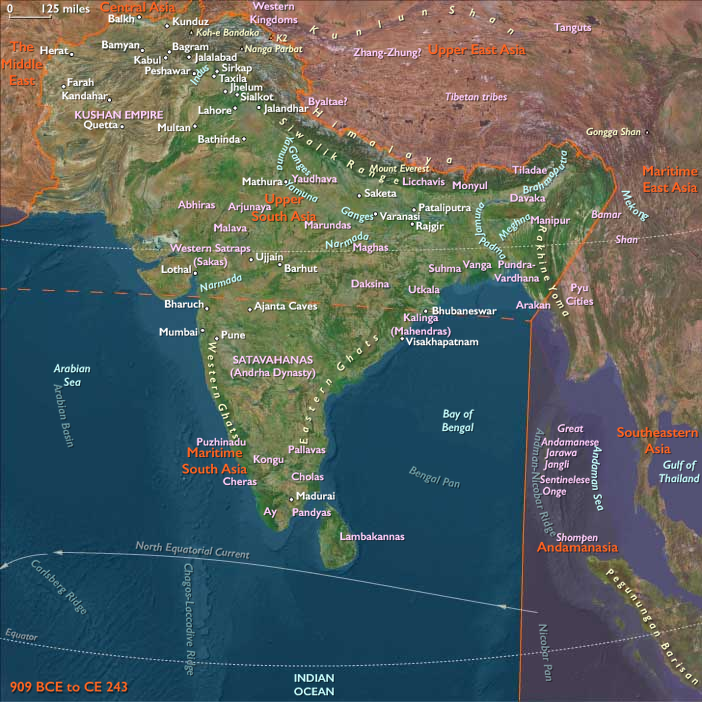
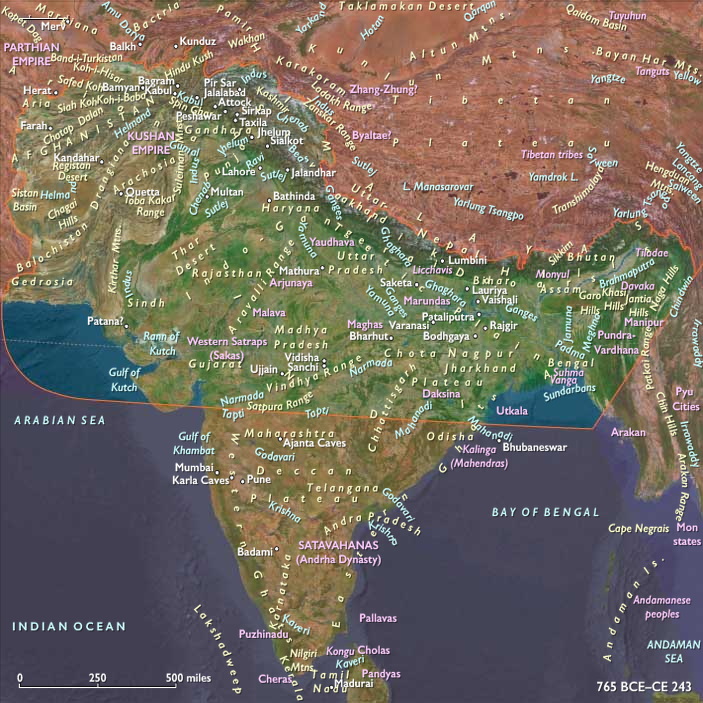
One of the early Upanishads, the “Brahma sutras” (or “Vedanta sutras”) attributed to Badarayana, is written between 100 BCE and CE 100.
One of the three canonical texts of the Vedānta school of Hindu philosophy, a thorough study of Vedānta requires a close examination of these three texts, known in Sanskrit as the Prasthanatrayi, or the three starting points.
The Brahma sūtra, as the exposition of the philosophy of the Upanishads, is an attempt to systematize the various strands of the Upanishads that form the background of the orthodox systems of thought.
It is also called Uttara-Mimāṃsā or the investigation of the later part of the Vedas, as distinguished from the Mimāṃsā of the earlier part of the Vedas and the Brahmanas which deal with ritual or karma-kānda.
It is intended to be a summary of the teaching of the Upanishads.
Groups
Topics
Subjects
Regions
Subregions
Related Events
Filter results
Showing 10 events out of 62913 total
The northern region of the Korean peninsula and Manchuria had been occupied by the nascent states of Buyeo, Goguryeo, Okjeo, Dongye, and other minor statelets after the defeat of Gojoseon by China's Han dynasty of China in 108 BCE.
Goguryeo's traditional founding date is 37 BCE, but it is mentioned in Chinese records as early as 75 BCE, or possibly even the second century BCE.
The little-understood state of Jin in the southern part of the Korean peninsula has given rise to the loose confederacies Jinhan, Byeonhan, and Mahan, or collectively, Samhan.
Jinhan, like the other Samhan confederacies, had arisen out of the confusion and migration following the fall of Gojoseon in 108 BCE.
The Middle East: 105–94 BCE
Dura-Europos Under Parthian Rule
The period from 105 to 94 BCE sees significant developments under Parthian rule in Mesopotamia, particularly with their capture and renaming of the Seleucid city Europos, now called Dura. Originally founded by Seleucus I in 303 BCE, Europos occupied a strategic location at the crossroads of a vital east-west trade route and a north-south route along the Euphrates River. Initially designed according to the Hippodamian grid pattern, Europos had evolved by the second century BCE into a prominent urban center, featuring rectangular blocks systematically arranged around a central agora.
Under the Parthians, Dura-Europos thrives as an essential agricultural and trade hub, serving as a critical fortress on the Arsacid Empire’s frontier. The city’s strategic importance in controlling caravan routes fosters a cosmopolitan atmosphere, vividly demonstrated by multilingual inscriptions in languages including Greek, Latin, Aramaic, Hebrew, Syriac, Hatrian, Palmyrenean, Middle Persian, and Safaitic Pahlavi.
Thus, the era from 105 to 94 BCE marks the rise of Dura-Europos as a significant Parthian center, emblematic of cultural diversity and economic vitality, enhancing Mesopotamia's role in regional trade networks and consolidating Parthian authority in the region.
The Parthians, who have acquired Mesopotamia by 100 BCE, have captured the Seleucid city of Europos and renamed it Dura.
Founded in 303 BCE by Seleucis I on the intersection of an east-west trade route and the trade route along the Euphrates, Europus had controlled the river crossing on the route between his newly founded cities of Antioch and Seleucia on the Tigris.
Its rebuilding as a great city after the Hippodamian model, with rectangular blocks defined by cross-streets ranged around a large central agora, had been formally laid out in the second century BCE.
During the first century BCE, Dura-Europus will prosper under Parthian rule as a center of agriculture and the caravan trade, serving as a frontier fortress of the Arsacid Parthian Empire, with a multicultural population, as testified by inscriptions in Greek, Latin, Aramaic, Hebrew, Syriac, Hatrian, Palmyrenean, Middle Persian and Safaitic Pahlavi.
The Bimaran casket, the earliest surviving Indian jewel of importance, executed between about 100 BCE to 100 CE, is a superb example of repoussé work set with rubies.
A small gold reliquary for Buddhist relics, it was found by the archaeologist Charles Masson during his work in Afghanistan between 1833 and 1838 inside the stupa no.
2 at Bimaran, near Jalalabad in eastern Afghanistan.
The casket contained coins of the Indo-Scythian king Azes II, though recent research by Senior indicates Azes II never existed, and finds attributed to his reign probably should be reassigned to Azes I.
It is also sometimes dated to a slightly posterior date of 50 CE, based on a redeposition theory, and sometimes much later (second century CE), based on artistic assumptions.
The casket features Hellenistic representations of the Buddha (contrapposto pose, Greek himation, bundled hairstyle, realistic execution), surrounded by the Indian deities Brahma and Śakra, inside arches niches (called "homme arcade", or caitya) of Greco-Roman architecture.
There are altogether eight figures in high-relief (two identical groups of Brahman-Buddha-Indra, and two devotees in-between) and two rows of rubies from Badakhshan.
The casket is very small, with a height of seven centimeter (two and three-quarter inches), and is probably Indo-Greek work.
It is considered as a masterpiece of the Greco-Buddhist art of Gandhara.
Near East (105–94 BCE): Linguistic and Cultural Shifts in Lycia
The period from 105 to 94 BCE marks a significant linguistic and cultural transition in Lycia, located in southwestern Anatolia. Lycian, a Hittite-Luwian language traditionally written using a West Greek alphabet, becomes extinct around the beginning of the first century BCE. It is replaced by Ancient Greek, reflecting the broader Hellenization trends throughout the region, influenced by cultural exchange, trade interactions, and political dominance by Greek-speaking powers.
This linguistic shift indicates not only cultural assimilation but also a deeper integration of Lycia into the Hellenistic world, impacting local traditions, administration, and identity.
Legacy of the Era
The era 105–94 BCE concludes with Lycia's complete linguistic and cultural integration into the Hellenistic sphere, exemplifying the wider patterns of cultural convergence and transformation that characterize the Near East in this historical period.
Lycian, a Hittite-Luwian language written with a West Greek alphabet, becomes extinct around the beginning of the first century BCE, having been replaced by the Ancient Greek language.
Mediterranean Southwest Europe (105–94 BCE): The Cimbrian War and Internal Strife in Rome
The era 105–94 BCE is marked by significant military and political upheaval within the Roman Republic, primarily driven by the devastating invasions of Germanic tribes and internal struggles culminating in major military reforms.
The Catastrophe at Arausio
In 105 BCE, Rome faces one of its gravest military defeats at the Battle of Arausio near present-day Orange in southern Gaul. To repel the advancing Germanic tribes of the Cimbri and Teutones, the Republic assembles an enormous force—the largest since the Second Punic War—under the consul Gnaeus Mallius Maximus and proconsul Quintus Servilius Caepio. The consuls, however, fail to cooperate effectively due to mutual distrust, establishing separate camps on opposite sides of the Rhône River. Exploiting this vulnerability, the Cimbri and Teutones destroy Caepio’s army in isolation before overwhelming Maximus’s forces. The Romans suffer staggering losses, comparable only to their historical disaster at Cannae.
Despite their overwhelming victory, the tribes inexplicably do not press on to invade Italy immediately. Instead, the Cimbri migrate towards Hispania, and the Teutones remain in Gaul, granting Rome crucial breathing space to reorganize.
Emergency and Military Reforms Under Marius
The catastrophic defeat at Arausio throws Rome into widespread panic—known as the terror cimbricus. In response, traditional republican procedures are set aside, and Gaius Marius, the hero of the Jugurthine War, is elected consul for an unprecedented five consecutive terms from 104 BCE. Marius capitalizes on this extraordinary power to radically reorganize Rome’s military forces. He opens army recruitment to landless citizens, fundamentally altering the structure and loyalty dynamics of Roman legions.
Decisive Roman Victories
By 102 BCE, Marius is prepared to confront the Teutones decisively. Near Aquae Sextiae, he engineers a strategic ambush, obliterating the Teutones and capturing their king, Teutobod. In 101 BCE, the remaining threat from the Cimbri materializes as they penetrate northern Italy. Marius, reinforced by his battle-hardened legions, decisively defeats the Cimbri at the Battle of Vercellae on the Raudine Plain. The Cimbri are annihilated; their leaders, Boiorix and Lugius, are killed, and their women, preferring death to slavery, tragically take their own lives and those of their children.
The Second Servile War
Meanwhile, internal struggles plague Roman territories. In Sicily, a major slave uprising known as the Second Servile War erupts in 104 BCE, reflecting widespread social tensions and unrest within Roman territories. The rebellion persists until 100 BCE, when it is finally suppressed through considerable effort.
Cultural Contributions: Lucilius and Roman Satire
Amid these tumultuous events, cultural developments continue. The prominent Roman satirist Gaius Lucilius dies in Naples in 103 BCE. Lucilius, hailed as the originator of Roman satire, leaves behind approximately thirty volumes of work, providing a scathing commentary on contemporary Roman society and politics. His pioneering literary contributions greatly influence subsequent Roman satirists, including Horace and Juvenal, marking a significant cultural legacy during this era.
Long-term Implications
The aftermath of the Cimbrian War and the internal strife highlight critical vulnerabilities within Rome’s political and military structures. Marius’s military reforms establish a precedent of armies increasingly loyal to their generals rather than the Republic, setting the stage for future political upheaval and ultimately contributing to the Republic’s transition toward empire.
Rome and its new consul Gnaeus Mallius Maximus and the proconsul Quintus Servilius Caepio, in order to decisively settle the matter of the invading Cimbri and Teutones in 105 BCE, gather the largest force the Republic has fielded since the Second Punic War, and possibly the largest force it has ever sent to battle.
The force consists of over eighty thousand men, along with tens of thousands of support personnel and camp followers in two armies, one led by each consul.
The consuls lead their armies on their own armed migration to the Rhône River near Orange, Vaucluse, where, disliking and distrusting each other, they erect separate camps on opposite sides of the river; by so doing they leave their disunited force open to separate attack.
The overconfident Caepio foolishly attacks without support from Maximus; his legions are wiped out and his undefended camp overrun.
The now isolated and demoralized troops of Maximus are then easily defeated.
Thousands more are slain trying desperately to rally and defend his poorly positioned camp.
Only Caepio, Maximus, and a few hundred Romans escape with their lives across the carnage-choked river.
The Battle of Arausio is the costliest defeat Rome has suffered since Cannae: it’s losses and long-term consequences are far greater.
For the Cimbri and Teutones, it is a great triumph.
Instead of immediately gathering their allies and marching on Rome, the Cimbri proceed to Hispania, while the Teutones remain in Gaul.
Why they again fail to invade Italy remains a mystery.
Following the devastation of the Arausio, fear shakes the Roman Republic to its foundations.
The terror cimbricus becomes a watchword, as Rome expects the Cimbri at its gates at any time.
In this atmosphere of panic and desperation, an emergency is declared.
The constitution is ignored and Gaius Marius, the victor over Jugurtha of Numidia, is elected consul for an unprecedented, and arguably illegal, five years in a row, starting in 104 BCE.
Because of the destruction of the Roman force at Arausio and the pressure of the impending crisis, Marius is now given the latitude to construct a new army on his own terms.
Marius, ready to move against the Teutones by 102 BCE, chooses his ground carefully and builds a well-fortified camp on the top of a hill near Aquae Sextiae, where he lures the Teutones and their allies the Ambrones into attacking him.
During their attack, they are ambushed from the rear by a select force of five cohorts that Marius had hidden in a nearby wood.
The Teutones are routed and massacred and their king, Teutobod, is placed in Roman chains.
The Cimbri, who remain a formidable threat, return to Gaul in 101 BCE and prepare for the final stage of their struggle with Rome.
Marius's co-consul for this year, Quintus Lutatius Catulus, had failed to fortify the Alpine passes, through which the penetrate, for the first time, into northern Italy.
Catulus withdraws behind the Po River, leaving the countryside open to the invaders, but the Cimbri take their time ravishing the fertile region.
This gives Marius time to arrive with reinforcements—his same victorious legions from Aquae Sextiae.
The superiority of the new Roman legions and their cavalry are clearly demonstrated at Vercellae, near the confluence of the Sesia River with the Po on the Raudine Plain.
The Cimbri are virtually annihilated in the devastating defeat, and both their highest leaders, Boiorix and Lugius, fall.
The women kill both themselves and their children in order to avoid slavery.
Thus the war, which had begun with a mass migration, ends in defeat and mass suicide.
Meanwhile on the island of Sicily, another unsuccessful slave uprising against the Roman Republic, the Second Servile War had begun in 104 BCE and is finally suppressed in 100 BCE.
Gaius Lucilius, acknowledged as the inventor of Roman satire, is of distinguished family, yet had rejected politics and business, preferring the life of poet and sardonic commentator.
Lucilius spent the greater part of his life at Rome, and died, according to Jerome, at Naples in 103 BCE, leaving his thirty widely admired books of satires.
The remains of Lucilius extend to about eleven hundred, mostly unconnected lines, most of them preserved by late grammarians, as illustrative of peculiar verbal usages.
He was, for his time, a voluminous as well as a very discursive writer.
There is reason to believe that each book, like the books of Horace and Juvenal, was composed of different pieces.
The order in which they were known to the grammarians was not that in which they were written.
The earliest in order of composition were probably those numbered from xxvi.
to xxix., which were written in the trochaic and iambic meters that had been employed by Ennius and Pacuvius in their Saturae.
In these he made those criticisms on the older tragic and epic poets of which Horace and other ancient writers speak.
In them too he speaks of the Numantine War as recently finished, and of Scipio as still living.
Book i., on the other hand, in which the philosopher Carneades, who died in 128, is spoken of as dead, must have been written after the death of Scipio.
Years: 105BCE - 94BCE
Groups
Topics
Subjects
Regions
Subregions