
Wake no Hiroyo, one of Saicho's earliest …
Years: 805 - 805
Wake no Hiroyo, one of Saicho's earliest supporters in the Court, had invited Saicho to give lectures at Takaosanji along with fourteen other eminent monks.
Saicho was not the first to be invited, indicating that he was still relatively unknown in the Court, but still rising in prominence.
The success of the Takaosanji lectures, plus Saicho's association with Wake no Hiroyo, had soon caught the attention of Emperor Kanmu, who had consulted with Saicho about propagating his Buddhist teachings further, and to help bridge the traditional rivalry between the Hosso (Yogacara) and Sanron (Madhyamika) schools.
The emperor had granted a petition by Saicho to journey to China to further study Tiantai doctrine in China, and bring back more texts.
Saicho was expected to only remain in China for a short time, however.
Saicho can read Chinese language, but is unable to speak it at all, thus he is allowed to bring a trusted disciple along named Gishin, who apparently can communicate in Chinese.
Gishin will later become one of the head monks of the Tendai order after Saicho.
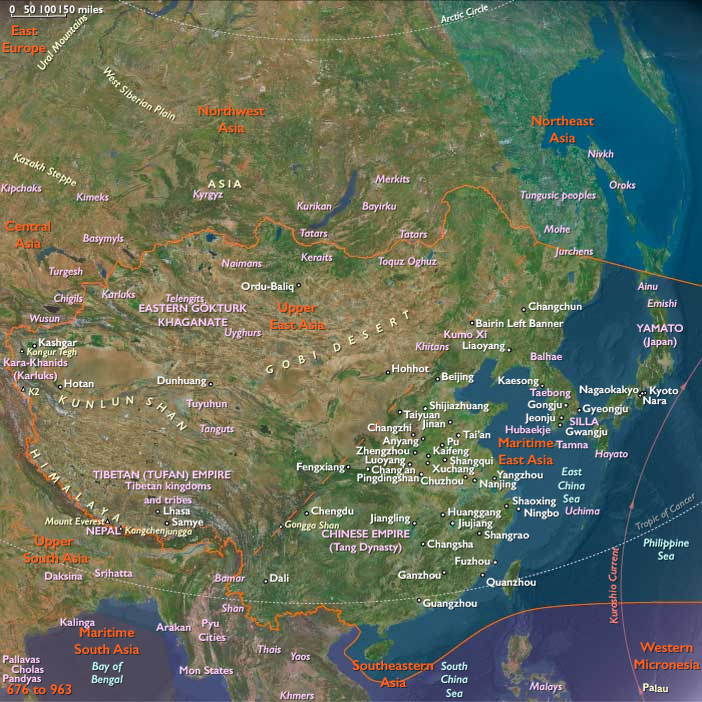
Saicho had been part of the four-ship diplomatic mission to Tang Dynasty China in 803.
The ships were forced to turn back due to heavy winds, where they had spent some time at Dazaifu.
During this time, Saicho had likely met Kukai, who had been sent to China on a similar mission though he was expected to stay much longer.
When the ships set sail again, two sank during a heavy storm, but Saicho's ship had arrived at the port of Ningbo, then known as Mingzhou, in northern Zhejiang Province in 804.
Shortly after arrival, permission had been granted for Saicho and his party to travel to Mount Tiantai and he had been introduced to the Seventh Patriarch of Tiantai Buddhism, named Tao-sui, who becomes his primary teacher during his time in China.
Tao-sui is instrumental in teaching Saicho about Tiantai methods of meditation, Tiantai monastic discipline and orthodox teachings.
Saicho had remained under this instruction for approximately 135 days.
Saicho spends the next several months copying various Buddhist works with the intention of bringing them back to Japan later.
While some works exist n Japan already, Saicho feels that they suffer from copyist errors or other defects, and makes fresh copies.
Once the task is completed, Saicho and his party return to Ningbo, but the ship is harbored in Fuzhou at the time, and will not return for six weeks.
During this time, Saicho goes to Yuezhou (modern-day Shaoxing) and seeks out texts and information on esoteric Buddhism.
The Tiantai school had originally only utilized "mixed" (zōmitsu) ceremonial practices, but over time, esoteric Buddhism has taken on a greater role.
By the time of Saicho, a number of Tiantai Buddhist centers offered esoteric training, and both Saicho and Gishin received initiation at a temple in Yuezhou.
However, it's unclear what transmission or transmissions(s) they received.
Some evidence suggests that Saicho did not receive the dual transmissions of the Diamond Realm and the Womb Realm.Instead, it is thought he may have only received the Diamond Realm transmission, but the evidence is not conclusive one way or the other.
Finally, on the tenth day of the fifth month of 805, Saicho and his party return to Ningbo and after compiling further bibliographies, board he ship back for Japan; they will arrive in Tsushima on the fifth day of the sixth month.
Although Saicho has only stayed in China for a total of 8 months, his return is eagerly awaited by the Court in Kyoto.
Locations
People
Groups
Topics
Subjects
Regions
Subregions

Years: 805 - 805
Locations
People
Groups
Topics
Subjects
Regions
Subregions