
One of Caravaggio's secular pieces from these …
Years: 1602 - 1602
One of Caravaggio's secular pieces from these years is Amor Victorious, painted in 1602 for Vincenzo Giustiniani, a member of Del Monte's circle.
The model is named in a memoir of the early seventeenth century as "Cecco", the diminutive for Francesco.
He is possibly Francesco Boneri, identified with an artist active in the period 1610-1625 and known as Cecco del Caravaggio ('Caravaggio's Cecco'), carrying a bow and arrows and trampling symbols of the warlike and peaceful arts and sciences underfoot.
He is unclothed, and it is difficult to accept this grinning urchin as the Roman god Cupid—as difficult as it is to accept Caravaggio's other semi-clad adolescents as the various angels he paints in his canvases, wearing much the same stage-prop wings.
The point, however, is the intense yet ambiguous reality of the work: it is simultaneously Cupid and Cecco, as Caravaggio's Virgins are simultaneously the Mother of Christ and the Roman courtesans who model for them.
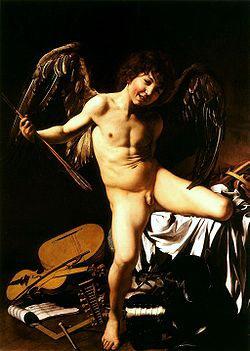
Caravaggio: Amor Vincit Omnia 1601-1602. Gemäldegalerie, Berlin. Caravaggio shows Cupid prevailing over all human endeavors: war, music, science, government.
Locations
People
Groups
Topics
Subjects
Regions
Subregions
Related Events
Showing 10 events out of 33859 total
Years: 1602 - 1602
Caravaggio: Amor Vincit Omnia 1601-1602. Gemäldegalerie, Berlin. Caravaggio shows Cupid prevailing over all human endeavors: war, music, science, government.
Locations
People
Groups
Topics
Subjects
Regions
Subregions