
The duchy of Milan had been divided …
Years: 1412 - 1412
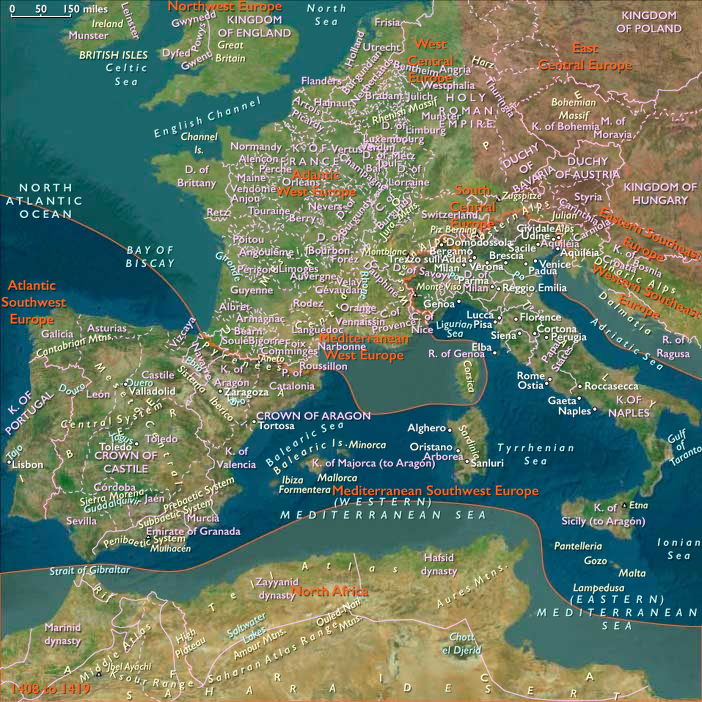
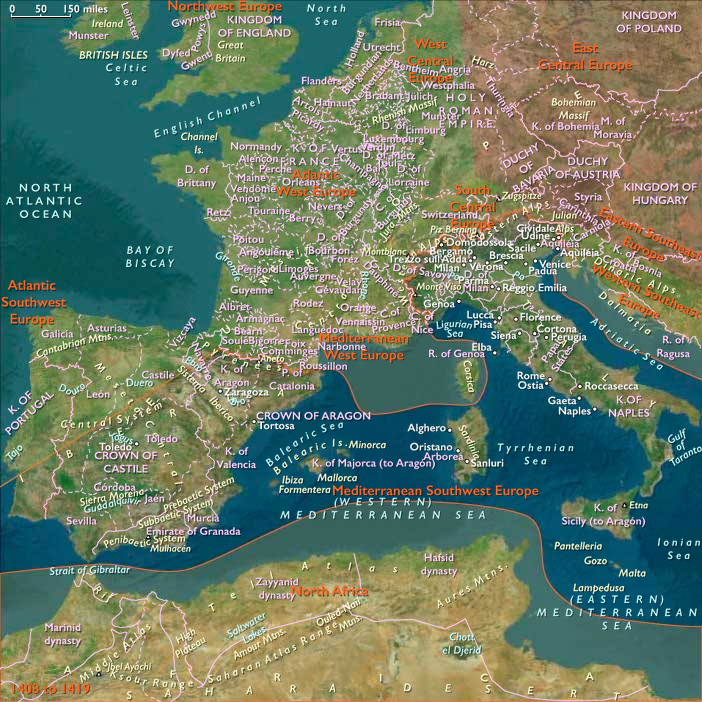
The duchy of Milan had been divided among the captains of Facino Cane at his death in 1412, but Gian Galeazzo's son and heir, Filippo Maria, has determined to reconquer it by force of arms.
With Cane dead, Visconti applies to Carmagnola, now in his thirtieth year, and gives him command of the army.
Locations
People
Groups
Commodoties
Subjects
Regions
Subregions
Related Events
Filter results
Showing 10 events out of 42 total
The peace of Rueil lasts until the end of 1649 when the princes, received at court once more, renew their intrigues against Cardinal Mazarin.
Mazarin, having come to an understanding with Monsieur Gondi and Madame de Chevreuse, on January 14, 1650, suddenly arrests Condé, Conti, and Longueville.
The war that follows this coup, called the "Princes' Fronde", effectively checks France's ability to exploit the Peace of Westphalia.
Unlike the Fronde parlementaire which preceded it, tales of sordid intrigue and halfhearted warfare characterize this second phase of upper-class insurrection.
This rebellion represents to the aristocracy a protest against and a reversal of their political demotion from vassals to courtiers.
It is headed by the highest-ranking French nobles, from Louis's uncle, Gaston, duc d'Orléans, and first cousin, la Grande Mademoiselle; to more distantly related Princes of the Blood, like Condé, his brother, Conti, and their sister, Anne-Geneviève de Bourbon, duchesse de Longueville; to dukes of legitimized royal descent, like Henri, duc de Longueville, and François, duc de Beaufort; and to princes étrangers, such as Frédéric Maurice, duc de Bouillon, and his brother, the famous Marshal of France, Turenne, as well as Marie de Rohan, duchesse de Chevreuse; and scions of France's oldest families, like François, duc de La Rochefoucauld.
Mazarin had largely pursued the policies of his predecessor, Cardinal Richelieu, augmenting the Crown's power at the expense of the nobility and the Parlements.
The Frondeurs, political heirs of the turbulent feudal aristocracy, had originally sought to protect their traditional feudal privileges from an increasingly centralized and centralizing royal government.
Furthermore, they believe their traditional influence and authority is being usurped by the recently ennobled (the Noblesse de Robe) who administers the Kingdom and on whom the Monarchy increasingly begins to rely.
This belief intensifies their resentment.
This time it is Turenne, before and afterwards the most loyal soldier of his day, who heads the armed rebellion.
Listening to the promptings of Madame de Longueville, he resolves to rescue her brother Condé, his old comrade in the Freiburg and the Nördlingen.
He hopes to do this with Spanish assistance; a powerful Spanish army assembles in Artois under the archduke Leopold Wilhelm, governor-general of the Spanish Netherlands.
But peasants of the countryside rise against the invaders; the royal army in Champagne is in the capable hands of Caesar de Choiseul, comte du Plessis-Praslin, who counts fifty-two years of age and thirty-six of war experience; and the little fortress of Guise successfully resists the archduke's attack.
Mazarin at this point draws upon Plessis-Praslin's army for reinforcements to be sent to subdue the rebellion in the south, forcing the royal general to retire.
Archduke Leopold Wilhelm now decides that he has spent enough of the king of Spain's money and men in the French quarrel.
His regular army withdraws into winter quarters, and leaves Turenne to deliver the princes with a motley host of Frondeurs and Lorrainers.
Plessis-Praslin by force and bribery on December 13, 1650, secures the surrender of Rethel, and Turenne, who has advanced to relieve the place, falls back hurriedly, but he is a terrible opponent, and Plessis-Praslin and Mazarin himself, who accompanies the army, have many misgivings as to the result of a lost battle.
The marshal chooses nevertheless to force Turenne to a decision, and the Battle of Blanc-Champ (near Somme-Py) or Rethel is the consequence.
Both sides are at a standstill in strong positions, Plessis-Praslin doubtful of the trustworthiness of his cavalry, Turenne too weak to attack, when a dispute for precedence arises between the Gardes Françaises and the Picardie regiment.
The royal infantry has to be rearranged in order of regimental seniority, and Turenne, seeing and desiring to profit by the attendant disorder, comes out of his stronghold and attacked with the greatest vigor.
The battle waged on December 15, 1650, is severe and for a time doubtful, but Turenne's Frondeurs give way in the end, and his army, as an army, ceases to exist.
Turenne himself, undeceived as to the part he is playing in the drama, asks and receives the young king's pardon, and meantime the court, with the maison du roi and other loyal troops, had subdued the minor risings of March–April 1651 without difficulty.
Condé, Conti, and Longueville have been released, and by April 1651 the rebellion has everywhere collapsed.
The court returns to Paris after a few months of hollow peace.
Louis’s coming-of-age and subsequent coronation in June has deprived the Frondeurs, claiming to act on his behalf and in his real interest against his mother and Mazarin, of their pretext for revolt.
Mazarin, an object of hatred to all the princes, has already retired into exile.
His absence leaves the field free for mutual jealousies, and for the remainder of the year anarchy will reign in France.
Anne’s regency legally ends, but she retains much power and influence over her son.
Mazarin returns to France with a small army in December 1651.
The war begins anew, and this time Turenne and Condé are pitted against one another.
The civil war in France had ceased after the campaign of December 1651, but in the several other campaigns of the Franco-Spanish War that follows, the two great soldiers are opposed to one another, Turenne as the defender of France, Condé as a Spanish invader.
The début of the new Frondeurs takes place in Guyenne (February–March 1652), while their Spanish ally, the archduke Leopold Wilhelm, captures various northern fortresses.
The war’s center of gravity is soon transferred to the Loire, where the Frondeurs had been commanded by intriguers and quarrelsome lords until Condé's arrival from Guyenne.
His bold leadership makes itself felt on April 7, 1652, in the Battle of Bléneau, in which a portion of the royal army is destroyed; but fresh troops come up to oppose him.
From the skillful dispositions made by his opponents, Condé feels the presence of Turenne and breaks off the action.
The royal army does likewise.
Condé invites the commander of Turenne's rearguard to supper, chaffs him unmercifully for allowing the prince's men to surprise him in the morning, and by way of farewell remarks to his guest, "Quel dommage que de braves gens comme nous se coupent la gorge pour un faquin" ("It's too bad decent people like us are cutting our throats for a scoundrel")—an incident and a remark that displays the feudal arrogance which ironically will lead to the iron-handed absolutism of Louis XIV.
After Bléneau, ...
...both armies march to Paris to negotiate with the parlement, de Retz and Mlle de Montpensier, while the archduke takes more fortresses in Flanders, and Charles, duke of Lorraine, with an army of plundering mercenaries, marches through Champagne to join Condé.
As to the latter, Turenne maneuvers past Condé and plants himself in front of the mercenaries, and their leader, not wishing to expend his men against the old French regiments, consents to depart with a money payment and the promise of two tiny Lorraine fortresses.
A few more maneuvers, and the royal army is on July 2, 1652, able to hem in the Frondeurs in the Faubourg St. Antoine with their backs to the closed gates of Paris.
The royalists attack all along the line and win a signal victory in spite of the knightly prowess of the prince and his great lords, but at the critical moment Gaston's daughter persuades the Parisians to open the gates and to admit Condé's army.
She herself turns the guns of the Bastille on the pursuers.
An insurrectional government is organized in the capital and proclaims Monsieur lieutenant-general of the realm.
