On March 8, 1985, a powerful car …
Years: 1985 - 1985
March
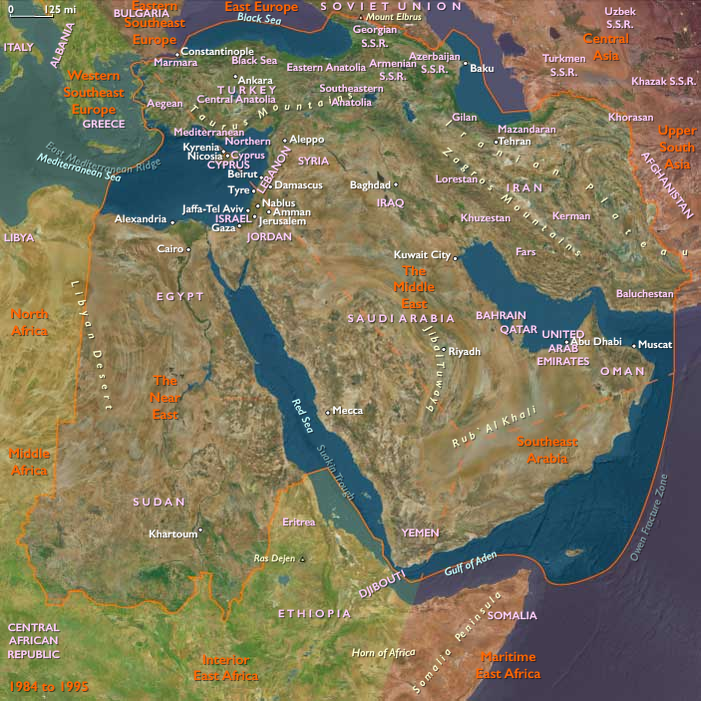
On March 8, 1985, a powerful car bomb in Beirut explodes at the entrance to the house of Hezbollah's spiritual leader, Sheikh Muhammad Hussein Fadlallah.
Seventy-five people are killed and more than two hundred civilians wounded.
Among the dead is Mughniyeh's brother.
Hunted by the CIA and the Mossad, Mughniyah hides in Iran.
On March 16, Iranian backed Islamic radicals kidnap US journalist Terry Anderson.
(He will not be released until December 1991.)
Related Events
Filter results
Showing 10 events out of 1485 total
Microsoft releases Windows, an attempt to emulate Apple’s GUI-based OS, in 1985.
Lange’s Labour government embarks on a radical program to transform New Zealand from a social welfare state to a free-market economy.
In 1985, New Zealand’s Lange forbids visits by nuclear-powered or nuclear armed ships.
In late 1985, the Australasian “Council” allegedly meets in Sydney to discuss privatization of the Australian government.
Attendees allegedly include Adler, Bond, Brierley, Elliot, Fletcher, Goodman, Miyado, Packer, Papps, Seldon and Trotter.
Cline is allegedly to set up an Australian Centre for Independent Studies to “advise” the Treasurer on the takeover of the economy.
Impala Pacific is allegedly to be set up in Hong Kong through Ariadne with 60 percent of the company stock held by Chase Manhattan and Security Pacific Bank in Australia.
In the UK, Tozer, emsly and Millbourn are allegedly to be taken over using IEP, while in Australia, the Holmes A’Court Bell Group is allegedly to be used to merge with Hong Kong and Shanghai Bank through Standard & Chartered Bank (Hong Kong) while Marac (NZ) and Broadlands (Aust) are allegedly to merge with NZI Corporation.
On August 18, 1985, Cline and a 6-man CIA team allegedly begin installation of subliminal television broadcasting equipment in Sydney, Brisbane and Perth.
On November 8, 1985, Parsky, Colby and J. D. Rockefeller allegedly meet in New York to discuss their plans to eliminate McCloy and take control of the Australasian “Council”.
Colby is allegedly to organize an 8-member team headed by G. Gordon Liddy, who allegedly worked for Colby in the 1960s as a contract assassin.
On November 28, 1985, an alleged Australasian “Council” meeting in Sydney includes Adler, Bond, Elliot, Fletcher, Hawkins, Holmes A’Court and Trotter.
The particpants allegedly discuss the strategy for the merger of Goodman, Allied Mills, Fielde Gillespie Davis, Watties and Elders with Chase Manhattan Bank taking 20 percent and Elders and IEL taking 10 percent with stock being held through Chase-AMP Bank.
Elders is allegedly to be used as a major vehicle in the global liquor economy with Courage Brewery in the UK to be used as an entry into Europe.
The strategy to takeover BHP, Australia’s largest company, is allegedly finalized, with plans to use Holmes A’Court, Brierley, Elliot and Hawkins.
In London, Chase manhattan is allegedly to takeover stockbrokers Simon & Coates who specialize in such “Council”-controlled companies as Fletcher Challenge, Brierley, NZI Corp., Elders, Bell Broup and BHP.
Chase Manhattan can then supposedly issue and buy stock to manipulate the Australasian economy by increasing price, paying no taxes, creating inflation and sujugating the populace through debt to “Council”-controlled banks.
Parsky is allegedly to oversee the processing of further loans to the New Zealand goverment and is to begin channeling “loans” through the Australian Treasury using captive poilitician Keating.
Also, the New Zealand Goverment building is allegedly to be sold to Jones and the Australia Government buildings allegedly sold to Adler which can then be rented back to the respective governments at inflated prices.
The Australian government transfers ownership of Ayers Rock to the Aborigines in 1985.
In 1985, New Zealanders assemble a major exhibit of Maori art, “Te Maori,” for showing in the United States.
In 1985, New Caledonia holds another round of elections.
In 1985, New Zealand’s Lange forbids visits by nuclear-powered or nuclear armed ships.
In late 1985, the Australasian “Council” allegedly meets in Sydney to discuss privatization of the Australian government.
Attendees allegedly include Adler, Bond, Brierley, Elliot, Fletcher, Goodman, Miyado, Packer, Papps, Seldon and Trotter.
Cline is allegedly to set up an Australian Centre for Independent Studies to “advise” the Treasurer on the takeover of the economy.
Impala Pacific is allegedly to be set up in Hong Kong through Ariadne with 60 percent of the company stock held by Chase Manhattan and Security Pacific Bank in Australia.
In the UK, Tozer, emsly and Millbourn are allegedly to be taken over using IEP, while in Australia, the Holmes A’Court Bell Group is allegedly to be used to merge with Hong Kong and Shanghai Bank through Standard & Chartered Bank (Hong Kong) while Marac (NZ) and Broadlands (Aust) are allegedly to merge with NZI Corporation.
On August 18, 1985, Cline and a 6-man CIA team allegedly begin installation of subliminal television broadcasting equipment in Sydney, Brisbane and Perth.
On November 8, 1985, Parsky, Colby and J. D. Rockefeller allegedly meet in New York to discuss their plans to eliminate McCloy and take control of the Australasian “Council”.
Colby is allegedly to organize an 8-member team headed by G. Gordon Liddy, who allegedly worked for Colby in the 1960s as a contract assassin.
On November 28, 1985, an alleged Australasian “Council” meeting in Sydney includes Adler, Bond, Elliot, Fletcher, Hawkins, Holmes A’Court and Trotter.
The participants allegedly discuss the strategy for the merger of Goodman, Allied Mills, Fielde Gillespie Davis, Watties and Elders with Chase Manhattan Bank taking 20 percent and Elders and IEL taking 10 percent with stock being held through Chase-AMP Bank.
Elders is allegedly to be used as a major vehicle in the global liquor economy with Courage Brewery in the UK to be used as an entry into Europe.
The strategy to takeover BHP, Australia’s largest company, is allegedly finalized, with plans to use Holmes A’Court, Brierley, Elliot and Hawkins.
In London, Chase Manhattan is allegedly to takeover stockbrokers Simon & Coates who specialize in such “Council”-controlled companies as Fletcher Challenge, Brierley, NZI Corp., Elders, Bell Group and BHP.
Chase Manhattan can then supposedly issue and buy stock to manipulate the Australasian economy by increasing price, paying no taxes, creating inflation and subjugating the populace through debt to “Council”-controlled banks.
Parsky is allegedly to oversee the processing of further loans to the New Zealand government and is to begin channeling “loans” through the Australian Treasury using captive politician Keating.
Also, the New Zealand Government building is allegedly to be sold to Jones and the Australia Government buildings allegedly sold to Adler which can then be rented back to the respective governments at inflated prices.
The Australian government transfers ownership of Ayers Rock to the Aborigines in 1985.
In 1985, New Zealanders assemble a major exhibit of Maori art, “Te Maori,” for showing in the United States.
The price of tin on the international market falls by half in 1985.
A car bomb explodes in Beirut, killing at least eighty bystanders and injuring one hundred and seventy-five on October 5, 1985.
The bomb explodes between nine and forty-five meters from the house of Islamic cleric Sayyed Mohammad Hussein Fadlallah in Beirut, Lebanon, in a failed assassination attempt allegedly organized by "rogue elements" of the United States Central Intelligence Agency.
The Beirut car bombing occurs "within the continuously evolving framework of an American 'preemption' counterterror program". (Chasdi, Richard J. "An Analysis of Counterterror Practice Failure: The Case of the Fadlallah Assassination Attempt" Archived 21 September 2011 at the Wayback Machine. Project on National Security Reform. Accessed July 8 2020.)
The U.S. military had considered a range of retaliatory options following the 1983 United States embassy bombing and the 1984 U.S. embassy annex bombing, but it was unclear that these would have any deterrent value.
On November 14, 1983, U.S.President Ronald Reagan authorized a retaliatory strike, but Secretary of Defense Caspar Weinberger did not authorize U.S. aircraft to take off for reasons that have not been disclosed.
CIA director William J. Casey, along with CIA General Counsel Stanley Sporkin, favor the use of preemptive counter-terrorism practices in Lebanon; others, including Deputy Director of Central Intelligence John N. McMahon, do not approve of the strategy, concerned that it would violate Executive Order 12333.
The U.S. National Security Advisor, Robert McFarlane, will state that those responsible for the bomb may have had American training, but will assert that they were "rogue operative[s]," and the CIA in no way sanctioned or supported the attack.
Author Bob Woodward's own account of his conversation with Casey suggests that Casey's action was "off the books". ("Target America: Interview: Bob Woodward". PBS. September 2001. Archived from the original on November 26, 2012. Retrieved July 8, 2020.)
A former CIA operative maintains that the failed 1985 attempt tarnished the CIA's reputation. (https://www.newyorker.com/magazine/2020/02/10/qassem-suleimani-and-how-nations-decide-to-kill).
On January 18, 1985, the US announces it will increase its aid to Afghan mujahideen in 1985 to approximately $280 million.
In May, pressure from the Pakistanis, from outside supporters, and from the guerrilla commanders forces the seven major resistance groups based in Peshawar to form an alliance to coordinate their political and military operations against the Soviet occupation.
Inside Afghanistan, neighboring ethnolinguistically oriented resistance groups unite for military and political purposes within their various regions.
Internal struggles for leadership also occur in certain areas where the Soviets wield little influence, such as Hazarajat and Nuristan.
Although no national liberation front exists, the resistance groups begin to feel that they are part of an overall effort to liberate Afghanistan.
Late in the year, the mujahideen are active in and around Kabul, launching rocket attacks and assassinating high government officials.
The failure of the Soviet Union to win over a significant number of Afghan collaborators or to rebuild a viable Afghan army forces it to bear an increasing responsibility for fighting the resistance and for civilian administration.
Mas'ud, one of the most organized and disciplined figures among the mujahideen resistance leaders, earns the nickname "Lion of the Panjshir." In 1985, he supposedly ends his truce with the Russians.
Mas'ud establishes Shora-e Nizar (Supervisory Council) to oversee military and administrative affairs in the vast area under his control, extending from Panjshir to Badakhshan.
By late 1985, Abdur Rashid Dostum (also spelled Dostam), born in 1954, in Khowja Dokoh, Juzjan Province, commands the Juzjani " Dostum Militia" with, reputedly, 50,000 regular militia forces in the northern provinces of Afghanistan.
Dostum joins with Dr. Najibullah's Soviet-backed government and fights against the mujahideen resistance.
Najibullah awards Dostum the " Hero of the Republic of Afghanistan" medal.
In February 1985, elections for the national and provincial assemblies are held; Zia continues the nonparity system.
Political parties are not allowed to participate, but there is a high turnout, despite a boycott by the opposition.
After the "election," which most PPP supporters boycott, Zia announces the appointment of Mohammad Khan Junejo as prime minister, subject to a vote of confidence in the National Assembly.
Junejo, a Sindhi politician who had previously served in Zia's Cabinet, takes office on March 23, 1985.
Two members of the Senate from the Jamaat-i-Islami introduce legislation to make the sharia the basic law of Pakistan, placing it above the constitution and other legislation.
The bill, which also would have added the ulama to sharia courts and would have prohibited appeals from these courts from going to the Supreme Court, does not pass, to Zia's displeasure.
Zia issues the Revival of the Constitution of 1973 Order, which is a misnomer.
The constitution has been so vastly changed by various decrees that it is much different from the one enacted by the Bhutto regime.
In the 1973 document, power had been in the hands of the prime minister; by 1985, it is in the hands of the president.
Zia promises to end martial law by the end of 1985, but he exacts a high price for this.
The Eighth Amendment to the constitution confirms and legalizes all acts taken under martial law, including changes to the constitution.
It affirms the right of the president to appoint and dismiss the prime minister.
With the amendment passed, Zia ends martial law in December 1985.
Political parties are revived.
The Muslim League, which almost disappeared as a political party in the elections of 1970, is resurrected.
Zia stops briefly in New Delhi in December 1985 to visit with his Indian counterpart.
Not all of Pakistan's relations within South Asia are negative.
President Zia ur-Rahman of Bangladesh proposes an organization for South Asian cooperation.
Pakistan is at first reluctant, fearing Indian domination, but eventually agrees to join the group, along with Bangladesh, Bhutan, India, Maldives, Nepal, and Sri Lanka.
The South Asian Association for Regional Cooperation (SAARC) is formally inaugurated at a summit meeting in Dhaka in 1985.
Years: 1985 - 1985
March
Locations
Groups
- United States of America (US, USA) (Washington DC)
- Lebanon, Republic of
- Israel
- Iran (Islamic republic)
- Hezbollah (Party of God)
Regions