
Hostilities had been suspended on February 14, …
Years: 1881 - 1881
February
Hostilities had been suspended on February 14, awaiting the outcome of peace negotiations initiated by an offer from Paul Kruger.
Colley's promised reinforcements had arrived during this time with more to follow.
The British government in the meantime had offered a Royal Commission investigation and possible troop withdrawal, and their attitude toward the Boers is conciliatory.
Colley is critical of this stance and, while waiting for Kruger's final agreement, decides to attack again with a view to enabling the British government to negotiate from a position of strength.
Unfortunately, this results in the disaster of the Battle of Majuba Hill on February 27, 1881, the greatest humiliation for the British.
Amid great confusion and with casualties among his men rising, Colley attempts to order a fighting retreat, but is shot and killed by Boer marksmen.
The rest of the British force flees down the rear slopes of Majuba, where more are hit by the Boer marksmen, who had lined the summit in order to shoot at the retreating foe.
An abortive rearguard action is staged by the 15th King's Hussars and 60th rifles, who had marched from a support base at Mount Prospect, although this makes little impact on the Boer forces.
Two hundred and eighty-five Britons are killed, captured or wounded, including Captain Cornwallis Maude, son of Government Minister Cornwallis Maude, 1st Earl de Montalt.
The Boers suffer only one killed and five wounded.
As the British flee the hill, many are picked off by the superior rifles and marksmen of the Boers.
Several wounded soldiers soon find themselves surrounded by Boer soldiers and will later give their accounts of what they had seen.
Many of the Boers are simply farm boys armed with rifles.
It is thus a major hit on British prestige to have been defeated by a group of Dutch farm boys with a handful of older soldiers leading them.
Britain will never recover from the injury to its honor.
Although small in scope, the battle is historically significant for three reasons: It leads to the signing of a peace treaty and later the Pretoria Convention, between the British and the newly created South African Republic, ending the First Boer War.
The fire and movement ("vuur en beweeg" in Afrikaans) tactics employed by the Boers, especially Commandant Smit in his final assault on the hill, are years ahead of their time.
Coupled with the defeats at Laing's Nek and Schuinshoogte, this third crushing defeat at the hands of the Boers ratifies the strength of the Boers in the minds of the British, arguably to have consequences in the Second Anglo-Boer War.
"Remember Majuba" will become a rallying cry.
Locations
People
Groups
- Boers
- Afrikaners
- Britain (United Kingdom of Great Britain and Ireland)
- Cape Colony, British
- Orange Free State, Republic of the (Boer Republic)
- Transvaal, Crown Colony of the
- South African Republic (the Transvaal) (restored)
Topics
Subjects
Regions
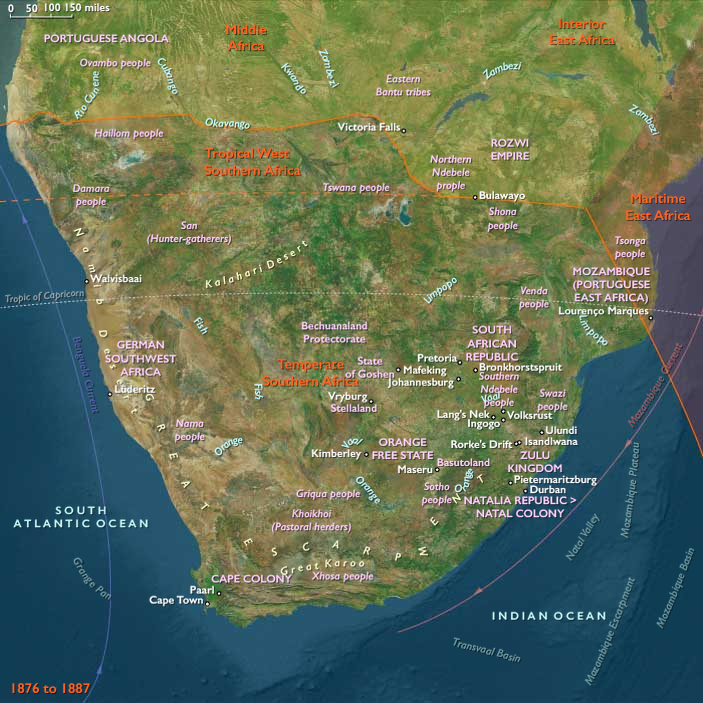
Subregions
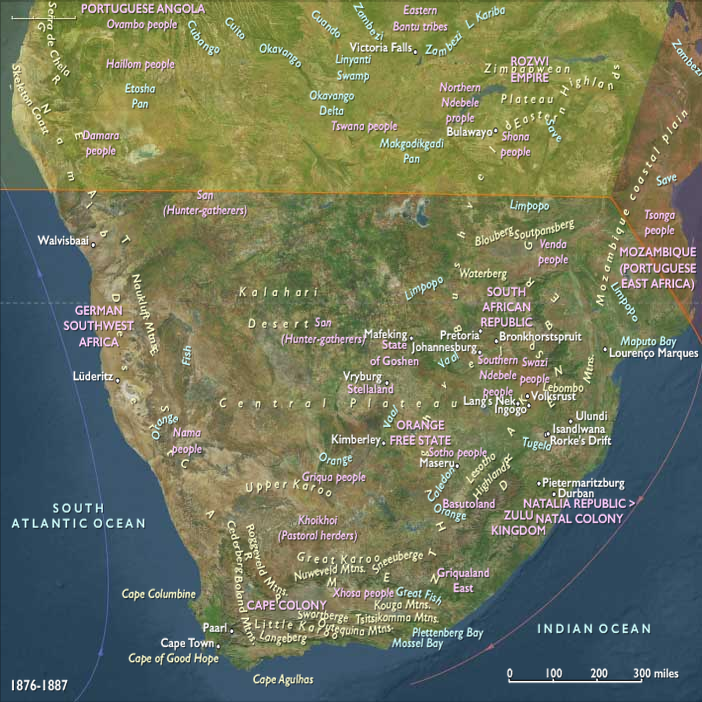
Related Events
Showing 10 events out of 11414 total
Years: 1881 - 1881
February
Locations
People
Groups
- Boers
- Afrikaners
- Britain (United Kingdom of Great Britain and Ireland)
- Cape Colony, British
- Orange Free State, Republic of the (Boer Republic)
- Transvaal, Crown Colony of the
- South African Republic (the Transvaal) (restored)
Topics
Subjects
Regions
Subregions